


























Views
Downloads
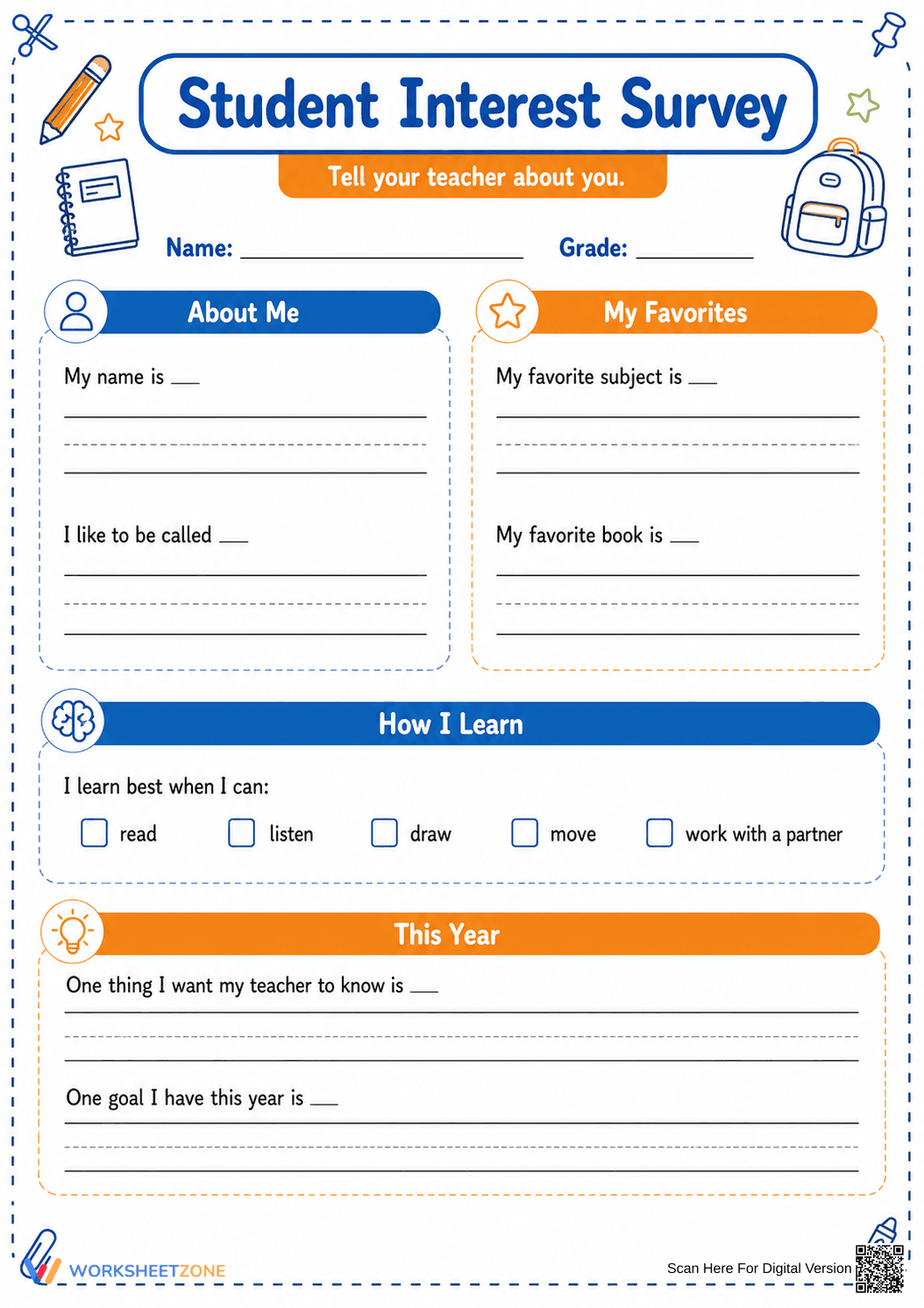

Student Interest Survey | Grade 2-5 Printable Worksheet
Paste this activity's link or code into your existing LMS (Google Classroom, Canvas, Teams, Schoology, Moodle, etc.).
Students can open and work on the activity right away, with no student login required.
You'll still be able to track student progress and results from your teacher account.
This Grade 2-5 Student Interest Survey helps teachers build meaningful connections with their students from the very first day of school. By providing a structured space for students to share their favorites, learning styles, and personal goals, this worksheet ensures that every child feels valued and understood. It serves as a vital tool for establishing a positive classroom culture and informing future instructional decisions.
At a Glance
- Grade: 2-5 · Subject: Social Emotional Learning
- Standard:
CCSS.ELA-LITERACY.W.3.10— Write for a range of discipline-specific tasks, purposes, and audiences- Skill Focus: Self-reflection and learning preferences
- Format: 1 page · 7 prompts · Answer key N/A · PDF
- Best For: First week of school icebreaker
- Time: 15–20 minutes
What's Inside
This single-page PDF features a clean, modern layout with four distinct sections: About Me, My Favorites, How I Learn, and This Year. It includes 7 specific prompts ranging from nickname preferences to academic goals. The design utilizes generous ruled writing lines for open-ended responses and a dedicated checkbox section for students to identify their preferred learning modalities, such as reading, listening, or working with a partner.
Zero-Prep Workflow
- Print (1 minute): Select the number of copies needed for your roster and print the high-resolution PDF directly from your device.
- Distribute (30 seconds): Hand out the surveys as a morning work activity or a quiet transition task during the first week of school.
- Review (1 minute per student): Quickly scan the completed forms to identify common interests and specific learning needs for your seating chart or small group planning.
Standards Alignment
This worksheet aligns with CCSS.ELA-LITERACY.W.3.10, which requires students to write routinely over shorter time frames for a range of discipline-specific tasks, purposes, and audiences. By writing to their teacher about their own lives, students practice authentic communication. Both standard codes can be copied directly into lesson plans, IEP goals, or district curriculum mapping tools.
How to Use It
Assign this survey during the first morning of school to keep students engaged while you handle administrative tasks like attendance and bus passes. It also works exceptionally well during one-on-one student conferences; use the student's answers as talking points to build rapport. Expect students to spend approximately 15 to 20 minutes completing the prompts with thoughtful detail.
Who It's For
This resource is designed for general education teachers in Grades 2-5, but it is also highly effective for Special Education teachers and ELL specialists who need to understand a student's background quickly. It pairs naturally with a "Meet the Teacher" presentation or a classroom library scavenger hunt where students find books matching the favorites they listed.
According to RAND AIRS 2024, student-teacher relationship quality is a primary predictor of academic engagement and long-term retention in elementary settings. This Student Interest Survey facilitates the initial data collection required to establish these bonds. By aligning with CCSS.ELA-LITERACY.W.3.10, the worksheet encourages students to write for a specific audience—their teacher—while reflecting on personal learning preferences. Research from Fisher & Frey (2014) emphasizes that understanding a student's 'How I Learn' profile allows for more effective scaffolding and differentiated instruction throughout the school year. This printable tool provides a structured format for students in Grades 2-5 to communicate their favorite subjects, books, and personal goals. Teachers can use the resulting data to curate classroom libraries and design collaborative groups that honor individual student strengths. The survey serves as a foundational artifact for Social Emotional Learning (SEL) and classroom management, ensuring every child feels seen and heard from the first day of instruction.


