


























Views
Downloads
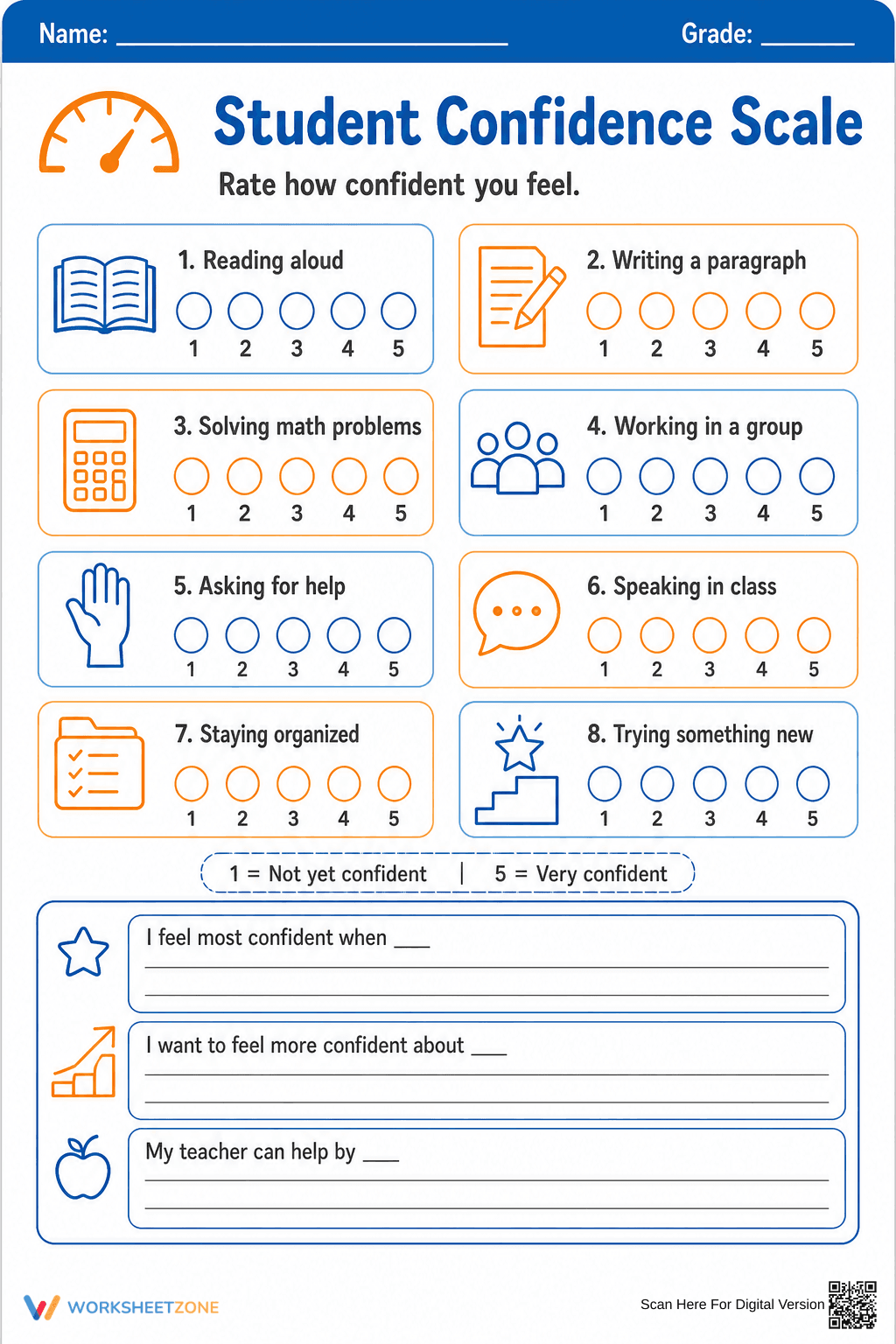

Student Confidence Scale | Grade 3-6 Essential Worksheet
Paste this activity's link or code into your existing LMS (Google Classroom, Canvas, Teams, Schoology, Moodle, etc.).
Students can open and work on the activity right away, with no student login required.
You'll still be able to track student progress and results from your teacher account.
This Grade 3-6 self-assessment tool empowers students to evaluate their academic and social self-efficacy across eight core classroom domains. By providing a structured visual scale, the worksheet helps learners identify personal strengths and areas for growth, fostering a growth mindset and improving teacher-student communication regarding specific learning needs and emotional support.
At a Glance
- Grade: 3-6 · Subject: Social Emotional Learning
- Standard:
CCSS.ELA-LITERACY.SL.5.1— Engage in collaborative discussions and express own ideas clearly- Skill Focus: Academic Self-Efficacy & Reflection
- Format: 1 page · 11 tasks · No answer key needed · PDF
- Best For: Back-to-school surveys and quarterly check-ins
- Time: 10–15 minutes
The worksheet features a dashboard-style layout with eight distinct rating cards. Each card includes a 1–5 Likert scale for skills such as reading aloud, solving math problems, and staying organized. Below the quantitative section, three qualitative reflection boxes provide space for students to articulate their feelings, goals, and specific requests for teacher assistance, ensuring a comprehensive view of the student's mindset.
This resource is designed for immediate classroom implementation with a total teacher prep time of under 2 minutes. First, print the single-page PDF for your class (1 minute). Next, distribute the sheets during a morning meeting or advisory period (30 seconds). Finally, review the completed scales to identify students who may require immediate intervention or differentiated support in specific subjects (5 minutes). It is an ideal sub-plan addition for maintaining classroom culture during absences.
This worksheet aligns with `CCSS.ELA-LITERACY.SL.5.1`, which requires students to engage effectively in a range of collaborative discussions and build on others' ideas while expressing their own clearly. By reflecting on their confidence in "Working in a group" and "Asking for help," students develop the self-awareness necessary for successful collaboration. Both standard codes can be copied directly into lesson plans, IEP goals, or district curriculum mapping tools.
Use this scale as a formative assessment at the start of a new unit to gauge student anxiety or confidence levels. For example, before a heavy writing unit, observe how many students rate "Writing a paragraph" as a 1 or 2. This data allows for proactive grouping. It also serves as an excellent artifact for parent-teacher conferences, providing a clear visual representation of the student's perspective on their own progress. Completion typically takes 10 to 15 minutes.
This tool is ideal for general education teachers, school counselors, and special education providers looking to build rapport with students. It is particularly effective for learners who struggle with verbalizing their needs. Pair this worksheet with a growth mindset anchor chart or a direct instruction lesson on self-advocacy to create a cohesive learning experience.
Research from Fisher & Frey (2014) emphasizes that self-assessment is a critical component of the gradual release of responsibility, as it requires students to monitor their own learning and emotional state. This Student Confidence Scale addresses the CCSS.ELA-LITERACY.SL.5.1 standard by facilitating the internal dialogue necessary for effective external communication and collaboration. By quantifying confidence across 11 specific tasks, the worksheet provides actionable data that correlates with higher academic achievement and improved student agency. According to the RAND AIRS 2024 report, structured self-reflection tools significantly reduce student anxiety by making expectations transparent and providing a safe channel for requesting help. This resource serves as a bridge between student perception and instructional reality, ensuring that teachers can tailor their support to the specific confidence gaps identified by the learners themselves, ultimately fostering a more inclusive and responsive classroom environment.


