




























Views
Downloads

Printable Name Tracing Worksheet | Grade K-1 Handwriting

Paste this activity's link or code into your existing LMS (Google Classroom, Canvas, Teams, Schoology, Moodle, etc.).
Students can open and work on the activity right away, with no student login required.
You'll still be able to track student progress and results from your teacher account.
This foundational handwriting worksheet provides young learners with targeted practice in writing their own names. By starting with guided tracing and moving to independent letter formation, students develop essential fine motor skills and letter recognition. This resource builds confidence in early writers as they master proper stroke sequence and spatial awareness on primary lines.
At a Glance
- Grade: K-1 · Subject: Handwriting
- Standard:
CCSS.ELA-LITERACY.L.K.1.A— Print many upper- and lowercase letters- Skill Focus: Name Tracing
- Format: 1 page · 7 practice lines · No answer key needed · PDF
- Best For: Morning work or literacy centers
- Time: 10–15 minutes
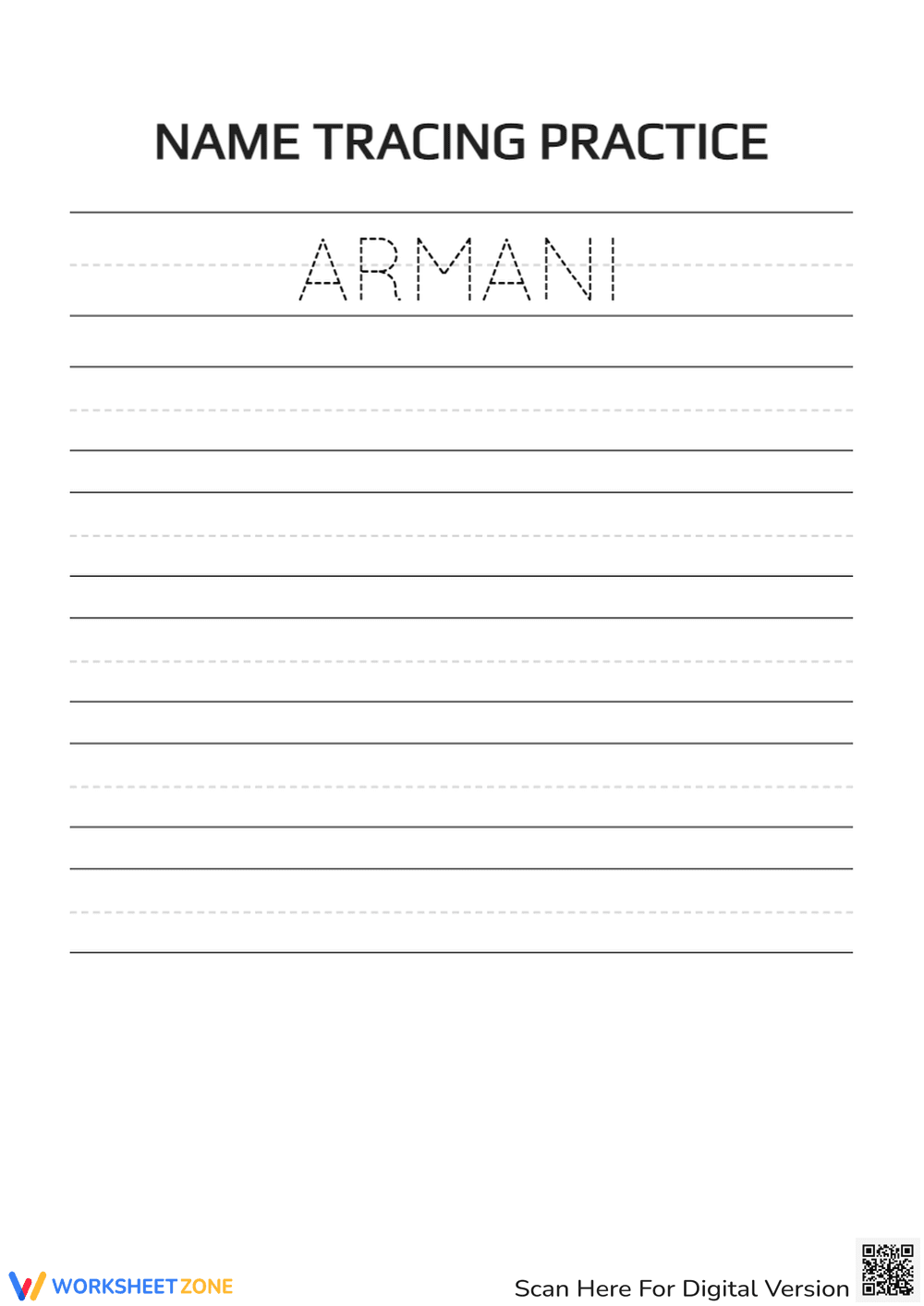
This single-page printable features a clear, structured layout designed specifically for early childhood education. The top section includes the name ARMANI formatted in dotted, traceable uppercase letters to guide initial stroke practice. Below the guided section, the page provides six blank primary writing lines—complete with solid top and bottom guidelines and a dashed midline—allowing students to transition from tracing to independent writing.
Zero-Prep Workflow
- Print (1 minute): Simply download the PDF and print the required number of copies. No special materials or cutting required.
- Distribute (1 minute): Hand out the worksheets along with standard primary pencils. The instructions are self-evident, requiring minimal teacher explanation.
- Review (Ongoing): Monitor students as they work to ensure proper pencil grip and stroke direction. Total teacher prep time is under two minutes, making this an ideal activity for emergency sub plans.
Standards Alignment
This resource aligns directly with CCSS.ELA-LITERACY.L.K.1.A: Print many upper- and lowercase letters. By practicing their names, students engage with high-frequency letters in a meaningful context, reinforcing both uppercase and lowercase printing conventions. It also supports foundational spatial awareness on standard primary lines. Both standard codes can be copied directly into lesson plans, IEP goals, or district curriculum mapping tools.
How to Use It
This worksheet is highly versatile for early primary classrooms. First, it serves as an excellent morning work routine; students can immediately sit down and practice their name while the teacher takes attendance. Second, it functions well within a dedicated literacy center focused on fine motor development. As a formative assessment tip, observe students during the tracing phase to correct improper pencil grips or bottom-to-top letter strokes before they move to the independent practice lines. Expected completion time is 10 to 15 minutes.
Who It's For
This resource is designed primarily for Kindergarten and early Grade 1 students who are mastering basic printing skills. It is also highly effective for preschool students demonstrating readiness for structured writing, or older students receiving occupational therapy for fine motor delays. Pair this worksheet with a tactile alphabet anchor chart or a direct instruction mini-lesson on pencil grip.
Developing automaticity in handwriting is a critical precursor to expressive writing and broader literacy success. According to Fisher & Frey (2014), explicit instruction in letter formation, combined with repeated, meaningful practice, significantly reduces the cognitive load required for transcription, allowing young writers to focus on content generation later on. This worksheet targets CCSS.ELA-LITERACY.L.K.1.A by having students print many upper- and lowercase letters within the highly motivating context of their own names. The transition from dotted tracing models to independent primary lines provides the exact scaffolding recommended for early motor skill acquisition. By integrating this targeted practice into daily routines, educators can ensure students build the foundational transcription skills necessary for advanced literacy tasks. This evidence-based approach supports both immediate classroom objectives and long-term developmental milestones in early childhood education.


