


























Views
Downloads

Essential Structure of the Earth Worksheet | Grade 3 Science
Paste this activity's link or code into your existing LMS (Google Classroom, Canvas, Teams, Schoology, Moodle, etc.).
Students can open and work on the activity right away, with no student login required.
You'll still be able to track student progress and results from your teacher account.
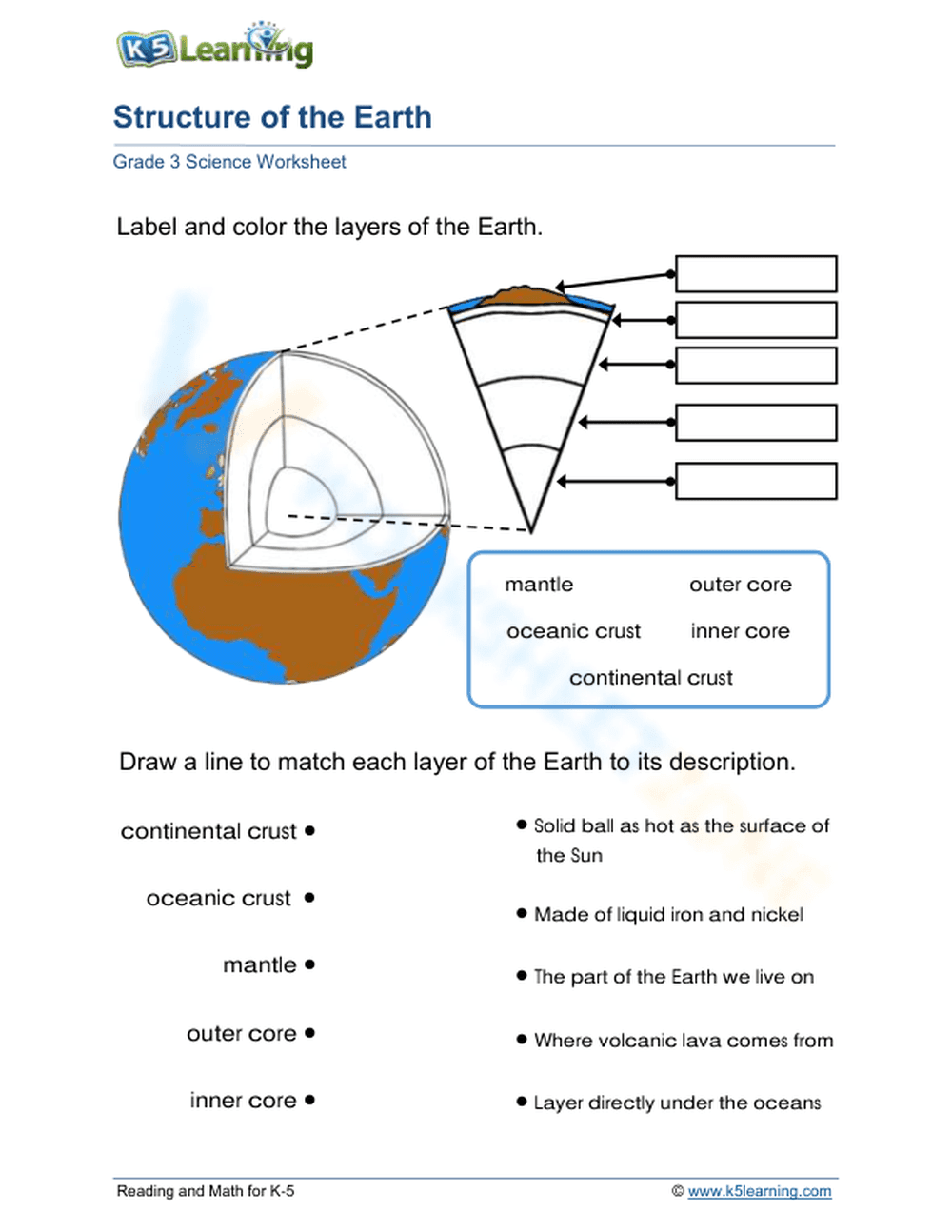
Students identify the physical layers of our planet through visual labeling and descriptive matching. This Grade 3 Science worksheet helps learners differentiate between the crust, mantle, and core, providing a foundational understanding of Earth's internal systems. By connecting scientific terminology to physical properties, students build the vocabulary needed for advanced geological studies.
At a Glance
- Grade: 3 · Subject: Science
- Standard:
3-ESS2-1— Identify the internal layers and composition of the Earth's geosphere.- Skill Focus: Earth's physical structure and layers
- Format: 1 page · 10 problems · Answer key included · PDF
- Best For: Earth Science introduction and formative assessment
- Time: 15–20 minutes
This single-page PDF features two distinct instructional tasks designed for immediate classroom application. The first section provides a cross-section diagram of the Earth with five labeling boxes and a corresponding word bank. The second section includes a five-item matching activity where students pair layer names with specific physical descriptions. A full answer key is included for quick grading.
Teachers can implement this resource in under two minutes with a three-step workflow. First, print the single-sided PDF for your class (30 seconds). Second, distribute the worksheets and allow students to use the word bank for the diagram (15 minutes). Third, review the matching section as a whole-class check to clarify the differences between the inner and outer core (5 minutes).
This activity is aligned to the primary standard 3-ESS2-1, which focuses on analyzing Earth's systems and physical patterns. While simplified for the Grade 3 level, it introduces the core concepts of Earth's internal composition. This standard code can be copied directly into lesson plans, IEP goals, or district curriculum mapping tools.
Use this worksheet as a concluding activity during your "Earth's Interior" unit to check for understanding. It serves as an excellent formative assessment tool; observe if students correctly distinguish between the oceanic and continental crusts. Expected completion time is roughly 18 minutes, making it an ideal choice for a science center or a reliable sub plan.
This resource is tailored for Grade 3 students but is suitable for Grade 4 review or Grade 2 enrichment. It supports visual learners through the cross-section diagram and provides literacy support with the word bank. It pairs naturally with an anchor chart showing Earth's temperature gradients or a short informational passage about tectonic plates.
Research from EdReports 2024 emphasizes the importance of utilizing high-quality, standards-aligned visual aids to anchor abstract scientific concepts in elementary education. This worksheet utilizes a standard cross-section model to help Grade 3 students visualize the 3-ESS2-1 concepts of Earth's composition. By integrating labeling with descriptive matching, the resource supports dual-coding theory, where verbal and visual information are processed simultaneously to improve long-term retention. Studies from ScienceDirect TpT Analysis indicate that structured diagrams with word banks significantly reduce cognitive load for early elementary learners, allowing them to focus on conceptual mastery rather than spelling. This science resource provides the 10 specific tasks necessary to verify that students can identify the crust, mantle, and core. Such foundational knowledge is critical before introducing complex topics like continental drift or volcanic activity in later grades.


