


























Views
Downloads
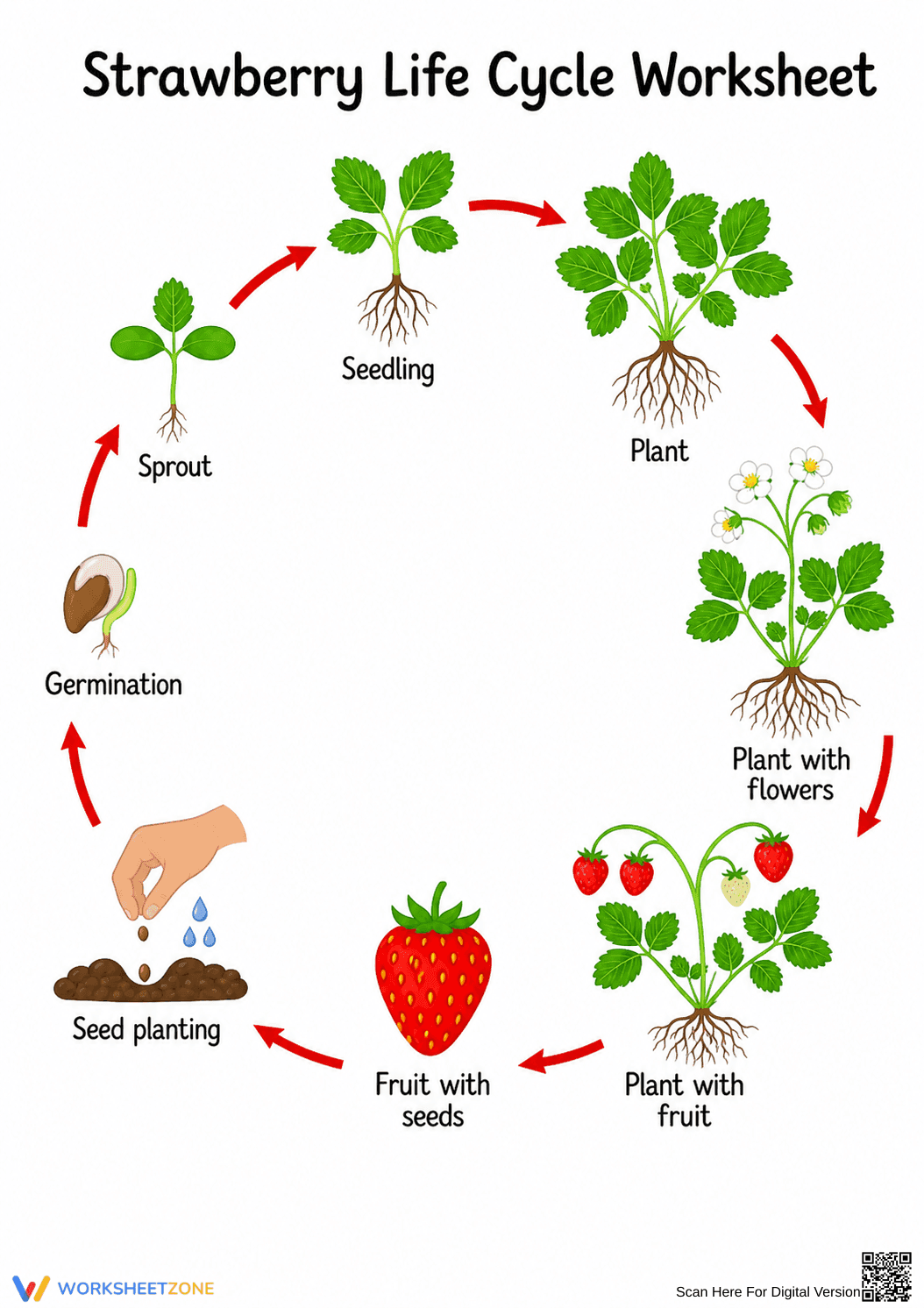

Strawberry Life Cycle Printable | Grade 6 Science
Paste this activity's link or code into your existing LMS (Google Classroom, Canvas, Teams, Schoology, Moodle, etc.).
Students can open and work on the activity right away, with no student login required.
You'll still be able to track student progress and results from your teacher account.
This printable strawberry life cycle diagram provides students with a clear, visual model of plant growth and reproduction. By tracing the stages from seed planting to mature fruit, learners can easily grasp how specialized plant structures develop over time to ensure successful reproduction and continued species survival.
At a Glance
- Grade: 6 · Subject: Science
- Standard:
MS-LS1-4— Understand how plant structures affect reproduction probability.- Skill Focus: Plant Life Cycles
- Format: 1 page · 0 problems · No answer key · PDF
- Best For: Visual reference and anchor charts
- Time: 5–10 minutes
Inside this single-page PDF, educators will find a full-color, clearly labeled diagram illustrating the complete life cycle of a strawberry plant. The visual traces eight distinct stages: seed planting, germination, sprout, seedling, mature plant, plant with flowers, plant with fruit, and fruit with seeds. Red directional arrows guide students through the cyclical process, making it an excellent reference sheet or anchor chart for science notebooks.
This resource is designed for immediate classroom implementation with a streamlined zero-prep workflow:
- Print (1 minute): Simply download the PDF and print in color or grayscale. No special formatting is required.
- Distribute (1 minute): Hand out to students as a reference guide to glue into their interactive science journals.
- Review (3 minutes): Walk through the cycle together, pointing out how the flower transitions into the fruit.
With under two minutes of total teacher prep time, this diagram is highly suitable for quick lesson introductions, visual scaffolding, or as an easy addition to a substitute teacher plan.
This visual model aligns with MS-LS1-4, which asks students to use evidence to support an explanation for how specialized plant structures affect the probability of successful reproduction. By showing the progression from flower to seed-bearing fruit, the diagram provides foundational knowledge for this standard. Both standard codes can be copied directly into lesson plans, IEP goals, or district curriculum mapping tools.
Teachers can utilize this diagram in multiple instructional moments. Before direct instruction, project the image as a warm-up activity to activate prior knowledge about plant growth. During a hands-on planting activity, students can keep this sheet on their desks to identify which stage their own plants have reached. As a formative assessment observation tip, ask students to verbally explain what happens between the flower and fruit stages to check for understanding. Expected completion time is 5 to 10 minutes.
This resource is primarily designed for middle school science students reviewing foundational biology concepts. It serves as an excellent differentiation tool for English Language Learners (ELLs) and visual learners who benefit from clear illustrations paired with simple vocabulary. Pair this diagram with a reading passage on pollination or a direct instruction lesson on angiosperm reproduction.
Integrating visual models like this strawberry life cycle diagram is a highly effective strategy for building scientific literacy in the modern classroom. According to a ScienceDirect TpT Analysis, providing students with clear, sequential diagrams significantly improves their ability to comprehend complex biological processes and retain domain-specific vocabulary. When students interact with visual representations of the MS-LS1-4 standard, they are better equipped to understand how plant structures affect reproduction probability. By explicitly mapping out the transition from seed to mature, fruit-bearing plant, educators can reduce cognitive load and help learners focus on the underlying mechanisms of growth and survival. This approach not only supports diverse learning needs but also fosters a deeper, more intuitive grasp of natural cycles, ensuring that foundational science concepts are firmly established before moving on to more advanced ecological topics and systems.


