


























Views
Downloads
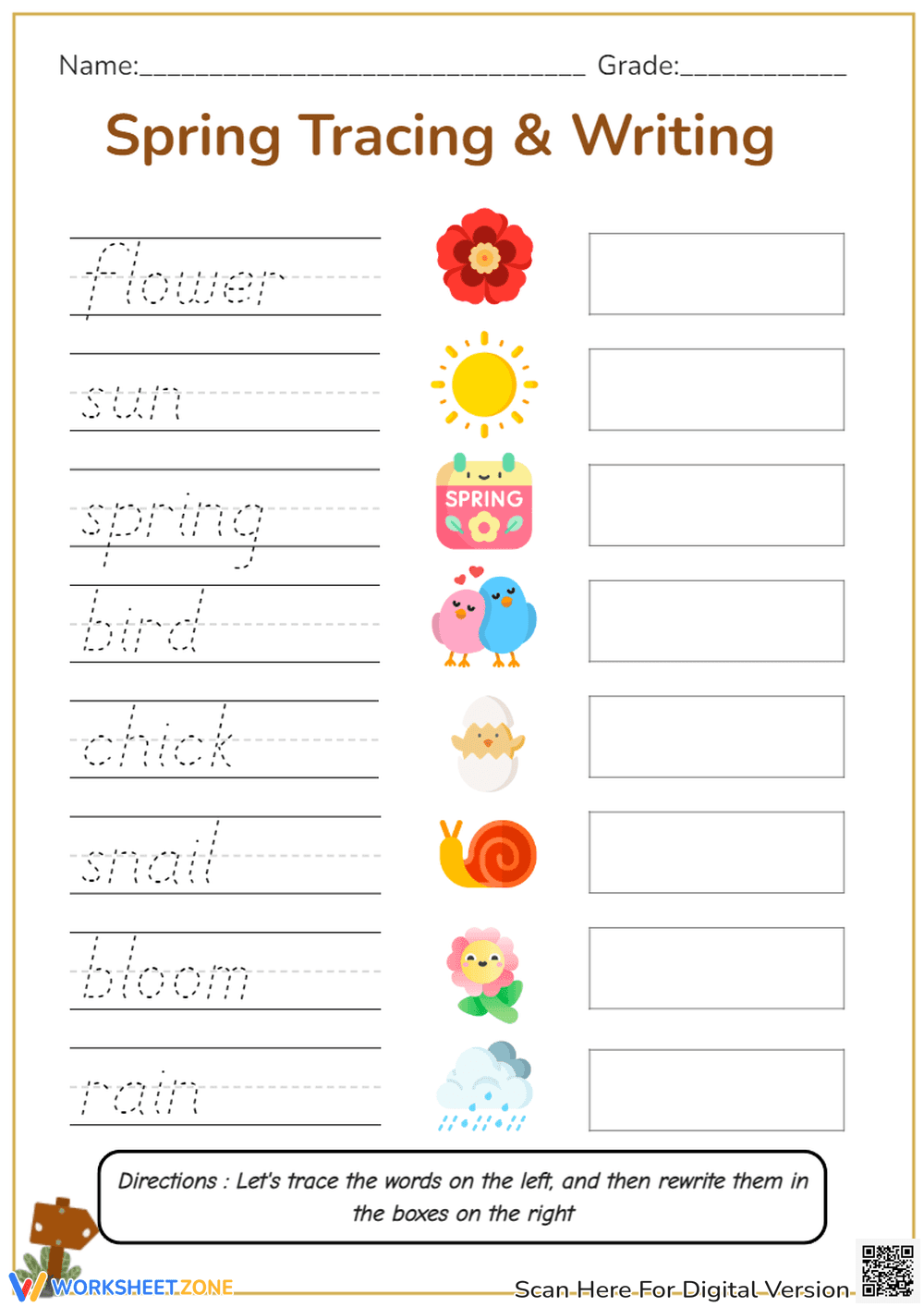

Spring Tracing & Writing | Grade 1-2 Essential
Paste this activity's link or code into your existing LMS (Google Classroom, Canvas, Teams, Schoology, Moodle, etc.).
Students can open and work on the activity right away, with no student login required.
You'll still be able to track student progress and results from your teacher account.
This Grade 1 and Grade 2 handwriting worksheet helps young learners master letter formation while building seasonal vocabulary. By combining tracing with independent writing, students develop the fine motor control necessary for legible penmanship. This resource provides a structured way to practice common spring-themed nouns and verbs in a visually engaging format.
At a Glance
- Grade: 1-2 · Subject: Handwriting
- Standard:
CCSS.ELA-LITERACY.L.1.1.A— Print all upper- and lowercase letters legibly and accurately- Skill Focus: Fine motor control and spelling
- Format: 1 page · 8 problems · Answer key included · PDF
- Best For: Morning work or literacy centers
- Time: 10–15 minutes
The worksheet features 8 high-frequency spring words, including "flower," "sun," and "bloom." Each entry includes a dashed-line tracing model on the left to guide initial formation. To the right, a dedicated box allows students to demonstrate mastery by rewriting the word independently. The inclusion of colorful icons next to each word provides visual cues that support vocabulary acquisition for early readers and English Language Learners.
Zero-Prep Workflow
This resource is designed for a zero-prep classroom workflow. Teachers can print the single-page PDF in less than 30 seconds. Distribution takes approximately 1 minute during transition periods. Reviewing student work is efficient, as the side-by-side tracing and writing boxes allow for immediate visual assessment of letter height, spacing, and alignment. Total teacher preparation time is under 2 minutes, making it an ideal choice for emergency sub plans or bell-ringer activities.
Standards Alignment
This activity aligns with `CCSS.ELA-LITERACY.L.1.1.A`, which requires students to print all upper- and lowercase letters. It also supports `CCSS.ELA-LITERACY.L.1.2.E` by encouraging students to spell untaught words phonetically, drawing on phonemic awareness and spelling patterns. Both standard codes can be copied directly into lesson plans, IEP goals, or district curriculum mapping tools.
How to Use It
Use this worksheet as a warm-up during the first 10 minutes of a literacy block to settle the class. It also serves as an effective formative assessment tool; observe students as they transition from the traced model to the independent box to identify specific letters that require additional intervention. Expected completion time ranges from 10 to 15 minutes depending on the student's fine motor development.
Who It's For
This resource is tailored for first and second-grade students, but it is also highly effective for kindergarteners ready for word-level writing. It pairs naturally with a spring-themed picture book or a nature walk activity. For students struggling with grip, provide a pencil topper or triangular grip to complement the structured tracing lines provided on the page.
Research from Fisher & Frey (2014) emphasizes the importance of the gradual release of responsibility, which this worksheet mirrors through its "trace then write" structure. By providing a scaffolded model before requiring independent production, the resource reduces cognitive load and allows the student to focus specifically on the mechanics of letter formation. According to the RAND AIRS 2024 report on early literacy, consistent short-burst handwriting practice is more effective for long-term retention than infrequent, long-duration sessions. This worksheet provides exactly that type of targeted, high-frequency practice. The integration of thematic vocabulary further strengthens the connection between orthographic processing and semantic meaning, ensuring that students are not just drawing shapes but are actively engaging with language. This dual-purpose approach is a hallmark of effective early childhood instructional design, supporting both physical dexterity and linguistic growth within a single, manageable task.


