


























Views
Downloads

Spinal Cord Crossword Puzzle | Essential Grade 4 Science
Paste this activity's link or code into your existing LMS (Google Classroom, Canvas, Teams, Schoology, Moodle, etc.).
Students can open and work on the activity right away, with no student login required.
You'll still be able to track student progress and results from your teacher account.
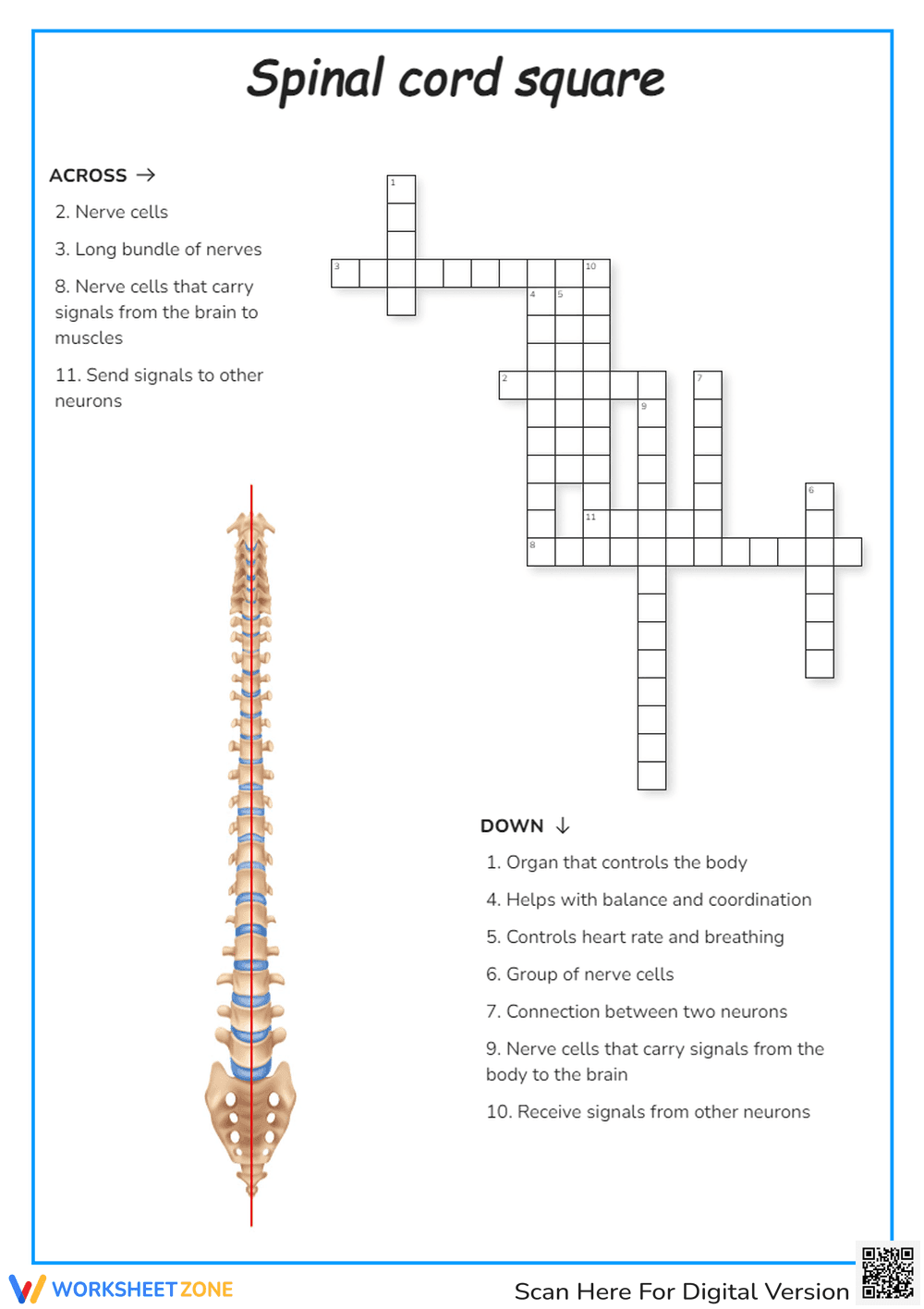
This Grade 4 science worksheet provides a focused way for students to master nervous system terminology. By solving the crossword, learners identify key structures like neurons, the brain, and the spinal cord. It transforms complex anatomical concepts into an engaging vocabulary challenge that reinforces the relationship between sensory input and physical response.
At a Glance
- Grade: 4 · Subject: Science
- Standard:
4-LS1-2— Describe how animals receive, process, and respond to information via the brain- Skill Focus: Nervous system anatomy
- Format: 1 page · 12 problems · Answer key included · PDF
- Best For: Vocabulary reinforcement and quick assessment
- Time: 15–20 minutes
The worksheet features a 12-clue crossword puzzle centered on a detailed diagram of the human spinal column. It includes 4 "Across" clues and 8 "Down" clues covering essential terms such as nerve cells, synapses, and coordination centers. The single-page PDF format ensures all clues and the puzzle grid are visible simultaneously, with a clear answer key for rapid grading.
This resource is designed for a zero-prep classroom environment. First, print the single-page PDF (30 seconds). Next, distribute the sheets to students for independent or partner work (1 minute). Finally, review the answers as a whole group using the provided key to clarify misconceptions about neuron functions (5 minutes). Total teacher preparation time is under 2 minutes. It is an ideal sub-plan resource.
This activity aligns with `4-LS1-2`, requiring students to describe how information is processed. By defining the roles of the brain and spinal cord, students build the foundational knowledge necessary to explain sensory-motor loops. Both standard codes can be copied directly into lesson plans, IEP goals, or district curriculum mapping tools.
Use this puzzle as a formative assessment after an introductory lesson on the human body. It works well as a "ticket out the door" to gauge student retention of anatomical terms. Teachers should observe if students can distinguish between the roles of the brain and the spinal cord during the 20-minute completion window. It provides immediate feedback on student comprehension.
This worksheet is ideal for Grade 4 students but remains accessible for Grade 2 and 3 learners as an enrichment activity. It pairs naturally with a nervous system anchor chart or a diagram of the human brain. It is particularly effective for visual learners who benefit from the spatial organization of a crossword and the included anatomical diagram.
According to the RAND AIRS 2024 report, structured vocabulary activities that link anatomical terms to functional roles significantly improve long-term retention in elementary science. This worksheet targets the 4-LS1-2 standard by requiring students to identify the biological structures responsible for processing information. By engaging with 12 specific clues, learners move beyond rote memorization toward a conceptual understanding of how the spinal cord serves as a communication highway between the brain and the body. Research from Fisher & Frey (2014) suggests that such word-play tasks reduce cognitive load while reinforcing technical terminology. This resource provides a reliable, evidence-based method for ensuring students meet NGSS benchmarks for life science. The inclusion of an answer key and a clear visual model of the spine supports diverse learners in achieving mastery of the nervous system's complex architecture within a standard 20-minute instructional block.


