


























Views
Downloads
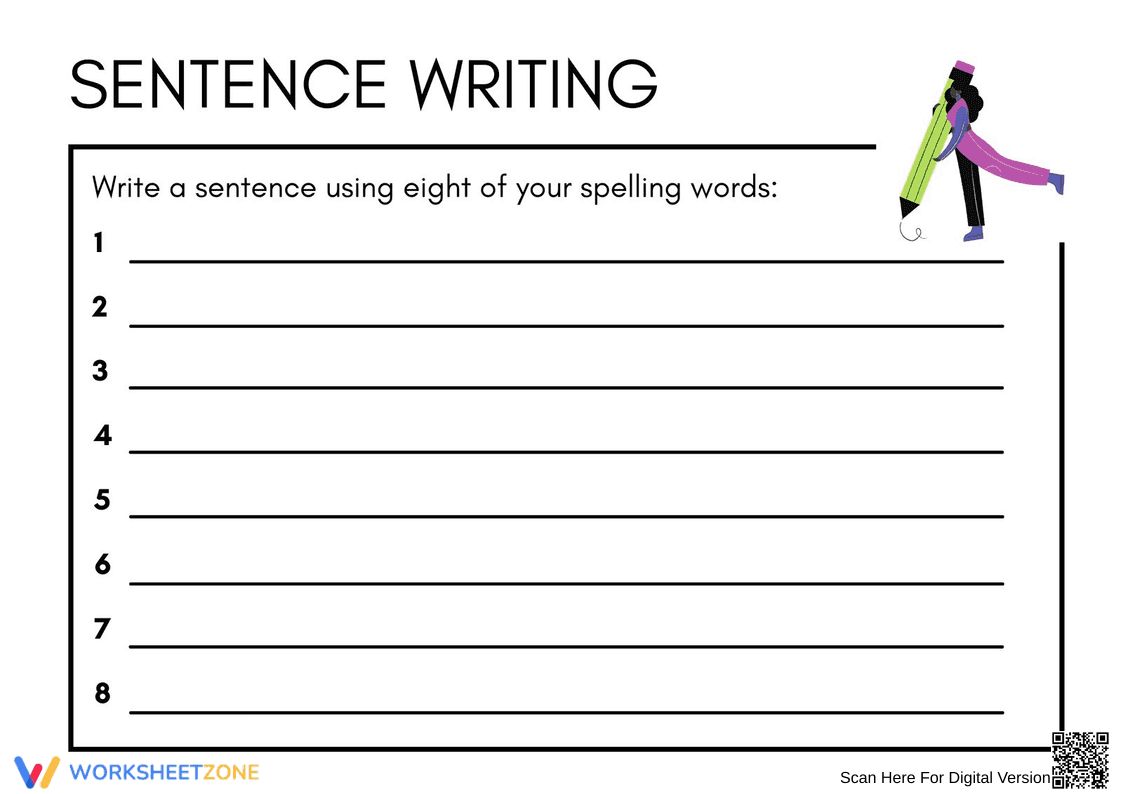

Grade 2 Spelling Sentences — Printable No-Prep Worksheet
Paste this activity's link or code into your existing LMS (Google Classroom, Canvas, Teams, Schoology, Moodle, etc.).
Students can open and work on the activity right away, with no student login required.
You'll still be able to track student progress and results from your teacher account.
This Grade 2 sentence writing worksheet gives students focused practice applying their weekly spelling words in context. By writing eight original sentences, learners demonstrate vocabulary comprehension while reinforcing proper capitalization and punctuation. This simple, effective activity transitions students from rote memorization to authentic writing application.
At a Glance
- Grade: 2 · Subject: ELA
- Standard:
CCSS.ELA-LITERACY.L.2.2— Apply spelling and punctuation conventions in writing- Skill Focus: Sentence writing and spelling
- Format: 1 page · 8 problems · Open-ended · PDF
- Best For: Independent practice or homework
- Time: 15–20 minutes
This single-page resource features a clean, distraction-free layout designed for early elementary writers. It includes eight clearly numbered, wide-ruled lines where students can draft complete sentences using their current spelling list. The open-ended format allows teachers to pair this page with any vocabulary curriculum. Because responses depend on specific assigned words, an answer key is omitted, encouraging teachers to review for individual progress in grammar and spelling accuracy.
Zero-Prep Workflow
This resource is designed for maximum efficiency in a busy classroom:
- Print (1 minute): The black-and-white design is printer-friendly and requires no special formatting.
- Distribute (1 minute): Hand out the page alongside the week's spelling list or display the words on the board.
- Review (3 minutes): Quickly scan completed sheets for capital letters, end marks, and correct spelling of target words.
With under two minutes of total teacher prep time, this activity is an excellent addition to emergency sub plans or morning work routines.
Standards Alignment
This activity aligns with CCSS.ELA-LITERACY.L.2.2: Demonstrate command of the conventions of standard English capitalization, punctuation, and spelling when writing. It also supports vocabulary acquisition by requiring students to use words in meaningful contexts. Both standard codes can be copied directly into lesson plans, IEP goals, or district curriculum mapping tools.
How to Use It
This versatile worksheet fits perfectly into a weekly spelling routine. Assign it on a Thursday after direct instruction on the week's spelling patterns, allowing students to practice before a Friday assessment. It also works well as a literacy center station. As a formative assessment observation tip, watch students as they write to see if they capitalize the first word and add correct punctuation without prompting. Expect students to complete this task in 15 to 20 minutes.
Who It's For
This resource is primarily designed for second-grade students, though it serves as excellent review for third graders or a challenge for advanced first graders. To differentiate, teachers can require advanced learners to write compound sentences or use two spelling words per line. For students needing extra support, provide sentence frames or a word bank with visual cues. It pairs naturally with any phonics anchor chart or direct instruction lesson on sentence structure.
Integrating spelling practice with authentic writing tasks significantly improves long-term retention and literacy development in early elementary classrooms. According to Fisher & Frey (2014), isolated skill drills are less effective than activities requiring students to apply conventions in their own generated text. This worksheet directly supports CCSS.ELA-LITERACY.L.2.2 by asking students to apply spelling and punctuation conventions in writing. When learners construct original sentences using target vocabulary, they engage in higher-order cognitive processing compared to simple copying or matching exercises. This transition from passive recognition to active production is essential for building writing fluency. By providing a structured yet open-ended format, educators can easily assess both spelling accuracy and grammatical understanding simultaneously, ensuring students are developing comprehensive communication skills rather than just memorizing letter sequences for a test.


