


























Views
Downloads


Sounds Near and Far Worksheet | Grade 1 Essential Science
Paste this activity's link or code into your existing LMS (Google Classroom, Canvas, Teams, Schoology, Moodle, etc.).
Students can open and work on the activity right away, with no student login required.
You'll still be able to track student progress and results from your teacher account.
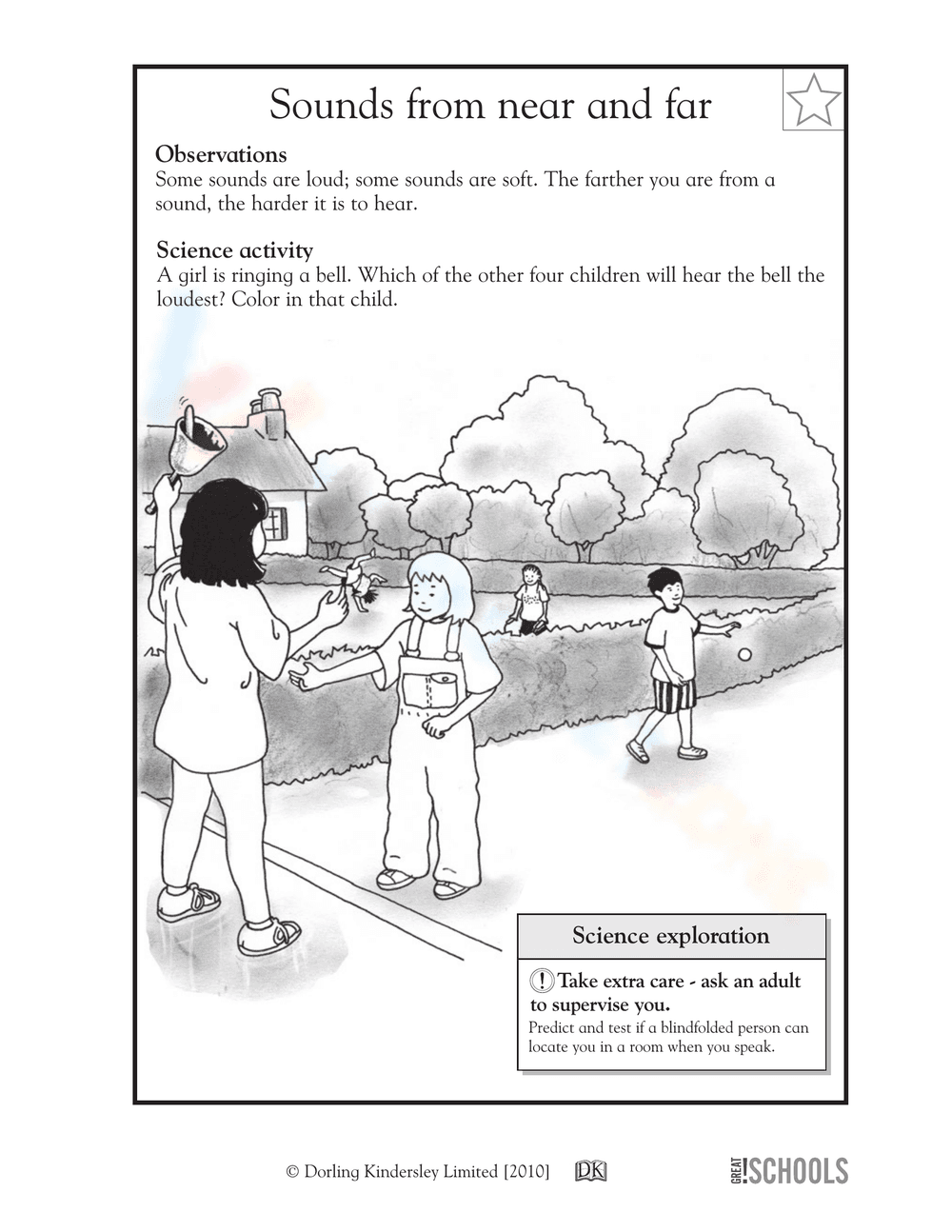
This Grade 1 science worksheet helps students understand the physical properties of sound, specifically how distance influences volume. By observing a visual scenario and participating in a guided exploration, learners conclude that sounds become quieter as they move further from the source. It provides a clear, visual entry point into energy and waves.
At a Glance
- Grade: 1 · Subject: Science
- Standard:
1-PS4-1— Plan and conduct investigations to provide evidence that materials make sound- Skill Focus: Sound volume and distance
- Format: 1 page · 2 tasks · Answer key included · PDF
- Best For: Introductory sound unit activity
- Time: 15–20 minutes
The worksheet features a high-quality illustration of children in a park setting. One child rings a bell, while others stand at varying distances. Students must identify and color the child who hears the sound the loudest. Below the main activity, a Science exploration box provides a hands-on extension where students predict and test sound localization while blindfolded, adding a kinesthetic layer to the lesson.
Zero-Prep Workflow
- Print: Generate the single-page PDF for your entire class in less than 1 minute.
- Distribute: Hand out the worksheets during your science block; no additional materials are required beyond crayons.
- Review: Spend 5 minutes discussing the results to confirm that students correctly identified the closest child as the one hearing the loudest sound.
This resource is perfect for emergency sub plans or as a quick transition activity between science labs.
Standards Alignment
Aligned to 1-PS4-1, this activity supports the understanding that sound is a physical phenomenon that can be observed and measured. While the standard focuses on vibrations, understanding the behavior of sound waves over distance is a critical prerequisite. This worksheet also supports CCSS.ELA-LITERACY.RI.1.1 by requiring students to answer questions about key details in a scientific text. Both standard codes can be copied directly into lesson plans, IEP goals, or district curriculum mapping tools.
How to Use It
Use this worksheet during the Explore phase of a 5E lesson model. After a brief demonstration with a bell or whistle, assign the coloring task to check for initial understanding. Alternatively, use the Science exploration box as a quick formative assessment at the end of the week. Expected completion time is 15 to 20 minutes depending on the depth of the extension activity.
Who It's For
This resource is ideal for Grade 1 students but is also appropriate for Kindergarten or Grade 2 learners exploring physical science. The visual nature of the task makes it an excellent choice for English Language Learners (ELLs) who are building scientific vocabulary like loud, soft, near, and far. It pairs naturally with an anchor chart showing sound waves or a direct instruction lesson on energy.
According to research by Fisher & Frey (2014) on the gradual release of responsibility, providing students with visual models before abstract experimentation is essential for conceptual mastery in early science. This worksheet utilizes a visual scenario to anchor the abstract concept of sound dissipation over distance. By requiring students to color a specific target, the task ensures active engagement with the scientific observation. The inclusion of a hands-on exploration task aligns with the NAEP science framework, which emphasizes the importance of conducting simple investigations to understand physical properties. The 1-PS4-1 standard is addressed through the observation of sound behavior, providing a foundation for later studies in wave mechanics and energy transfer. This structured approach ensures that 100% of students can access the core scientific concept regardless of their initial reading level or prior knowledge of acoustics.


