




























Views
Downloads

Essential Sound Energy Worksheet | Grade 3 Science

Paste this activity's link or code into your existing LMS (Google Classroom, Canvas, Teams, Schoology, Moodle, etc.).
Students can open and work on the activity right away, with no student login required.
You'll still be able to track student progress and results from your teacher account.
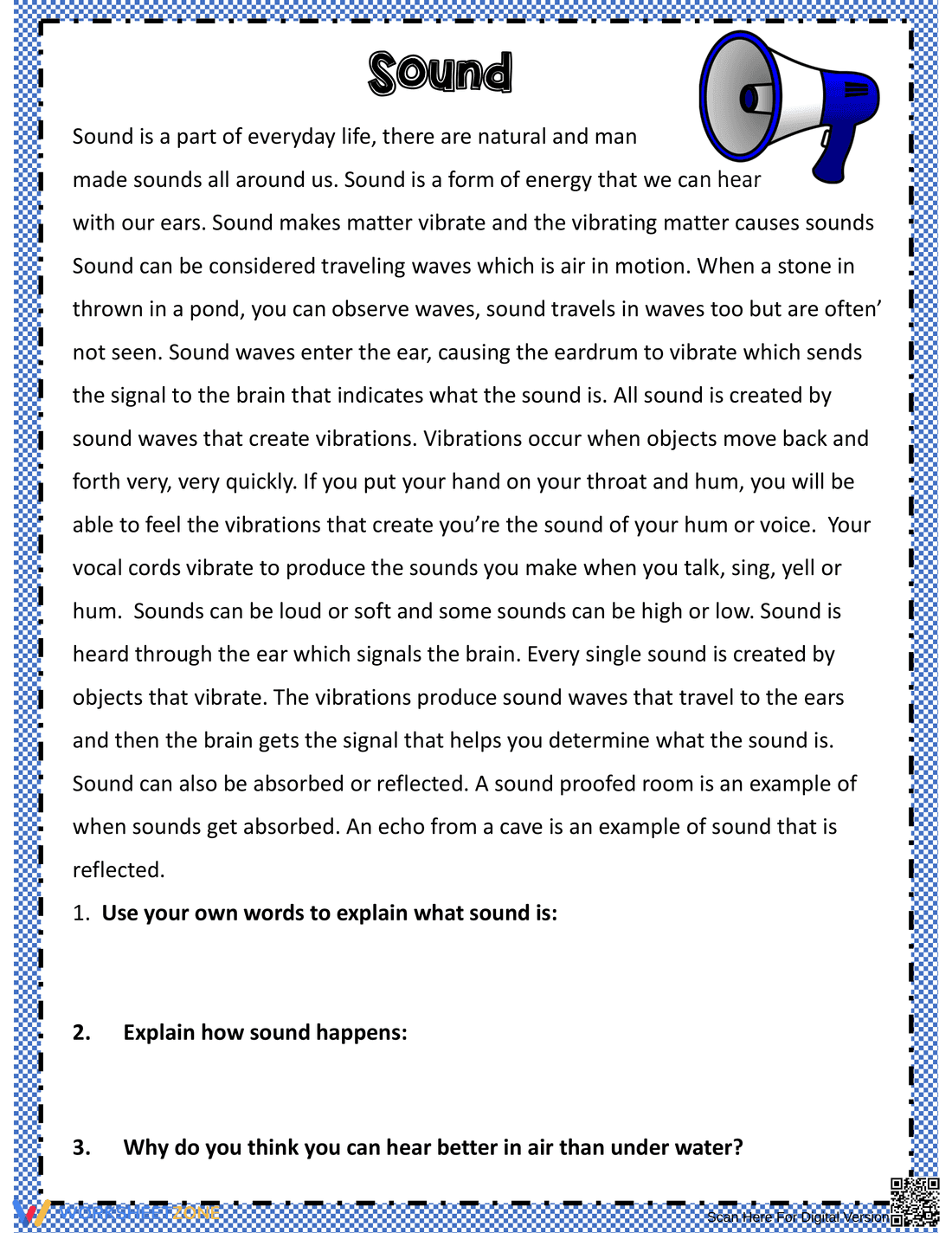
This Grade 3 sound energy worksheet helps students understand the physical science behind how we hear. By reading a concise passage on vibrations, waves, and energy, learners build a foundation for more complex physics concepts. It provides a direct way to assess reading comprehension while reinforcing core science curriculum goals.
At a Glance
- Grade: 3 · Subject: Science
- Standard:
RI.3.1— Ask and answer questions to demonstrate understanding of a text- Skill Focus: Sound vibrations and energy
- Format: 1 page · 3 problems · PDF
- Best For: Independent practice or quick science assessment
- Time: 15–20 minutes
What's Inside
The resource features a single-page layout containing a detailed informational text about sound. It covers natural versus man-made sounds, the mechanics of vibrations, and how sound travels through different mediums. Following the text, there are 3 open-ended response questions that require students to synthesize the information and explain concepts in their own words.
Zero-Prep Workflow
This worksheet is designed for immediate classroom implementation. Teachers can print the single PDF page in under 1 minute. Distribution takes seconds, and because the text is self-contained, students can begin working immediately without additional lecture time. Reviewing the three open-ended answers typically takes less than 5 minutes for a full class set, making it an ideal choice for busy schedules or emergency sub plans.
Standards Alignment
This resource aligns with `CCSS.ELA-LITERACY.RI.3.1`: "Ask and answer questions to demonstrate understanding of a text, referring explicitly to the text as the basis for the answers." It also supports NGSS concepts related to waves and their applications in technologies for information transfer. Both standard codes can be copied directly into lesson plans, IEP goals, or district curriculum mapping tools.
How to Use It
Use this worksheet during the "Explain" phase of a 5E science lesson to solidify vocabulary like "vibration" and "absorption." It also serves as an effective formative assessment after a hands-on demonstration with tuning forks or rubber bands. Expect students to spend approximately 15 to 20 minutes reading the passage and drafting their written responses.
Who It's For
This is designed for third-grade students but is highly effective for fourth-grade review or English Language Learners (ELLs) who need clear, descriptive text about physical science. It pairs naturally with an anchor chart showing the anatomy of the ear or a short video clip demonstrating sound waves in water.
According to the RAND AIRS 2024 report, integrating informational text within subject-specific domains like science significantly improves both literacy outcomes and content retention for elementary learners. This worksheet utilizes the RI.3.1 standard to bridge the gap between reading skills and physical science knowledge, specifically focusing on the mechanics of sound vibrations. By requiring students to explain how sound happens in their own words, the resource encourages the cognitive processing necessary for long-term memory. Research from Fisher & Frey (2014) suggests that such structured reading tasks provide the necessary scaffolding for students to move from surface-level recognition to conceptual mastery. This 1-page PDF provides a focused, evidence-based approach to teaching the properties of energy, ensuring that Grade 3 students meet both state and national benchmarks for science literacy and reading comprehension.


