




























Views
Downloads

Grade 1 Sound Waves — Printable No-Prep Worksheet

Paste this activity's link or code into your existing LMS (Google Classroom, Canvas, Teams, Schoology, Moodle, etc.).
Students can open and work on the activity right away, with no student login required.
You'll still be able to track student progress and results from your teacher account.
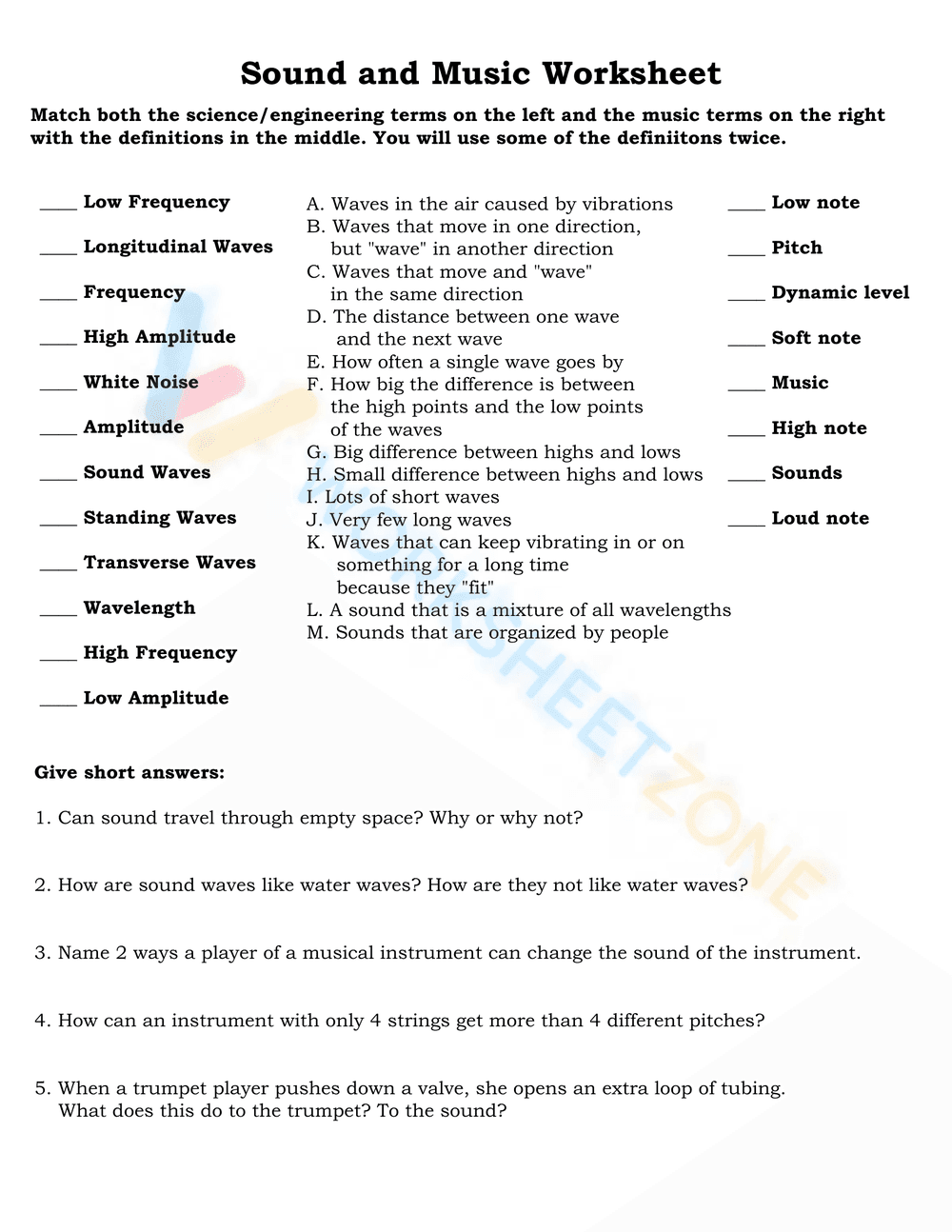
This Grade 1 science worksheet helps students connect the physics of sound waves to musical concepts. By matching scientific terms like frequency and amplitude to musical ideas like pitch and volume, learners build a strong foundational vocabulary. The structured format ensures focused practice on how vibrations create the sounds we hear.
At a Glance
- Grade: 1 · Subject: Science
- Standard:
1-PS4-1— Understand that vibrating materials can make sound- Skill Focus: Sound waves and music terminology
- Format: 1 page · 25 problems · Answer key included · PDF
- Best For: Independent practice or review
- Time: 20–30 minutes
This single-page resource features a matching section with 20 vocabulary connections, linking science terms to their musical equivalents using a shared definition bank. Following this, students will find five short-answer questions that prompt them to apply their knowledge to real-world scenarios, like how sound travels. A complete answer key is included.
Designed for immediate classroom use, this resource follows a simple zero-prep workflow:
- Print (1 minute): Download the PDF and print a class set.
- Distribute (1 minute): Hand out the worksheets as a warm-up or homework task.
- Review (3 minutes): Use the included answer key to quickly check student understanding.
With a total teacher prep time of under two minutes, this worksheet is an excellent addition to any emergency sub plan.
This activity is aligned to 1-PS4-1: Plan and conduct investigations to provide evidence that vibrating materials can make sound. It supports cross-curricular connections by linking wave properties to musical arts. Both standard codes can be copied directly into lesson plans, IEP goals, or district curriculum mapping tools.
Teachers can deploy this worksheet during the independent practice phase of a science lesson on sound energy. It works well after a hands-on demonstration with tuning forks. As a formative assessment tip, monitor students as they complete the short-answer section; their responses about sound in empty space will reveal if they grasp the concept of a physical medium. Expect completion in 20 to 30 minutes.
This resource is designed for first-grade science students exploring light and sound, though the rigorous vocabulary makes it adaptable for older students reviewing wave properties. For learners needing extra support, teachers can pre-teach the vocabulary. It pairs perfectly with a direct instruction lesson on how musical instruments produce different notes, or alongside a visual anchor chart.
Understanding the relationship between physical vibrations and auditory experiences is a critical step in early science education. Aligned with 1-PS4-1, this resource helps students understand that vibrating materials can make sound by explicitly connecting abstract wave terminology to familiar musical concepts. According to a recent ScienceDirect TpT Analysis, instructional materials that bridge scientific vocabulary with real-world applications—such as music and instrumentation—significantly improve long-term retention of physics concepts in elementary classrooms. By requiring students to map terms like amplitude and frequency to loud notes and high pitches, this worksheet reinforces the cognitive links between observable phenomena and scientific theory. The combination of targeted matching tasks and open-ended short answers ensures learners synthesize the mechanics of sound transmission, providing a robust foundation for future STEM coursework.


