


























Views
Downloads

Printable Sort & Count Worksheet: Leaves & Flowers (Grade 1)
Paste this activity's link or code into your existing LMS (Google Classroom, Canvas, Teams, Schoology, Moodle, etc.).
Students can open and work on the activity right away, with no student login required.
You'll still be able to track student progress and results from your teacher account.
Sorting and counting data is a foundational mathematical skill that transitions students from concrete objects to abstract representation. This 2-page Sort and Count Leaves and Flowers worksheet provides a structured environment for Grade 1 and 2 students to organize visual information, create a bar graph, and interpret their findings through targeted analytical questions.
At a Glance
- Grade: 1 · Subject: Math
- Standard:
CCSS.1.MD.C.4— Organize, represent, and interpret data with up to four categories and answer questions.- Skill Focus: Data Sorting and Graphing
- Format: 2 pages · 8 problems · Answer key included · PDF
- Best For: Independent practice or morning work
- Time: 15–20 minutes
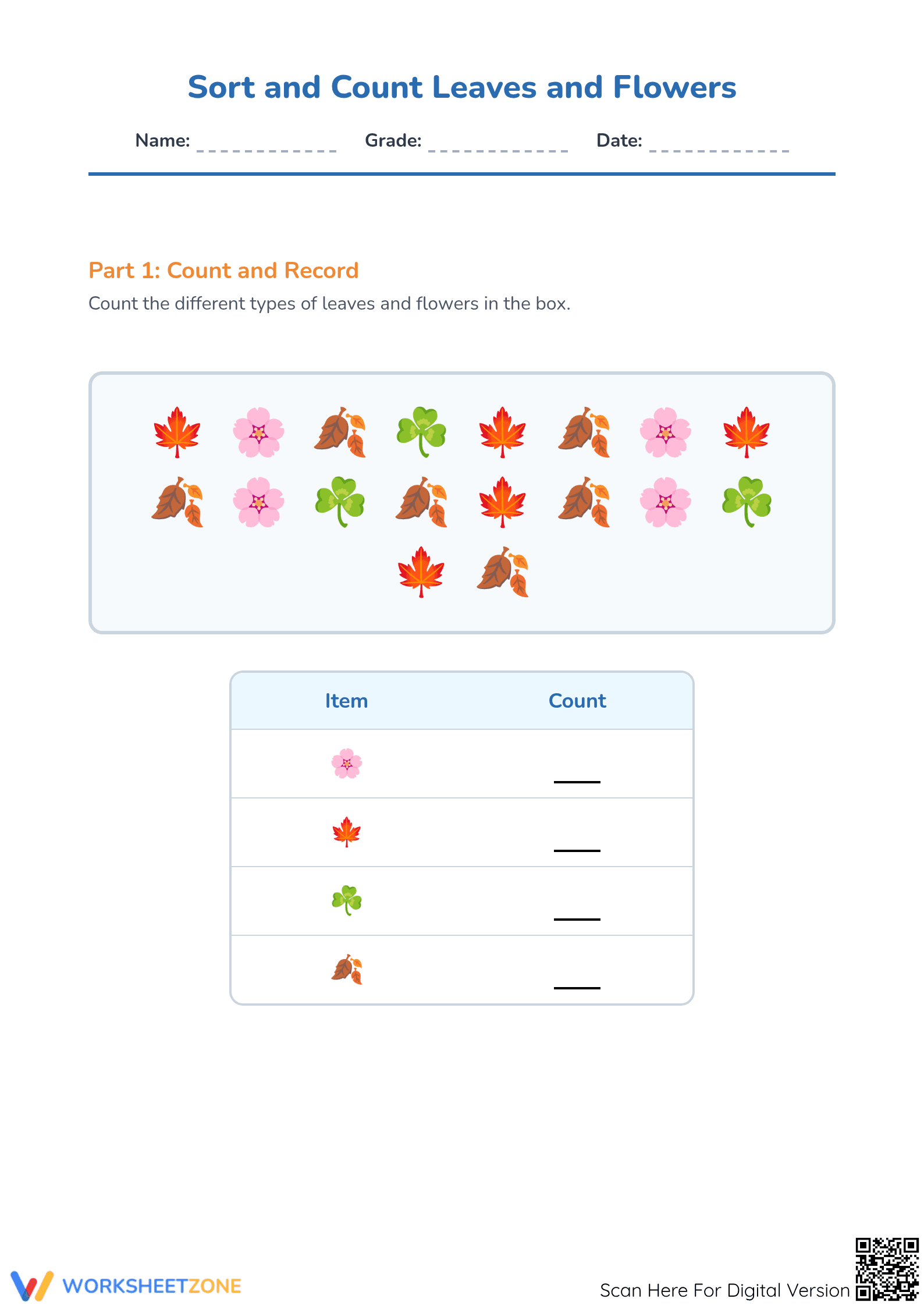
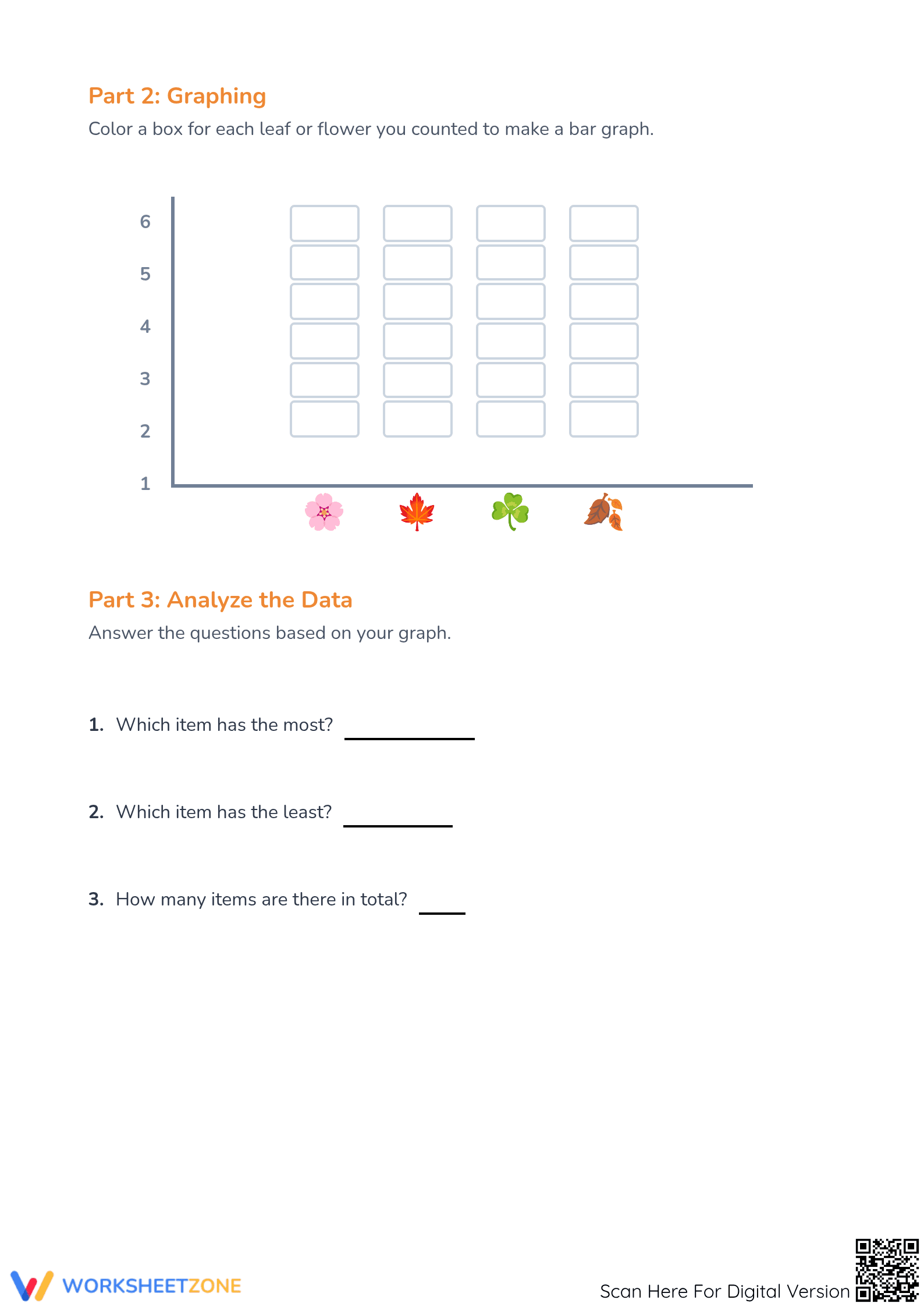
The worksheet is divided into three logical phases across two printable pages. Students begin with a "Count and Record" task featuring a disorganized box of autumn-themed icons. They move to a "Graphing" section where they construct a vertical bar graph by coloring boxes corresponding to their counts. Finally, the "Analyze the Data" section poses three comparative questions to solidify comprehension and verify accuracy.
This resource is designed for immediate classroom implementation with a total prep time of under 2 minutes. First, print the two-page PDF (30 seconds). Second, distribute to students with basic coloring supplies (1 minute). Finally, use the included answer key for rapid whole-class review or individual grading (30 seconds). Its self-contained nature makes it an ideal choice for emergency substitute plans or transition periods between major units.
This activity is primarily aligned with CCSS.MATH.CONTENT.1.MD.C.4, which requires students to organize, represent, and interpret data. It also supports CCSS.MATH.CONTENT.2.MD.D.10 by having students draw a bar graph to represent a data set with up to four categories. These standard codes can be copied directly into lesson plans, IEP goals, or district curriculum mapping tools to ensure rigorous alignment with state and national frameworks.
Incorporate this worksheet during the "You Do" phase of a gradual release lesson on data. After demonstrating how to cross off items as they are counted, assign the worksheet for independent practice. As a formative assessment, observe if students use a consistent marking strategy to keep track of the icons in the disorganized set, which indicates higher organizational awareness and reduces errors in the graphing phase.
Designed for Grade 1 and Grade 2 students, this resource is particularly effective for learners who benefit from high-contrast visual supports. It pairs naturally with a physical sorting activity using real leaves or math manipulatives before moving to this paper-based representation. It is also suitable for Grade 3 students requiring a quick review of unscaled graphing concepts or for students on an accelerated learning path in Kindergarten.
Effective data literacy instruction in early elementary education requires a progression from concrete sorting to abstract graphical representation. Research by Fisher & Frey (2014) highlights that scaffolding the transition between counting and interpreting data through structured worksheets like the "Sort and Count Leaves and Flowers" activity significantly improves mathematical fluency. By requiring students to address CCSS.1.MD.C.4 through three distinct cognitive steps—recording, graphing, and analyzing—this resource ensures that learners do more than simply tally numbers; they extract meaning from information. According to the NAEP 2024 framework, students who can accurately translate raw data into visual formats demonstrate a higher capacity for problem-solving in later algebraic domains. This 2-page printable provides the necessary repetition and clear visual cues required for Grade 1 mastery, serving as a reliable tool for both formative assessment and skill reinforcement within a standards-aligned curriculum.


