


























Views
Downloads
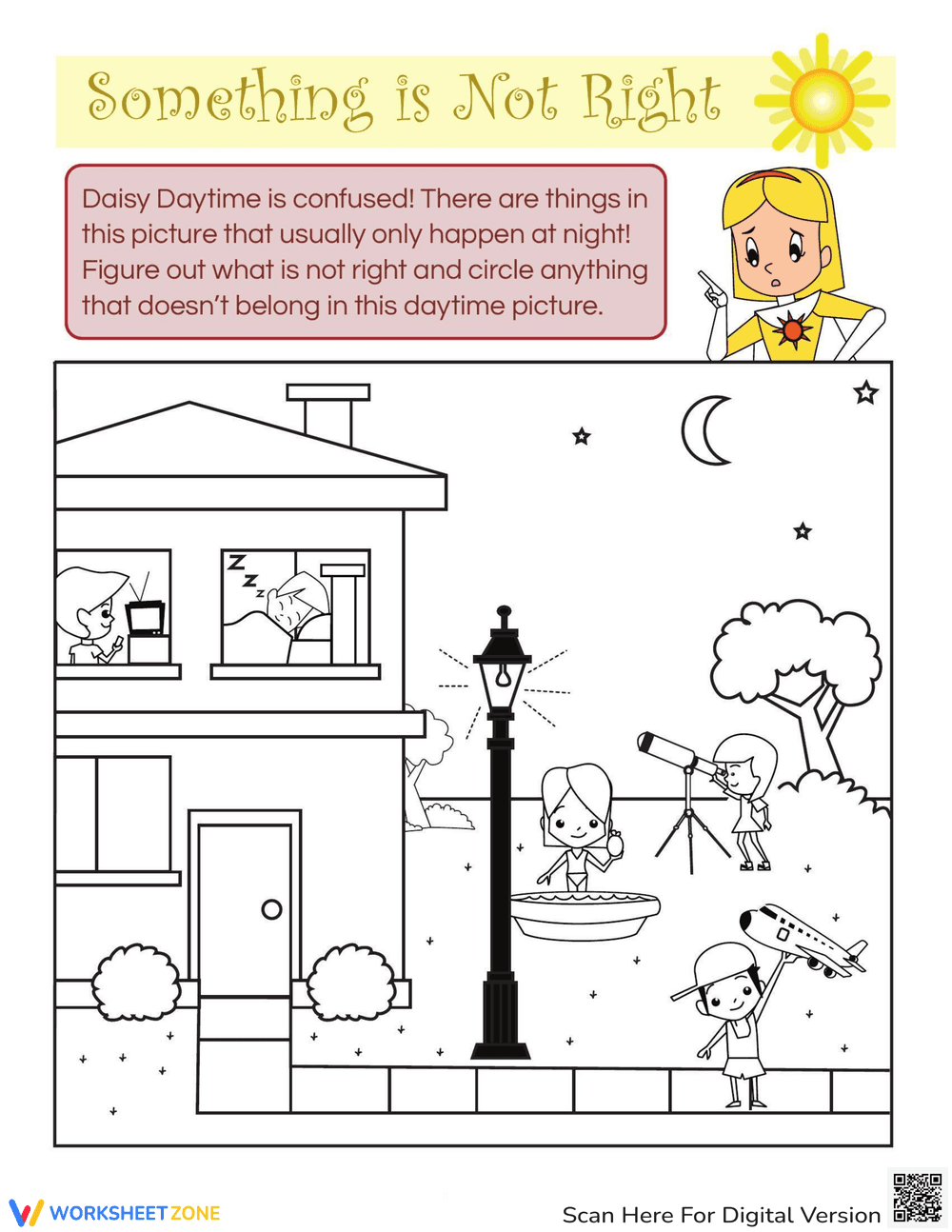

Day and Night Logic Worksheet | Grade K-1 Printable
Paste this activity's link or code into your existing LMS (Google Classroom, Canvas, Teams, Schoology, Moodle, etc.).
Students can open and work on the activity right away, with no student login required.
You'll still be able to track student progress and results from your teacher account.
This visual discrimination worksheet helps young learners distinguish daytime and nighttime concepts. Students analyze a scene to circle objects that do not belong, strengthening logical reasoning and categorization skills in an accessible format.
At a Glance
- Grade: K · Subject: ELA
- Standard:
CCSS.ELA-LITERACY.L.K.5.A— Sort common objects into categories- Skill Focus: Visual discrimination and categorization
- Format: 1 page · 5 problems · Answer key included · PDF
- Best For: Independent practice or morning work
- Time: 10–15 minutes
This single-page printable features a coloring-book style neighborhood scene. The prompt introduces Daisy Daytime, who needs help finding things that only happen at night. Students scan the image to find five out-of-place elements: a moon, stars, a lit streetlamp, a sleeping person, and a telescope. The bold line art allows early childhood students to color the page after completing the sorting task. An answer key is provided.
This resource offers a zero-prep workflow, requiring under two minutes of teacher preparation. Print the PDF master copy (30 seconds). Distribute the single-page activity to student folders (1 minute). Review the instructions aloud before students work independently (30 seconds). Because the visual instructions are self-explanatory, this worksheet is highly suitable for substitute teacher plans.
This activity aligns with CCSS.ELA-LITERACY.L.K.5.A: "Sort common objects into categories to gain a sense of the concepts the categories represent." By identifying nighttime objects in a daytime scene, students categorize concepts based on environmental context. Both standard codes can be copied directly into lesson plans, IEP goals, or district curriculum mapping tools.
Use this worksheet as engaging morning work to activate critical thinking. It also serves as an independent center activity during a thematic unit on daily routines. Teachers can conduct formative assessments by observing which children easily spot contextual anomalies. Expect students to complete the task within 10 to 15 minutes, plus coloring time.
Designed for kindergarten and first-grade students developing early logic skills. The visual task is highly accessible for English Language Learners (ELLs) and students receiving special education support, relying on picture comprehension rather than reading. Pair this worksheet with a whole-class anchor chart sorting daytime and nighttime activities.
Developing early categorization skills through visual discrimination tasks is a foundational component of early childhood education. When students practice sorting common objects into categories, as outlined in CCSS.ELA-LITERACY.L.K.5.A, they build the cognitive frameworks necessary for advanced vocabulary acquisition and reading comprehension. According to a RAND AIRS 2024 report on early literacy interventions, integrating visual logic puzzles with thematic vocabulary instruction significantly improves students' ability to organize new information and recognize contextual anomalies. This worksheet provides a targeted, age-appropriate opportunity for young learners to apply these categorization skills by distinguishing between daytime and nighttime elements. By engaging in this specific type of visual sorting, students strengthen their semantic networks, which directly supports their future ability to decode complex texts and understand nuanced relationships between different concepts across both literacy and science domains.


