




























Views
Downloads

Printable Solids Worksheet | Grade 3-4 Science Essential

Paste this activity's link or code into your existing LMS (Google Classroom, Canvas, Teams, Schoology, Moodle, etc.).
Students can open and work on the activity right away, with no student login required.
You'll still be able to track student progress and results from your teacher account.
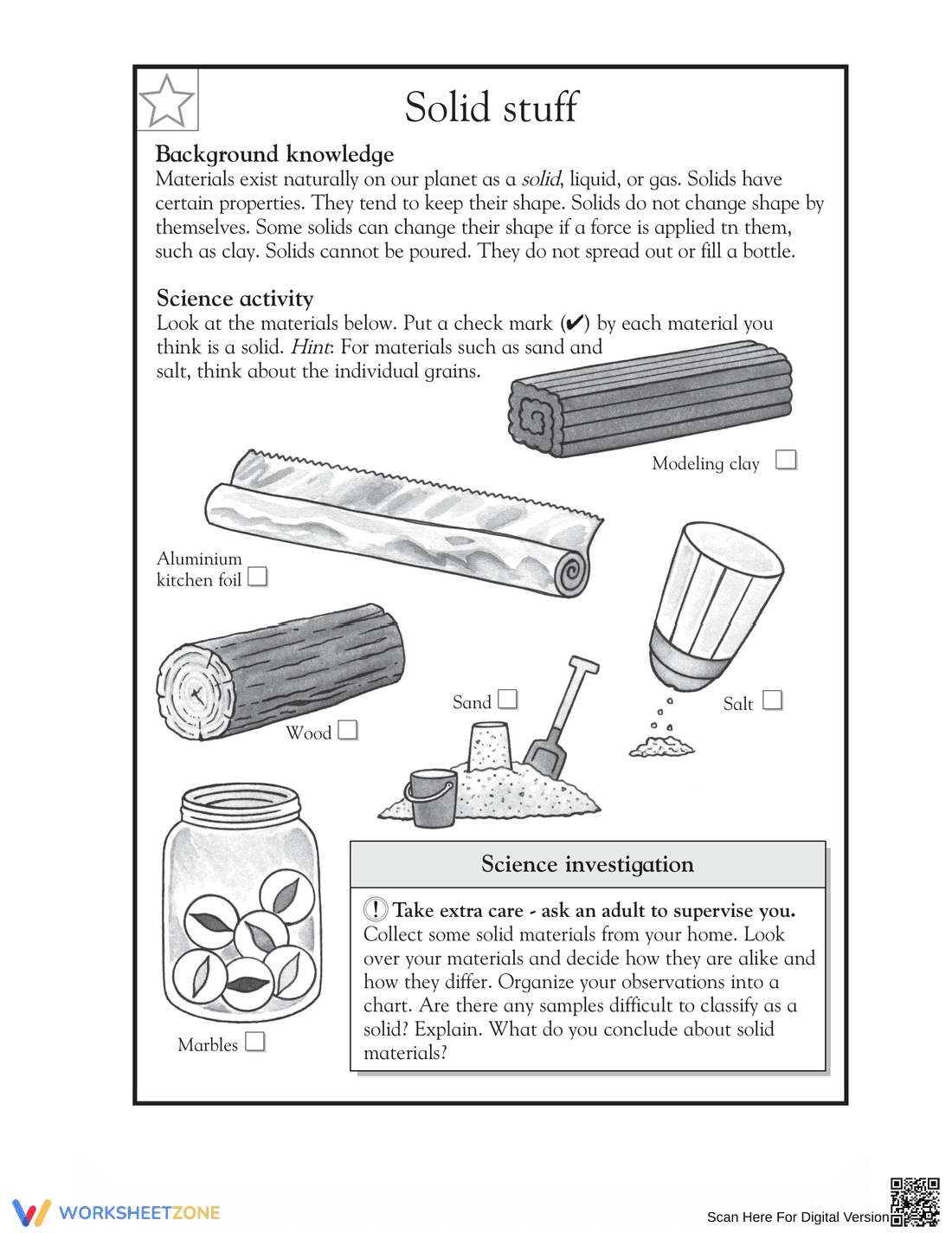
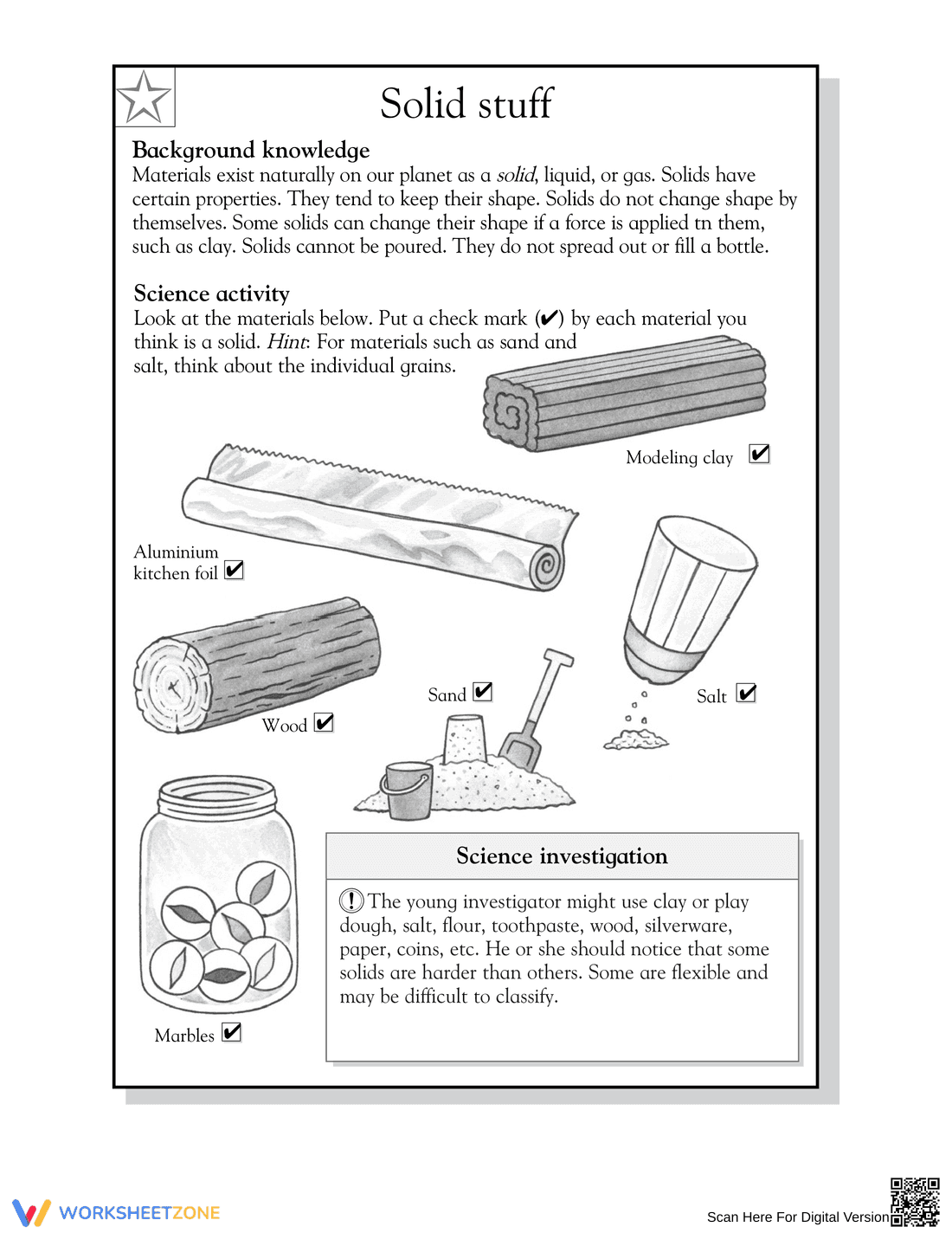
This comprehensive science worksheet helps Grade 3 and 4 students master the properties of solids through observation and investigation. Students will define what makes a material solid and classify common household items based on their physical characteristics. By engaging with both theory and practice, learners develop a deep understanding of states of matter and scientific inquiry.
At a Glance
- Grade: 3-4 · Subject: Science
- Standard:
2-PS1-1— Classify different kinds of materials by their observable properties- Skill Focus: Identifying properties of solid materials
- Format: 1 page · 7 tasks · Answer key included · PDF
- Best For: States of matter lesson supplement
- Time: 20–30 minutes
What's Inside
This single-page PDF includes a focused "Background Knowledge" section that clearly defines the properties of solids, such as shape retention and inability to be poured. The worksheet features a "Science Activity" with six visual identification tasks—ranging from wood to granulated materials like sand—and a guided "Science Investigation" prompt that encourages hands-on learning and data organization into a chart format.
Zero-Prep Workflow
- Print: Generate the single-page document in less than a minute.
- Distribute: Hand out the sheets for use as a bell-ringer or independent practice activity.
- Review: Discuss the classification answers as a group or assign the investigation for homework.
Total teacher preparation time is under two minutes, making this an ideal choice for substitute plans or last-minute lesson enhancements.
Standards Alignment
The primary alignment is 2-PS1-1: "Plan and conduct an investigation to describe and classify different kinds of materials by their observable properties." This worksheet directly supports this by providing the conceptual framework and a structured path for identifying and investigating materials. Both standard codes can be copied directly into lesson plans, IEP goals, or district curriculum mapping tools.
How to Use It
Use this worksheet during the direct instruction phase of a states of matter unit to reinforce the definition of solids. Alternatively, assign the investigation section as a formative assessment after students have learned the basics of liquids and gases. Teachers should observe if students correctly classify granulated solids like salt, which is a common point of confusion in early science education.
Who It's For
This resource is designed for elementary students in Grades 3 and 4, providing clear language for ESL/ELL learners and structured prompts for students requiring scaffolding. It pairs naturally with a hands-on lab involving different containers or an anchor chart displaying the molecular structure of various states of matter to provide a multi-modal learning experience.
Research from the ScienceDirect TpT Analysis (2024) indicates that science worksheets which combine informational text with hands-on investigation prompts significantly improve retention of abstract concepts like states of matter. By aligning with standard 2-PS1-1, this resource ensures that students are not merely memorizing definitions but are actively classifying materials by observable properties. This dual-approach methodology supports the development of critical thinking skills in early elementary learners, providing a robust foundation for more complex physical science topics in middle school. The inclusion of an investigation prompt bridges the gap between passive reading and active scientific inquiry, a key component of modern pedagogical standards. Educators can confidently integrate this worksheet into their curriculum knowing it meets rigorous academic requirements while remaining accessible to diverse student populations.


