


























Views
Downloads
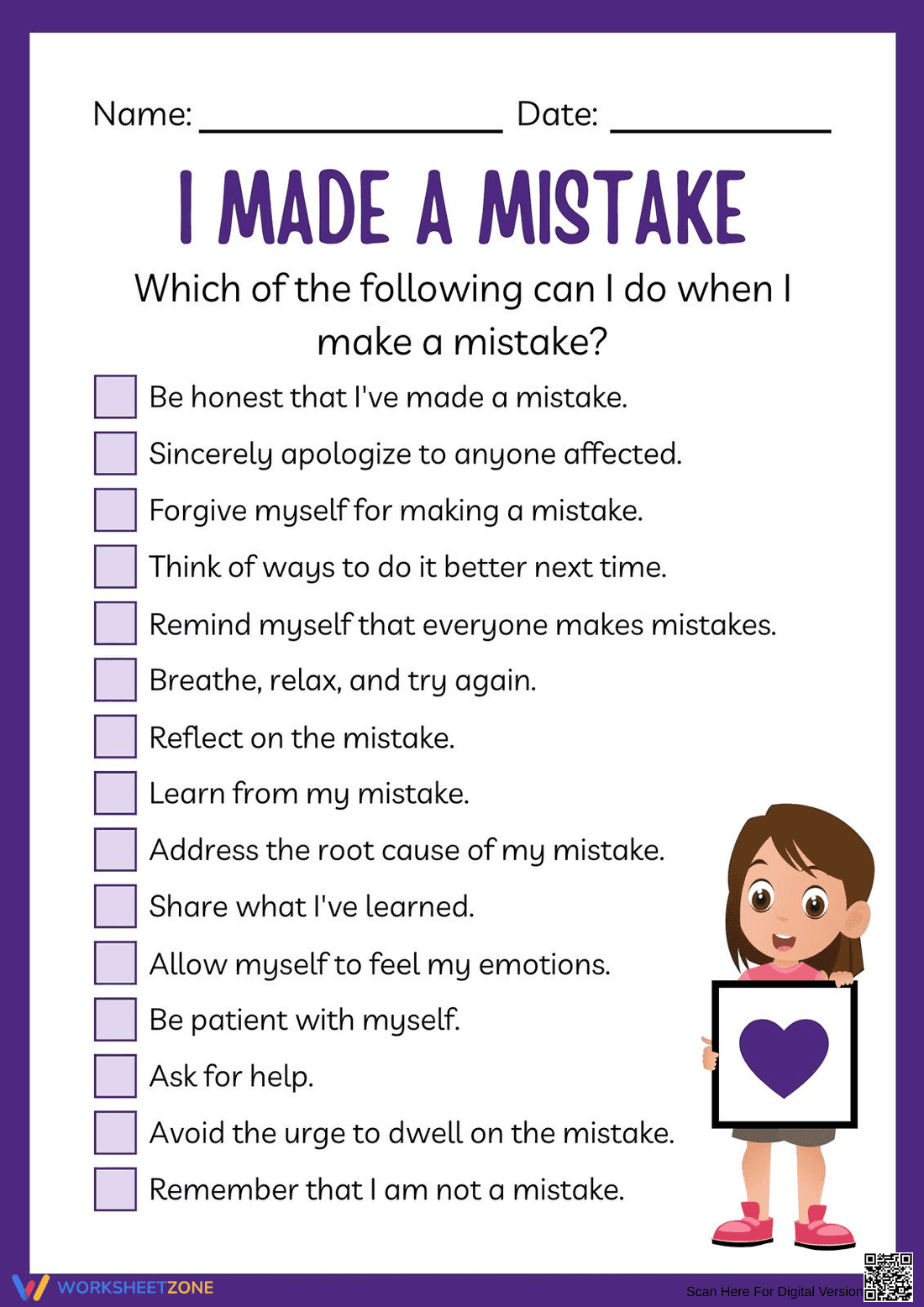

Dealing with Mistakes SEL Worksheet | Printable Grade 3
Paste this activity's link or code into your existing LMS (Google Classroom, Canvas, Teams, Schoology, Moodle, etc.).
Students can open and work on the activity right away, with no student login required.
You'll still be able to track student progress and results from your teacher account.
This Grade 3 Social Emotional Learning worksheet helps students develop healthy coping strategies for dealing with mistakes. By reviewing a checklist of positive actions, children learn to manage their emotions, take responsibility, and practice self-compassion. This resource builds essential self-management skills for a supportive classroom environment.
At a Glance
- Grade: 3 · Subject: SEL
- Standard:
CASEL.SM— Regulate emotions and behaviors in different situations- Skill Focus: Coping with mistakes
- Format: 1 page · 15 checklist items · No answer key needed · PDF
- Best For: Morning work or counseling
- Time: 10–15 minutes
This single-page printable features a clear checklist of 15 constructive actions students can take after making an error. Options range from interpersonal steps, like apologizing, to internal emotional regulation techniques, such as taking a deep breath. The straightforward layout includes checkboxes for students to identify strategies they use, accompanied by a friendly illustration to keep young learners engaged.
Zero-Prep Workflow
This resource is designed for immediate classroom implementation with minimal teacher setup.
- Print (1 minute): Simply download the PDF and print a class set.
- Distribute (1 minute): Hand out the checklist during morning meeting, after a challenging activity, or as part of a dedicated SEL block.
- Review (3 minutes): Read through the options together as a class, allowing students to check off their preferred coping mechanisms.
With under two minutes of total teacher prep time, this worksheet is an excellent addition to emergency sub plans or a school counselor's toolkit.
Standards Alignment
This worksheet aligns with CASEL.SM (Self-Management), focusing on the ability to regulate one's emotions, thoughts, and behaviors effectively in different situations. A supporting focus on Self-Awareness helps students recognize how their emotions influence their behavior. Both standard codes can be copied directly into lesson plans, IEP goals, or district curriculum mapping tools.
How to Use It
Introduce this checklist before beginning a difficult academic task to proactively set a growth mindset. Alternatively, use it during a restorative conversation after a student experiences frustration over an error. As a formative assessment observation tip, watch which items students select; children who only check external actions (like apologizing) may need additional support developing internal self-compassion strategies. The entire activity takes just 10 to 15 minutes to complete.
Who It's For
This worksheet is primarily designed for Grade 3 students, though its universal themes make it appropriate for any elementary classroom focusing on character education. For differentiation, teachers can read the checklist aloud for emerging readers or have advanced students write a short reflection on a time they used one of the strategies. It pairs perfectly with an anchor chart about the "Power of Yet" or a direct instruction lesson on growth mindset.
Developing robust self-management skills, particularly the ability to handle setbacks constructively, is a critical component of early childhood education. This resource supports CASEL.SM by providing concrete strategies to regulate emotions and behaviors in different situations. According to a comprehensive EdReports 2024 analysis of social-emotional learning materials, explicit instruction in coping mechanisms significantly reduces classroom disruptions and increases academic perseverance. When students are equipped with a tangible list of positive actions, they transition from reactive frustration to proactive problem-solving. This checklist serves as a vital scaffold, transforming abstract emotional concepts into actionable steps that young learners can easily understand and apply. By normalizing mistakes as a natural part of the learning process, educators foster a resilient classroom culture where students feel safe taking academic risks and growing from their experiences.


