




























Views
Downloads
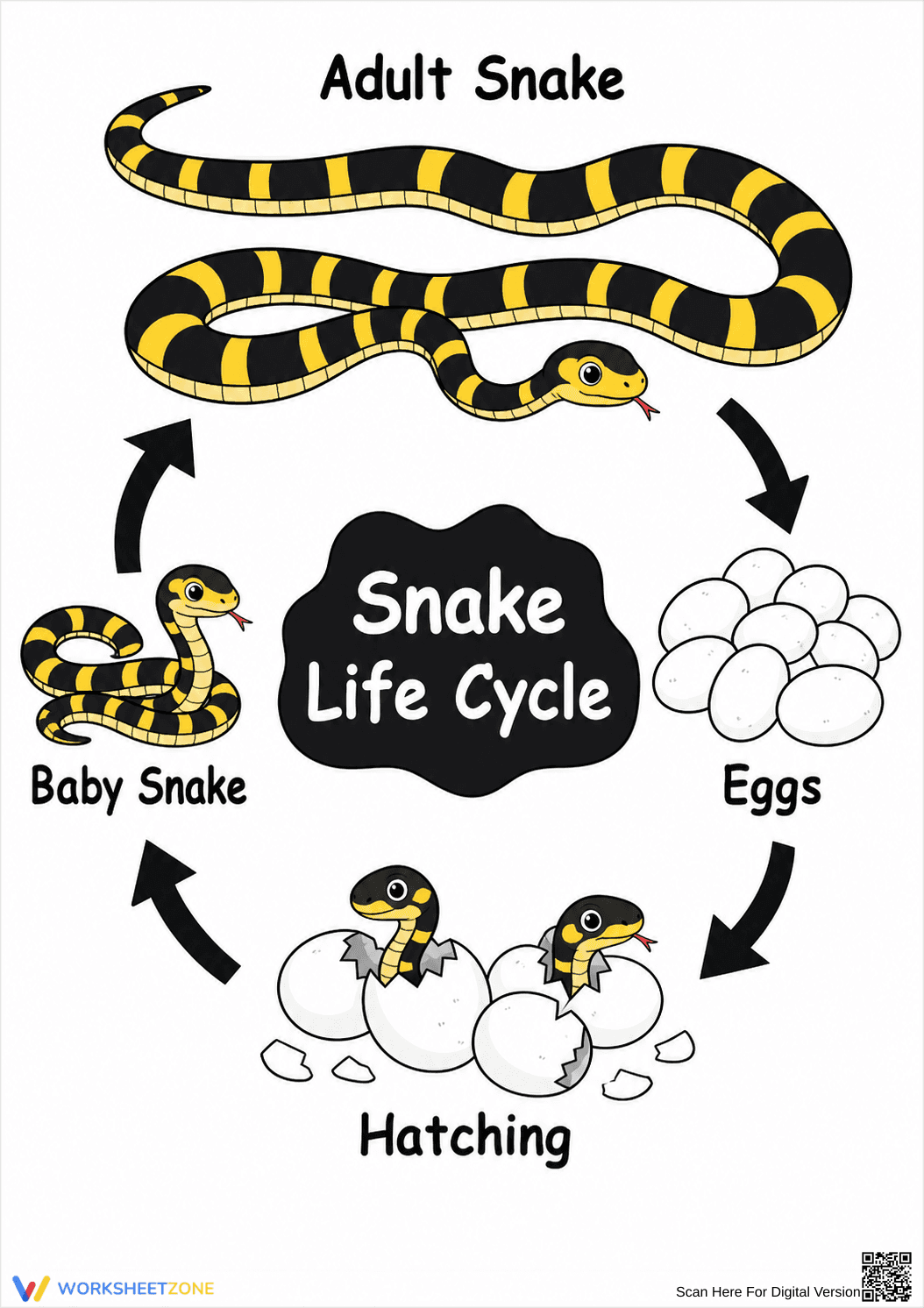

Grade 3 Snake Life Cycle — Printable No-Prep Worksheet

Paste this activity's link or code into your existing LMS (Google Classroom, Canvas, Teams, Schoology, Moodle, etc.).
Students can open and work on the activity right away, with no student login required.
You'll still be able to track student progress and results from your teacher account.
This printable snake life cycle diagram helps students visualize the biological progression of reptiles. By examining the four distinct stages—from eggs to adulthood—young learners build foundational science skills and understand how organisms grow, reproduce, and change over time.
At a Glance
- Grade: 3 · Subject: Science
- Standard:
3-LS1-1— Describe that organisms have unique and diverse life cycles- Skill Focus: Sequencing animal life cycles
- Format: 1 page · 4 stages · No answer key needed · PDF
- Best For: Visual reference and science centers
- Time: 10–15 minutes
This single-page visual resource features a clear, circular diagram illustrating the four main phases of a snake's life: Adult Snake, Eggs, Hatching, and Baby Snake. Bold directional arrows guide students through the continuous biological loop, while vibrant, kid-friendly illustrations provide clear visual context for each vocabulary word. It serves perfectly as an anchor chart or a reference handout.
This resource is designed for a smooth, zero-prep classroom experience. Follow these simple steps:
- Print (1 minute): Generate high-quality color or grayscale copies directly from the PDF.
- Distribute (1 minute): Hand out to students as a reference guide or paste into interactive science notebooks.
- Review (3 minutes): Walk through the cycle together, pointing out how the arrows connect the hatching phase back to the adult phase.
With under two minutes of total teacher prep time, this diagram is an excellent addition to any emergency sub plan or spontaneous science mini-lesson.
Aligned to primary standard 3-LS1-1: Develop models to describe that organisms have unique and diverse life cycles but all have in common birth, growth, reproduction, and death. This visual model directly supports students in recognizing these commonalities within a specific reptile species. Both standard codes can be copied directly into lesson plans, IEP goals, or district curriculum mapping tools.
Introduce this diagram before direct instruction on reptile characteristics to activate prior knowledge and spark curiosity. Alternatively, use it during a science center rotation where students are tasked with comparing the snake's life cycle to that of a frog or butterfly. As a formative assessment observation tip, ask students to cover the labels and verbally explain what is happening at each stage to check for understanding. Expected completion and review time ranges from 10 to 15 minutes.
This resource is primarily designed for third-grade science students, though its highly visual nature makes it accessible for younger learners or English Language Learners needing vocabulary support. For differentiation, advanced students can be challenged to research and add a juvenile stage to the cycle. It pairs naturally with a direct instruction lesson on animal classification or a nonfiction reading passage about reptiles.
Understanding biological sequencing through visual models like the snake life cycle is a critical component of early elementary science education. According to the EdReports 2024 instructional materials review, providing students with clear, sequential diagrams significantly improves their ability to grasp complex biological processes and domain-specific vocabulary. By aligning with standard 3-LS1-1 to describe that organisms have unique and diverse life cycles, educators ensure that foundational life science concepts are firmly established in the classroom. Utilizing explicit visual aids reduces cognitive load, allowing young learners to focus entirely on the scientific relationships and transitions between life stages. When students can trace the physical development of an animal from birth to reproduction, they build a stronger schema for broader ecological concepts, preparing them for more advanced scientific inquiry and observation in later grades.


