


























Views
Downloads

Printable SN Consonant Blends Worksheet | Grade 1 Phonics
Paste this activity's link or code into your existing LMS (Google Classroom, Canvas, Teams, Schoology, Moodle, etc.).
Students can open and work on the activity right away, with no student login required.
You'll still be able to track student progress and results from your teacher account.
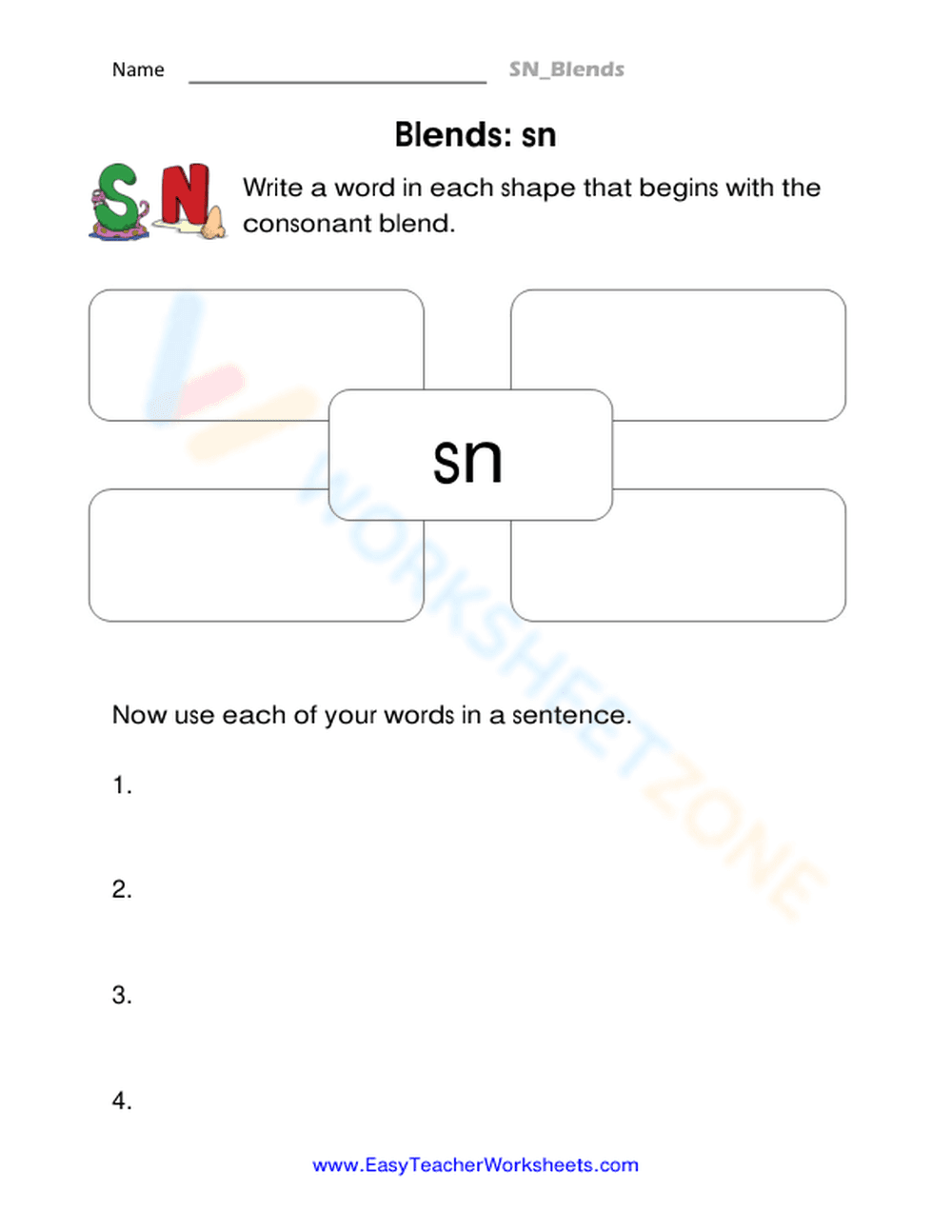
This Grade 1 phonics worksheet strengthens reading skills by focusing on "sn" consonant blends through word generation and sentence application. Students write four "sn" words before constructing original sentences for each. This dual-task approach ensures students not only recognize the blend but can apply it fluently in written composition.
At a Glance
- Grade: 1 · Subject: English Language Arts
- Standard:
CCSS.ELA-LITERACY.RF.1.3— Decode two-letter consonant blends in single-syllable words accurately- Skill Focus: SN Consonant Blends
- Format: 1 page · 8 tasks · Answer key included · PDF
- Best For: Independent phonics practice and morning work
- Time: 10–15 minutes
This single-page PDF features a central graphic organizer for brainstorming four words beginning with the "sn" blend. Following this, the worksheet provides four numbered lines for sentence construction. The layout includes a visual anchor of "S" and "N" characters to support phonemic awareness. A comprehensive answer key is provided to facilitate quick teacher review or student self-checking of generated vocabulary.
Zero-Prep Workflow
This resource is optimized for efficiency with a three-step workflow. Printing takes under 30 seconds for a class set. Distribution and instructions require 60 seconds to model the first "sn" word. Finally, reviewing completed sentences during a walk-around takes under two minutes. Total teacher prep time is under two minutes, making this an ideal choice for emergency sub plans, transition periods, or as a quick morning work activity.
Standards Alignment
Primary alignment is to CCSS.ELA-LITERACY.RF.1.3, requiring students to apply grade-level phonics in decoding. By generating words and using them in context, the worksheet also supports CCSS.ELA-LITERACY.L.1.1.J, focusing on simple sentence production. Both standard codes can be copied directly into lesson plans, IEP goals, or district curriculum mapping tools to ensure compliance with state and national framework requirements.
How to Use It
Use this during the independent practice phase of a phonics lesson after introducing the "sn" blend via direct instruction. Observe students during brainstorming to identify those needing phoneme-grapheme mapping support. For formative assessment, listen as students read their sentences aloud to check pronunciation and fluency. The expected completion time is 10 to 15 minutes. It serves as a perfect transition task between whole-group instruction and literacy centers.
Who It's For
This resource is tailored for first-grade students mastering blends, though it works as an intervention for second graders. It provides necessary scaffolding for English Language Learners by isolating specific phonemes. Pair this with a reading passage about winter or animals to provide thematic connections. It is suitable for general education classrooms, resource rooms, or homeschooling environments focusing on foundational ELA skills.
According to EdReports 2024, systematic instruction of consonant blends is critical for high-quality early literacy. This worksheet utilizes a research-based approach by moving from isolated word identification to contextual application. By engaging both phonological and orthographic processors, students build robust neural connections for the "sn" blend, a concept supported by the RAND AIRS 2024 report on foundational reading. The integration of writing and phonics practice aligns with NAEP recommendations for balanced literacy, ensuring students apply sounds to express ideas. This 1-page resource provides the repetition and cognitive demand required for long-term retention of "sn" structures. As students progress through the eight tasks, they move from simple recall to higher-order application, facilitating mastery of the CCSS.ELA-LITERACY.RF.1.3 standard. This targeted practice is essential for developing decoding automaticity and fluency in beginning readers.


