


























Views
Downloads
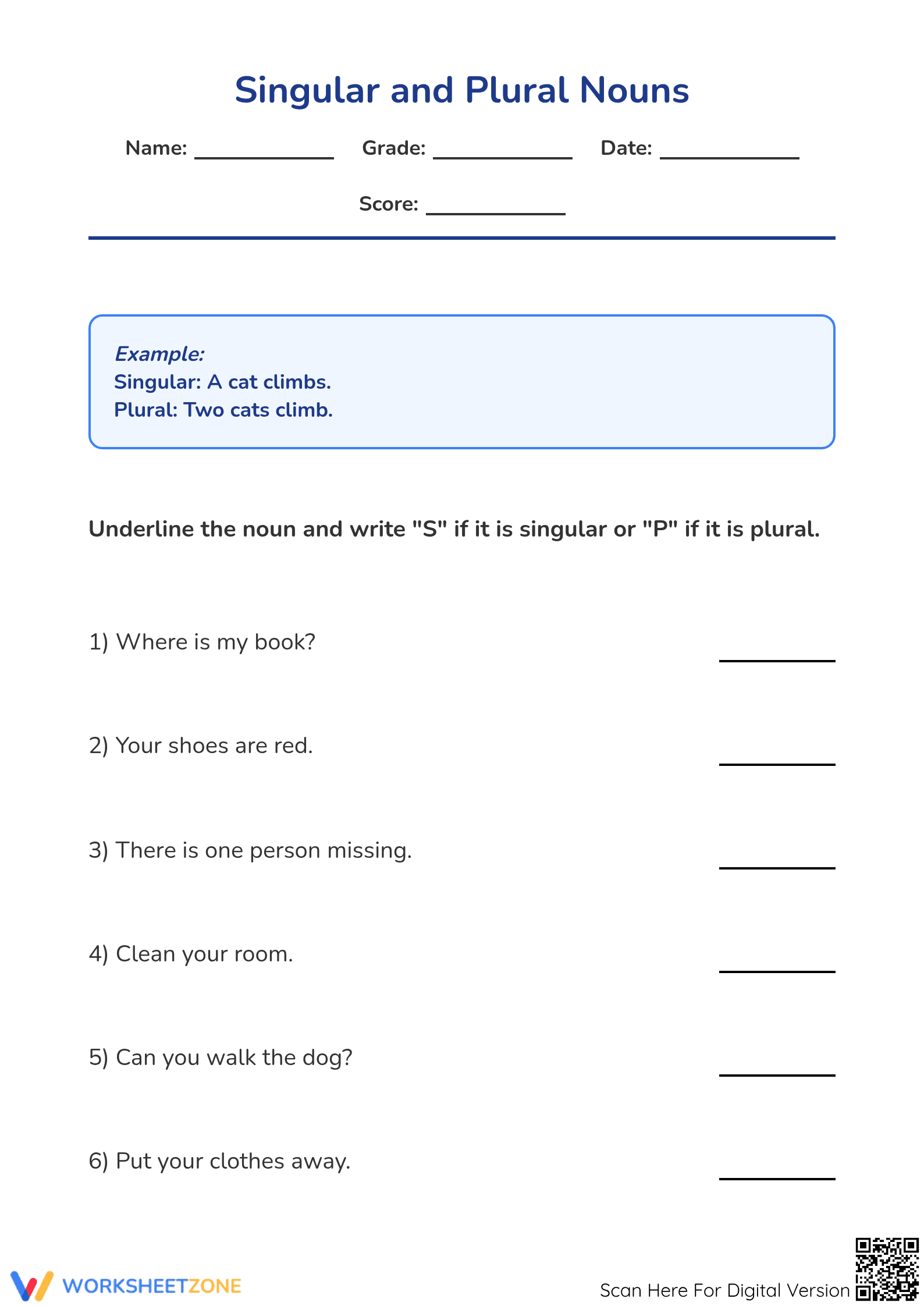


Grade 1 Singular and Plural Nouns — Printable Worksheet
Paste this activity's link or code into your existing LMS (Google Classroom, Canvas, Teams, Schoology, Moodle, etc.).
Students can open and work on the activity right away, with no student login required.
You'll still be able to track student progress and results from your teacher account.
This Grade 1 singular and plural nouns worksheet helps students distinguish between one and more than one in a sentence context. By identifying nouns and labeling them as singular or plural, learners build the foundational grammar skills necessary for subject-verb agreement. This resource provides immediate practice with common nouns in clear, accessible sentences.
At a Glance
- Grade: 1 · Subject: ELA
- Standard:
CCSS.ELA-LITERACY.L.1.1.C— Use singular and plural nouns with matching verbs in basic sentences- Skill Focus: Noun Number Identification
- Format: 2 pages · 10 problems · Answer key included · PDF
- Best For: Independent practice or quick formative assessment
- Time: 10–15 minutes
What's Inside: This two-page PDF features 10 targeted practice items. The worksheet begins with a clear example box that demonstrates the transformation from singular to plural (e.g., "cat" to "cats"). Students are tasked with two actions per item: underlining the noun within a complete sentence and writing "S" or "P" in the provided margin. A comprehensive answer key is included for rapid grading.
Zero-Prep Workflow: This resource is designed for maximum efficiency. First, print the two-page PDF (30 seconds). Second, distribute the sheets to students as a bell ringer or independent center activity (1 minute). Third, use the included answer key to review responses as a whole group or for individual grading. The total teacher preparation time is under two minutes, making it an ideal choice for sub plans.
Standards Alignment: The primary focus is `CCSS.ELA-LITERACY.L.1.1.C`, which requires students to use singular and plural nouns with matching verbs. By identifying the noun's number first, students prepare for the more complex task of ensuring subject-verb agreement in their own writing. This worksheet also supports Grade 2 and 3 review. Both standard codes can be copied directly into lesson plans or IEP goals.
How to Use It: Use this worksheet during the independent practice phase of a grammar lesson. After introducing the concept of adding "-s" to nouns, assign this to verify student understanding. It also serves as an excellent formative assessment tool; a quick scan of the "S" and "P" column allows teachers to identify students who struggle with irregular plurals like "children" or "shoes."
Who It's For: This resource is tailored for first and second-grade students mastering basic grammar. It is also effective for English Language Learners (ELLs) learning the morphological markers of English nouns. The simple sentence structures ensure the cognitive load remains focused on the grammar skill. Pair this with a visual anchor chart showing singular and plural picture pairs.
Research by Fisher & Frey (2014) emphasizes the importance of scaffolded practice in the gradual release of responsibility model. This worksheet provides that essential independent application step where students must demonstrate mastery of `CCSS.ELA-LITERACY.L.1.1.C` without direct teacher prompting. By isolating the skill of identifying noun number within a sentence, the resource helps solidify the concept of plurality before students are asked to produce complex original text. According to the NAEP frameworks, early mastery of parts of speech and their properties is a significant predictor of later reading comprehension and writing fluency. This 10-item assessment provides the high-frequency exposure required for students to internalize the difference between singular and plural forms, ensuring they can accurately apply these rules in diverse linguistic contexts.


