


























Views
Plays


Sentence Structure Worksheet | Grade 5 Essential Practice
Paste this activity's link or code into your existing LMS (Google Classroom, Canvas, Teams, Schoology, Moodle, etc.).
Students can open and work on the activity right away, with no student login required.
You'll still be able to track student progress and results from your teacher account.
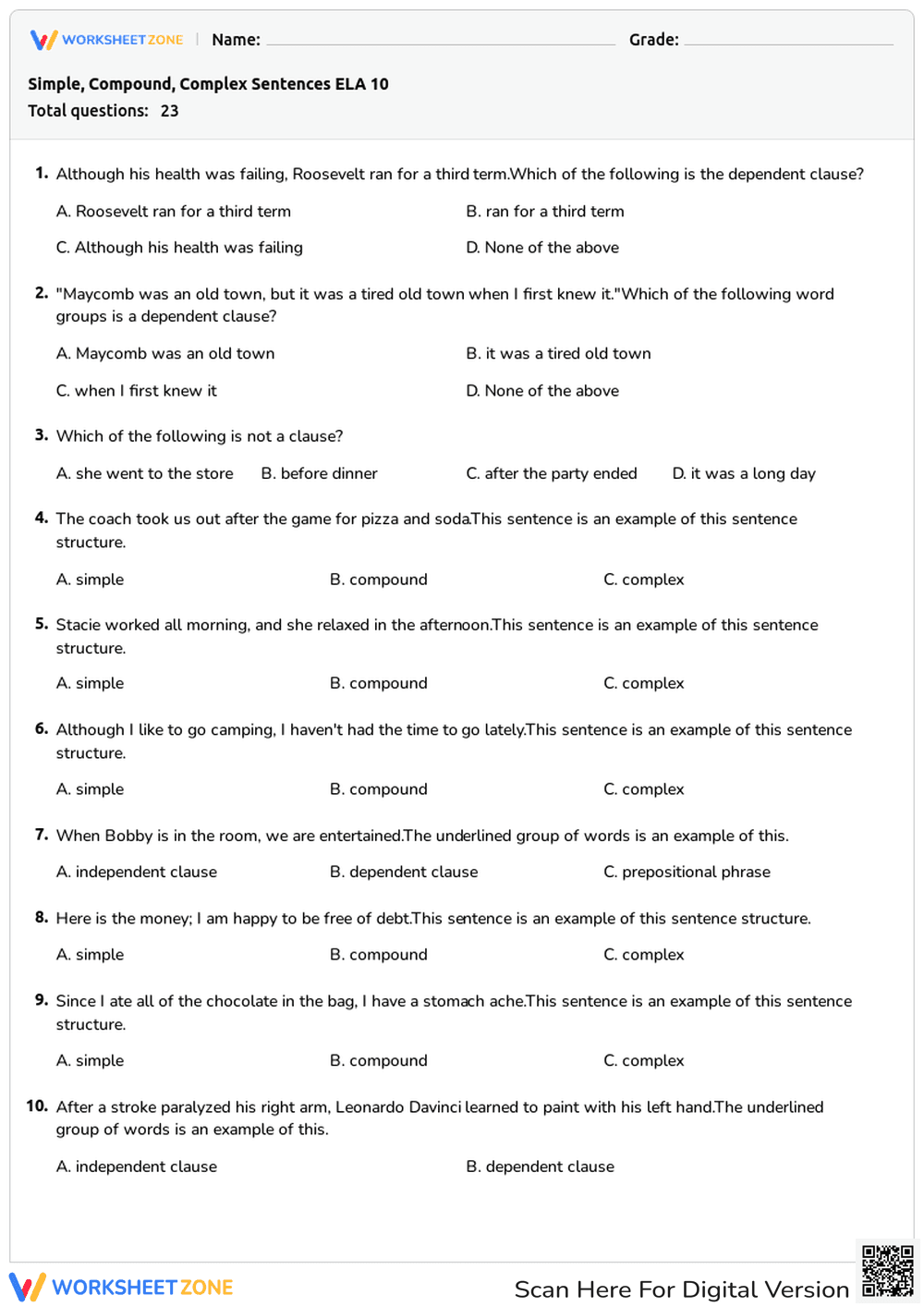
This Grade 5 ELA worksheet provides comprehensive practice in identifying and constructing simple, compound, and complex sentences. Students analyze 23 specific examples to distinguish between independent and dependent clauses while mastering the mechanics of sentence variety. By the end of the activity, learners will demonstrate a firm grasp of how different clauses combine to form sophisticated prose.
At a Glance
- Grade: 5 · Subject: ELA Grammar
- Standard:
CCSS.ELA-LITERACY.L.4.1.F— Produce complete sentences, recognizing and correcting inappropriate fragments and run-ons.- Skill Focus: Sentence Structure Identification
- Format: 2 pages · 23 problems · Answer key included · PDF
- Best For: Formative assessment and grammar review
- Time: 20–30 minutes
What's Inside
This two-page PDF contains 23 multiple-choice questions designed to test both conceptual knowledge and practical application. The first half of the worksheet focuses on identifying specific clauses within sentences—such as dependent and independent units—using historical and literary context clues. The second half transitions into definitional mastery, asking students to quantify the number of clauses required for each sentence type. A full answer key is provided for rapid grading.
Skill Progression
- Guided Identification: The first 10 tasks provide complete sentences where students must isolate specific clauses or identify the overall structure, building confidence through recognition.
- Supported Analysis: Questions 11 through 15 require students to differentiate between phrases and clauses, ensuring they understand the grammatical components that define sentence complexity.
- Independent Mastery: The final 8 questions require students to recall the rules of sentence construction without the aid of example sentences, proving they understand the underlying logic of ELA standards.
This gradual-release approach ensures students move from simple recognition to deep conceptual understanding of syntax through the I Do, We Do, You Do model.
Standards Alignment
The primary focus of this resource is `CCSS.ELA-LITERACY.L.4.1.F`, which requires students to produce complete sentences while recognizing and correcting fragments or run-ons. Additionally, it supports `CCSS.ELA-LITERACY.L.5.1`, emphasizing the command of standard English grammar. Both standard codes can be copied directly into lesson plans, IEP goals, or district curriculum mapping tools.
How to Use It
Use this worksheet as a mid-unit formative assessment after teaching the definitions of coordinating and subordinating conjunctions. During the activity, circulate the room and observe if students are confusing prepositional phrases with dependent clauses—a common hurdle in question 3. This worksheet typically takes 25 minutes to complete and serves as an excellent data point for small-group intervention.
Who It's For
This resource is ideal for general education students in grades 4 through 6, as well as English Language Learners (ELL) who need explicit practice with English syntax. It pairs naturally with an anchor chart on "FANBOYS" and "SWABI" conjunctions to provide visual support during the independent practice phase of a lesson.
According to the RAND AIRS 2024 report on literacy instruction, explicit grammar practice in sentence combining and clause identification significantly improves student writing quality and reading comprehension. This worksheet targets CCSS.ELA-LITERACY.L.4.1.F by requiring students to distinguish between independent and dependent clauses across 23 distinct tasks. By mastering the structural differences between simple, compound, and complex sentences, students develop the syntactic fluency necessary for middle school writing. Research from Fisher & Frey (2014) suggests that identifying these structures in context—as seen in the historical examples provided here—helps bridge the gap between isolated grammar rules and functional application. This resource provides the structured repetition needed to move these skills into long-term memory, ensuring students can produce varied and sophisticated sentence structures in their own original compositions.


