




























Similar vs. Congruent: Guided Skill Practice
Paste this activity's link or code into your existing LMS (Google Classroom, Canvas, Teams, Schoology, Moodle, etc.).
Students can open and work on the activity right away, with no student login required.
You'll still be able to track student progress and results from your teacher account.
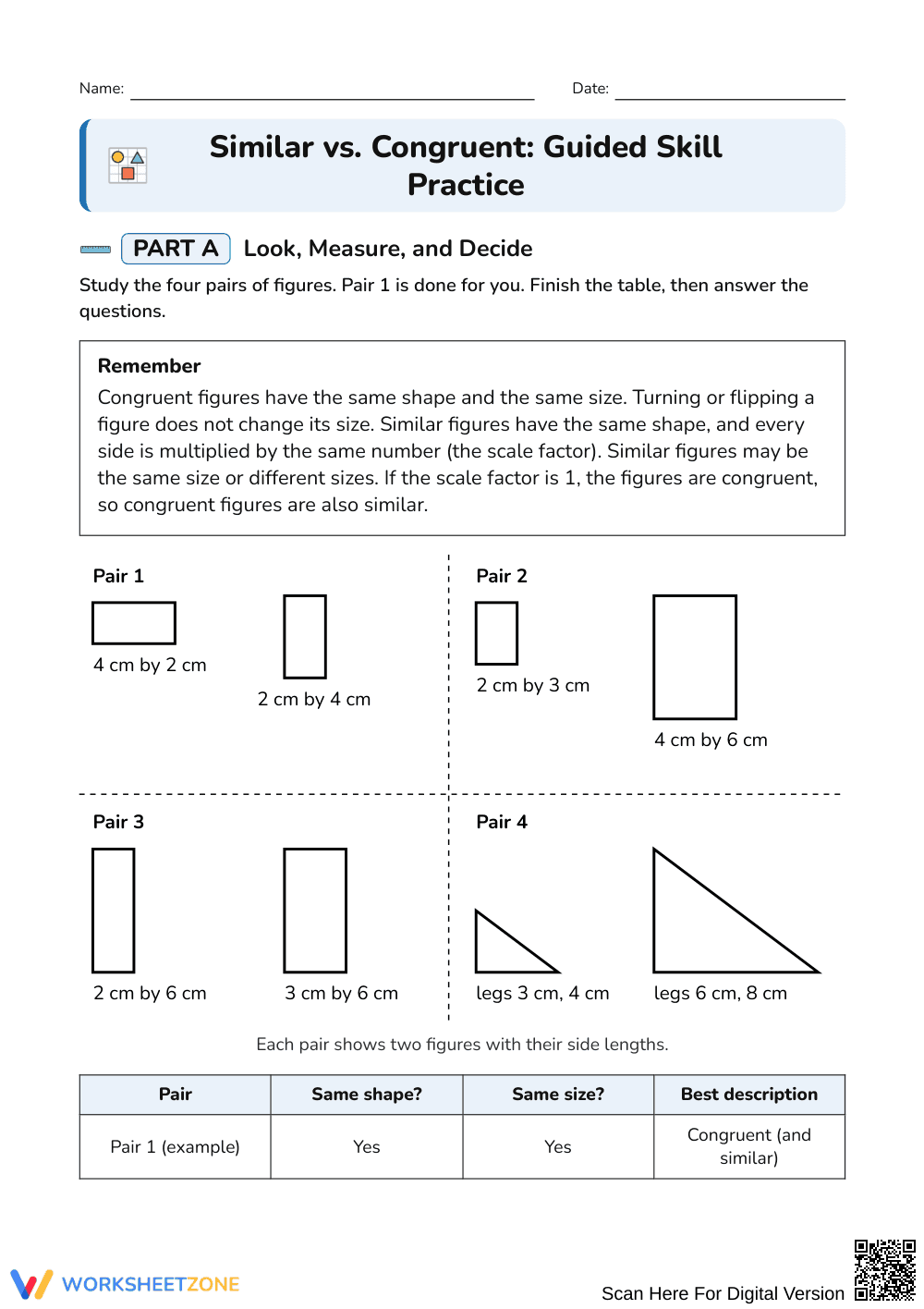
This Grade 8 math worksheet helps students master the distinction between similar and congruent geometric figures across 21 structured tasks. Learners analyze side length ratios, evaluate rigid motions on coordinate grids, and write geometric justifications. By connecting scale factors to transformations, students build a solid foundation for geometric proof.
At a Glance
- Grade: 8 · Subject: Mathematics
- Standard: Differentiate similar and congruent figures using scale factors and rigid transformation properties
- Skill Focus: Similar vs. Congruent Geometric Figures
- Format: 3 printable pages · 21 structured problems · Full teacher answer key included · PDF document
- Best For: Core skill instruction, partner practice, and targeted formative assessment checks
- Time: 40–50 minutes
What's Inside
Across 3 printable pages, this resource features a reference box, comparative measurement tables, coordinate grid transformation tasks, and open-ended written explanations. A complete 3-page teacher answer key provides calculations, scale factors, and sample student explanations for every question, ensuring efficient grading and immediate feedback.
Skill Progression
- Guided Practice (Part A): Students examine 4 figure pairs using an explicit reference summary and a completed model to verify side length ratios.
- Supported Practice (Part B): Learners analyze coordinate grid tasks involving translations, reflections, and dilations of Triangle A to identify congruence.
- Independent Practice (Part C): Students solve unassisted word problems requiring written geometric justifications about dimensions and similarity.
This sequence follows a gradual-release model, moving students from guided observation to independent mathematical reasoning.
Standards Alignment
This resource focuses on Grade 8 geometry standards addressing similarity and congruence through transformations and proportional relationships. Students demonstrate that figures are congruent through rigid motions and similar through dilations. Supporting standards reinforce applying proportional reasoning to side lengths. Both standard codes can be copied directly into lesson plans, IEP goals, or district curriculum mapping tools.
How to Use It
Use this worksheet during guided practice immediately following instruction on similarity and scale factors. Alternatively, assign it after teaching transformations as an active partner review station. During work time, check Part B to confirm students distinguish reflections from non-uniform scaling. Most Grade 8 classes complete all 21 problems in 40 to 50 minutes.
Who It's For
This worksheet serves Grade 8 mathematics students learning transformation geometry, as well as high school students needing foundational review. Struggling learners rely on the reference table in Part A, while advanced learners tackle reasoning in Part C. Pair this set with an anchor chart on rigid motions to maximize retention.
Developing a precise conceptual understanding of similar versus congruent figures is critical for Grade 8 geometric reasoning and high school readiness. According to Fisher & Frey (2014), structured gradual-release frameworks significantly increase student problem-solving accuracy by sequencing explicit models, guided grid analysis, and independent written justification. When students actively compare side length scale factors and evaluate rigid motions such as reflections and translations, they build durable cognitive schemas that distinguish shape preservation from size transformation. This 3-page instructional resource incorporates 21 targeted exercises that move learners from scaffolded ratio tables to independent geometric proofs. By requiring students to articulate mathematical justifications in complete sentences, the activities reinforce vocabulary precision and conceptual clarity. Implementing research-backed guided practice protocols ensures that diverse learners effectively bridge concrete visual representations and abstract proportional reasoning across middle school mathematics curricula.


