



























Similar vs. Congruent: Complete Representations
Paste this activity's link or code into your existing LMS (Google Classroom, Canvas, Teams, Schoology, Moodle, etc.).
Students can open and work on the activity right away, with no student login required.
You'll still be able to track student progress and results from your teacher account.
This Grade 8 geometry worksheet helps students master the distinction between similar and congruent figures across multiple mathematical representations. Working through structured comparisons, learners analyze visual diagrams, evaluate data tables, and plot coordinate grids to determine whether geometric figures maintain identical side lengths or share proportional relationships.
At a Glance
- Grade: 8 · Subject: Math
- Standard: Geometric Similarity and Congruence — Translate relationships among symbols, tables, and coordinate graphs
- Skill Focus: Comparing similar and congruent figures across representations
- Format: 2 pages · 18 problems · Answer key included · PDF
- Best For: Targeted skill practice and concept reinforcement
- Time: 30–45 minutes
What's Inside
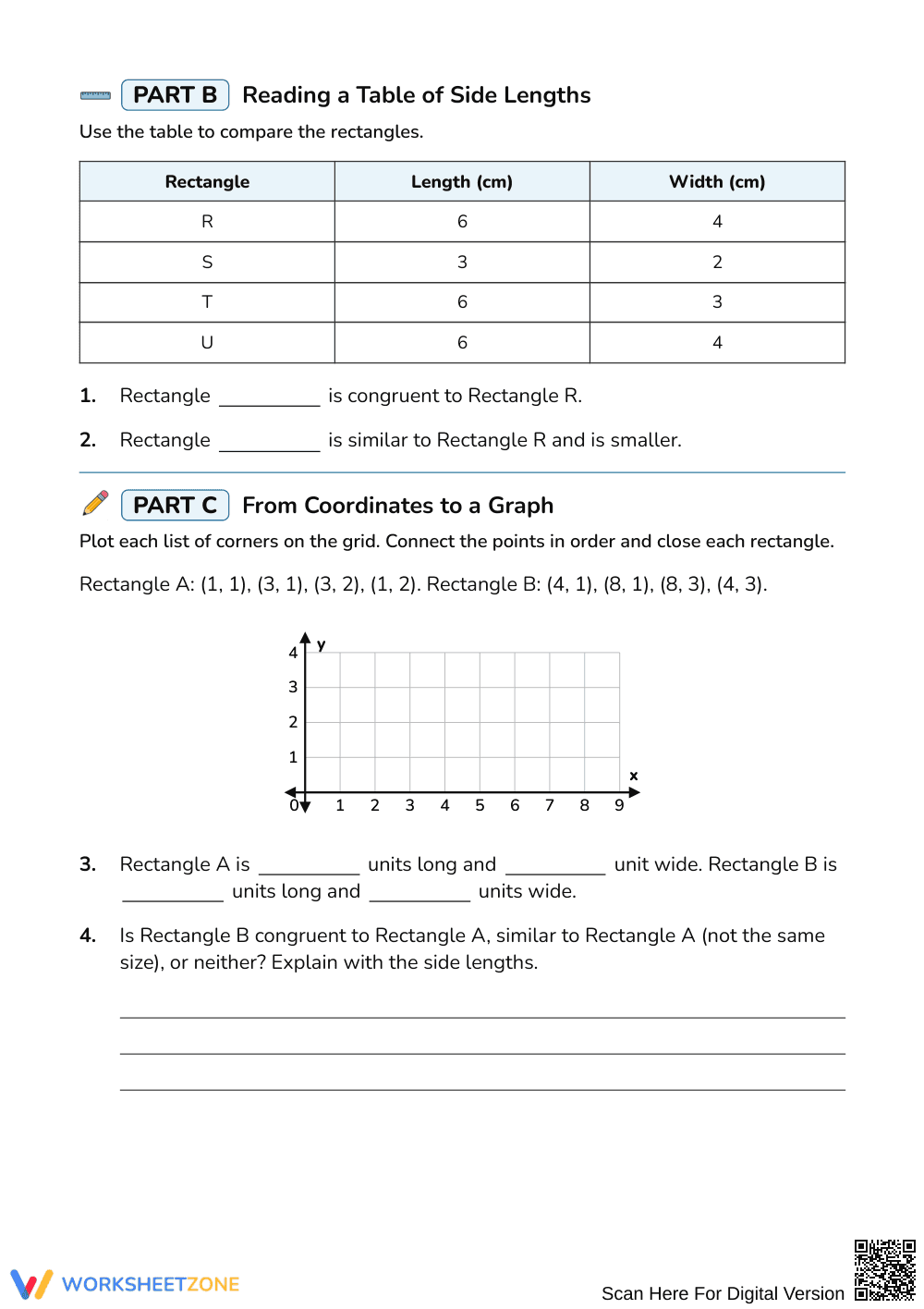
This 2-page printable activity contains 18 structured tasks organized across three core sections. Part A introduces precise definitions, notation symbols, and visual pairs with centimeter side lengths. Part B features a data table of rectangle dimensions that requires analytical comparison of side length ratios. Part C challenges students to plot coordinates on a grid and write explanatory justifications. A complete 2-page answer key provides full solutions and sample explanations.
Skill Progression
- Guided practice (Part A, 6 problems): Direct visual comparisons scaffolded with a reference box defining congruence, similarity, and symbolic notation.
- Supported practice (Part B, 6 problems): Tabular analysis where students evaluate dimensions numerically to identify equivalent ratios without visual figures.
- Independent practice (Part C, 6 problems): Unscaffolded coordinate plotting and written synthesis where learners graph rectangles and justify similarity using scale factors.
This sequence follows a gradual-release instructional model that transitions learners smoothly from supported observation to independent coordinate graphing and reasoning.
Standards Alignment
This resource targets Grade 8 standards requiring students to understand similarity and congruence through transformations and coordinate geometry, translating fluently between verbal descriptions, symbolic statements, data tables, and coordinate plots. Both standard codes can be copied directly into lesson plans, IEP goals, or district curriculum mapping tools.
How to Use It
Implement this worksheet immediately after direct instruction on similarity ratios to reinforce the distinction between equal and proportional side lengths. For formative assessment, observe students during Part B to verify whether they check both dimensions rather than matching a single side length. The entire activity requires approximately 30 to 45 minutes of instructional time.
Who It's For
This resource serves general education Grade 8 math students, introductory geometry learners, and small-group intervention pods requiring conceptual reinforcement. Pair this activity with a physical coordinate plane anchor chart or scale factor transformation lesson to solidify visual-spatial understanding.
Understanding the distinction between congruent and similar figures is a foundational prerequisite for high school transformation geometry and algebraic modeling. According to Fisher & Frey (2014), structured instructional progressions that guide students through multiple mathematical representations—including symbolic notation, structured tables, and coordinate graphs—significantly reduce cognitive load and enhance conceptual retention. This Grade 8 geometry worksheet applies that research-backed progression across 18 targeted tasks, ensuring learners do not merely memorize geometric definitions but actively translate relationships across visual diagrams, numeric data tables, and Cartesian grids. By requiring students to justify proportional relationships using exact scale factors, the resource strengthens rigorous spatial reasoning. The comprehensive structure and included solutions provide educators with a practical, research-aligned tool for evaluating student mastery in middle school mathematics curricula.


