




























Similar vs. Congruent: Complete Real-World Modeling
Paste this activity's link or code into your existing LMS (Google Classroom, Canvas, Teams, Schoology, Moodle, etc.).
Students can open and work on the activity right away, with no student login required.
You'll still be able to track student progress and results from your teacher account.
This Grade 8 math worksheet develops real-world modeling skills by guiding students to distinguish between similar and congruent figures across practical scenarios. Learners analyze photo print dimensions, quilt patch rectangles, and ceramic floor tiles to calculate scale factors, evaluate perimeters, and justify geometric relationships with numerical evidence.
At a Glance
- Grade: Grade 8 · Subject: Middle School Mathematics
- Standard: Identify and compare similar and congruent two-dimensional figures through scale factors and side lengths
- Skill Focus: Real-World Geometric Modeling and Ratio Reasoning
- Format: 3 student pages · 17 structured problems · Full answer key included · PDF printable
- Best For: Independent classroom practice and geometric modeling
- Time: 35–45 instructional minutes
What's Inside
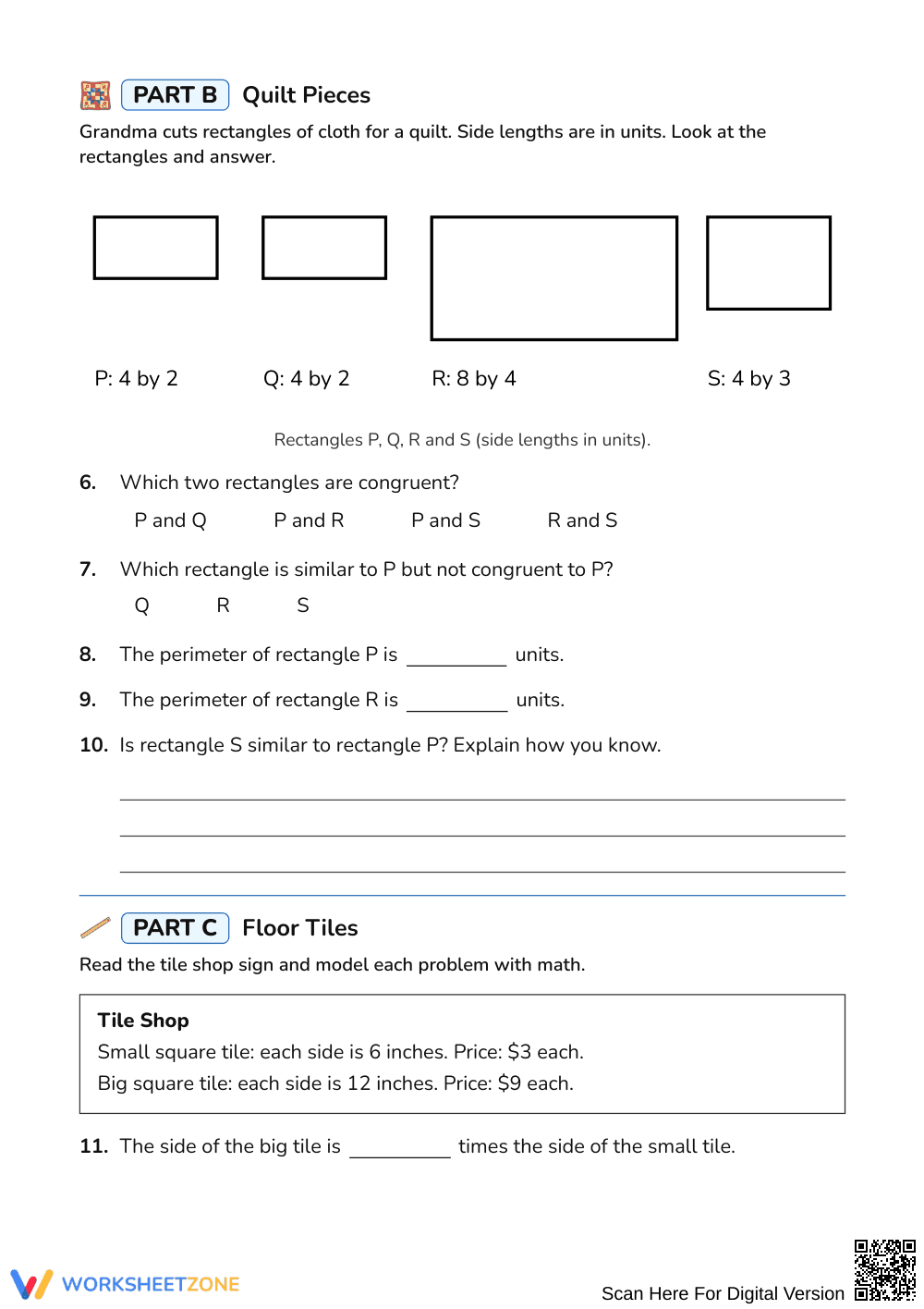
This 3-page printable resource features 17 problems across three real-world scenarios. Part A uses a photo sizing table to evaluate proportional enlargements and non-similar dimensions. Part B presents quilt rectangles for students to identify congruent pairs and calculate perimeters. Part C explores ceramic floor tile dimensions and pricing, prompting students to evaluate geometric claims. A complete 3-page answer key provides step-by-step solutions.
Skill Progression
- Guided practice (Part A, 5 tasks): Students examine photo tables, identifying scale factors and writing short explanations.
- Supported practice (Part B, 6 tasks): Learners inspect quilt rectangles, finding perimeters and congruent pairs.
- Independent practice (Part C, 6 tasks): Students analyze tile scenarios and critique geometric claims with mathematical evidence.
This sequence follows gradual-release principles, moving students from guided tables to independent proof.
Standards Alignment
This worksheet addresses middle school geometry standards requiring students to understand similarity and congruence through scale drawings, proportional side lengths, and angle preservation. A supporting standard involves analyzing proportional relationships to solve multi-step real-world problems. Both standard codes can be copied directly into lesson plans, IEP goals, or district curriculum mapping tools.
How to Use It
Implement this activity immediately after direct instruction on scale factor and geometric similarity. During independent seatwork, conduct a formative-assessment check by examining student reasoning on Part A's explanation question; watch for students who subtract dimensions rather than checking constant multiplicative ratios. Alternatively, assign Part C as a collaborative exit ticket where partners debate the tile worker's claim. Expected completion time is 35 to 45 minutes.
Who It's For
This resource serves Grade 8 mathematics students learning geometric modeling and proportionality. Provide ratio formula cards for developing learners, while challenging advanced students to calculate area ratios between tiles. Pair this worksheet directly with an anchor chart contrasting congruent figures and similar figures.
According to empirical research highlighted in Fisher & Frey (2014), structured geometric modeling tasks that progress from scaffolded data interpretation to independent argumentation significantly enhance middle school mathematical proficiency. This Grade 8 math worksheet emphasizes the core geometric skill of distinguishing similar and congruent two-dimensional figures through contextualized problem solving and multiplicative ratio comparison. By requiring students to calculate explicit scale factors, verify perimeter relationships, and defend geometric conclusions using numerical proof, the 17 tasks directly reinforce conceptual mastery rather than rote formula memorization. Classroom implementations demonstrate that contextual modeling anchors abstract transformation concepts into tangible scenarios such as photo enlargement and tile layout. Furthermore, requiring written justification ensures learners confront common misconceptions regarding proportionality and congruence, establishing the rigorous reasoning necessary for high school coordinate geometry and formal proof construction across diverse classroom learning environments.


