


























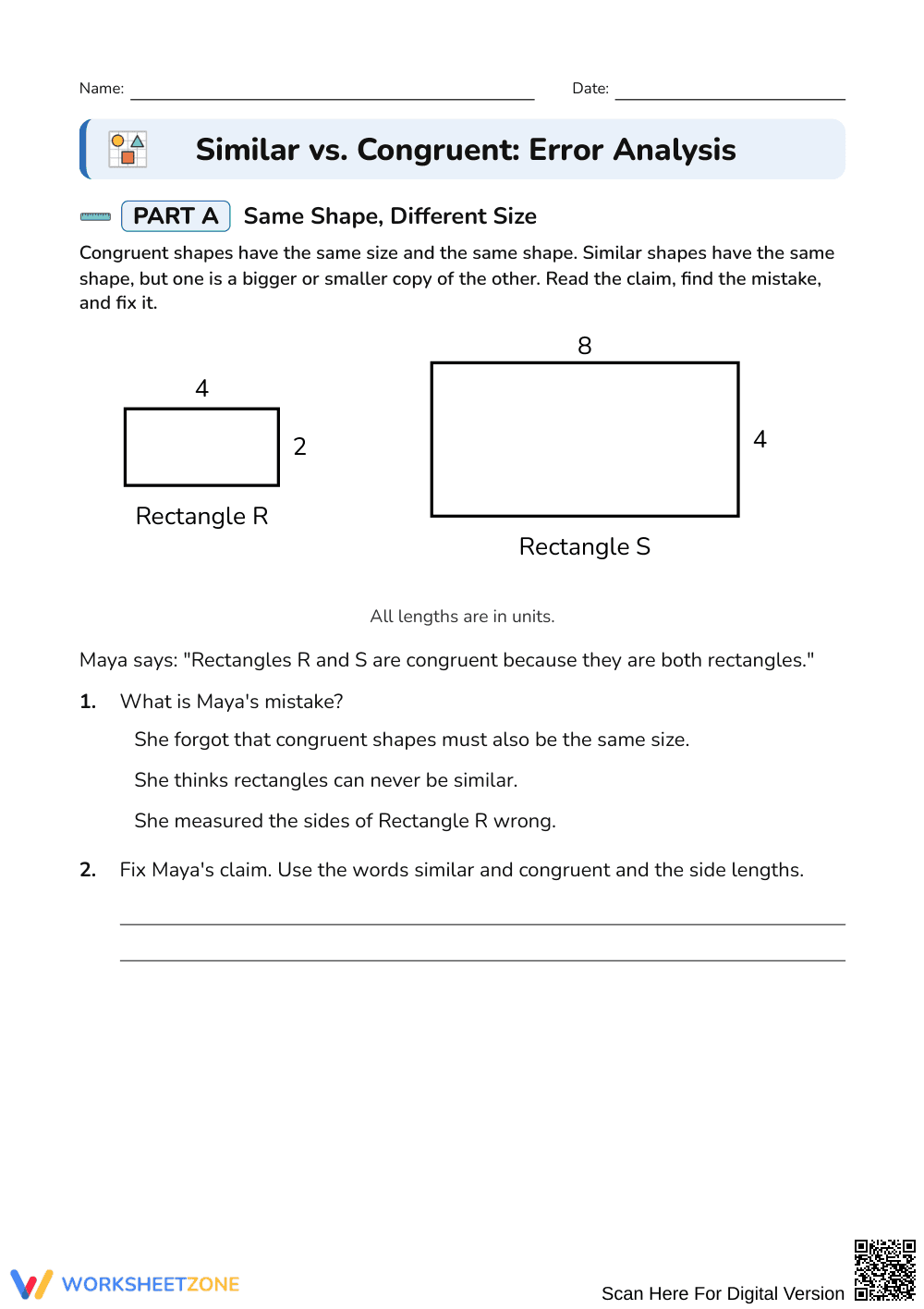
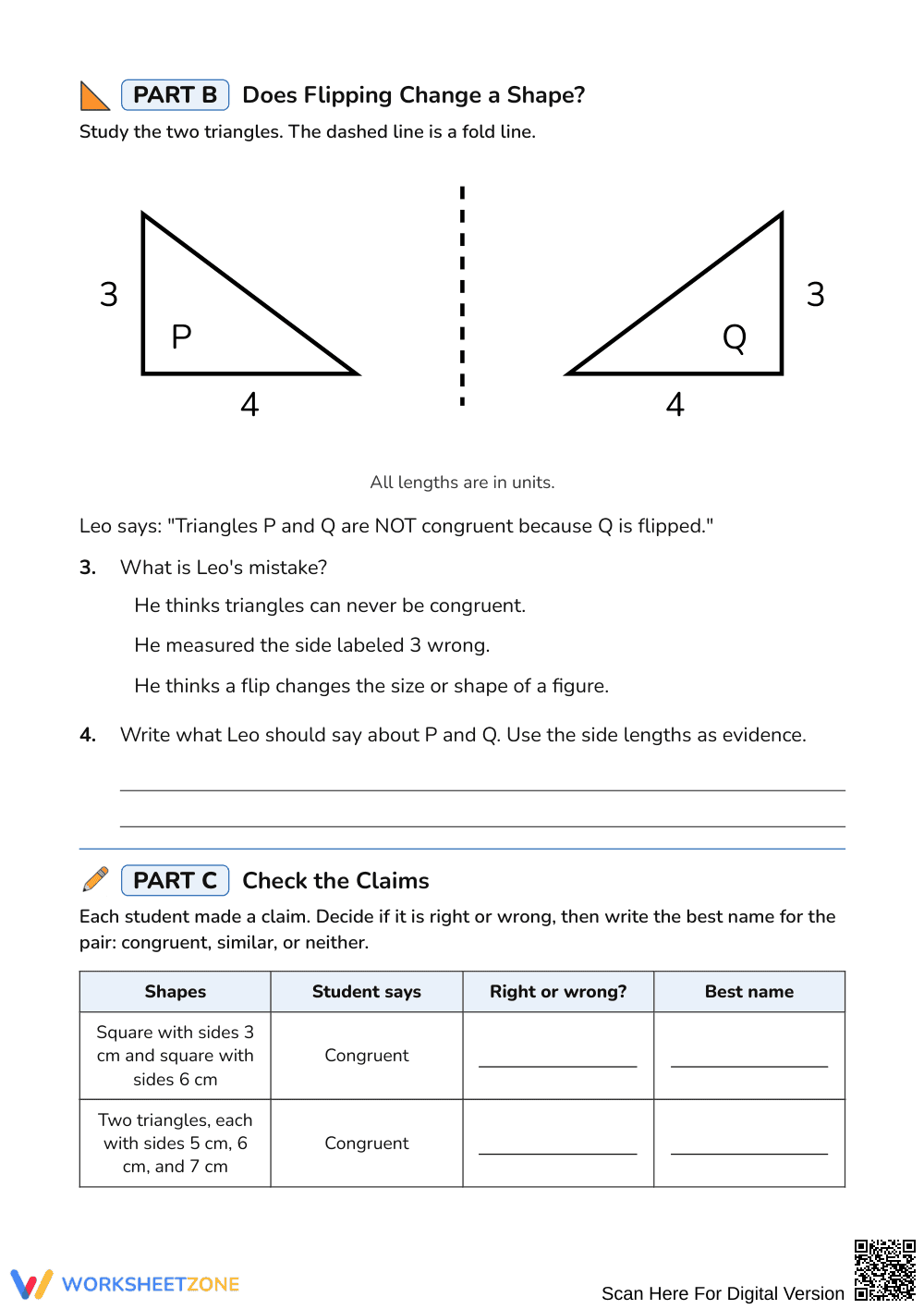
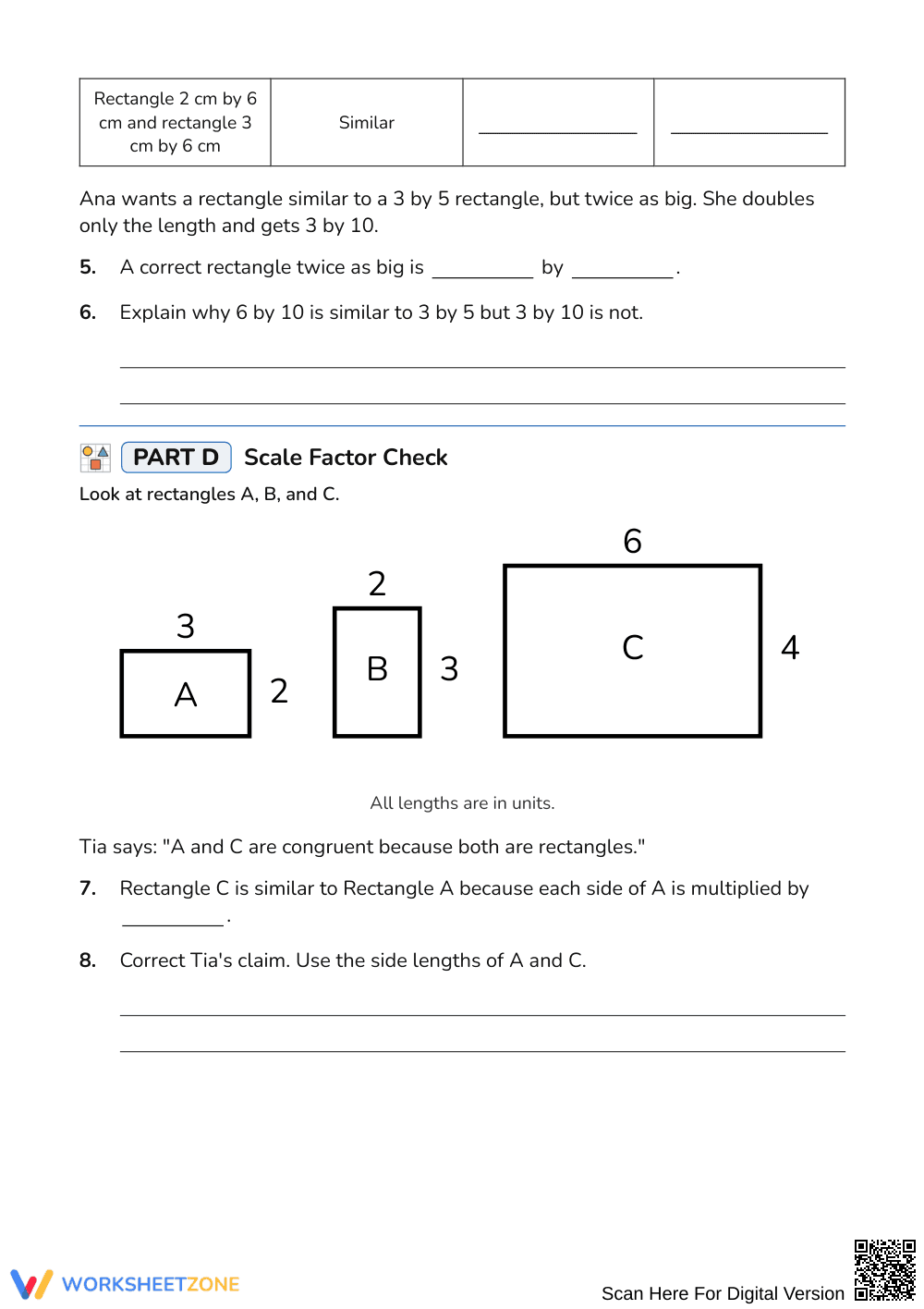

Similar vs. Congruent: Complete Error Analysis
Paste this activity's link or code into your existing LMS (Google Classroom, Canvas, Teams, Schoology, Moodle, etc.).
Students can open and work on the activity right away, with no student login required.
You'll still be able to track student progress and results from your teacher account.
This Grade 8 math worksheet targets common misconceptions between similar and congruent figures through structured error analysis. Students evaluate flawed mathematical claims, identify incorrect geometric reasoning, and write accurate explanations using side lengths and scale factors. By analyzing authentic mistakes, learners build conceptual precision regarding how transformations affect size, shape, and orientation.
At a Glance
- Grade: 8 · Subject: Math
- Standard: Analyze side lengths and geometric properties to verify similarity and congruence in figures
- Skill Focus: Error analysis identifying misconceptions in similar versus congruent figures
- Format: 3 pages · 15 problems · Complete answer key included · Printable PDF
- Best For: Mid-unit formative assessment, intervention, and review
- Time: 30–45 minutes
What's Inside
This 3-page resource contains 15 diagnostic tasks across four progressive parts: Part A (Same Shape, Different Size), Part B (Does Flipping Change a Shape?), Part C (Check the Claims), and Part D (Scale Factor Check). Students work through multiple-choice error identification, claim-checking tables, and written explanations with side measurements. A complete 3-page answer key provides worked explanations.
Skill Progression
- Guided practice (Tasks 1–4): In Parts A and B, students evaluate peer claims with multiple-choice prompts to identify misconceptions before writing corrected statements.
- Supported practice (Tasks 5–10): In Part C, students evaluate four claims in a classification table, categorizing pairs as congruent, similar, or neither.
- Independent practice (Tasks 11–15): In Parts C and D, students independently analyze proportional scaling, explain non-examples of stretching, and justify similarity using scale factors.
This sequence follows a gradual-release model transitioning learners from error identification to independent justification.
Standards Alignment
This worksheet addresses Grade 8 geometry standards on understanding congruence and similarity. Students verify whether two-dimensional figures are congruent through rigid motions or similar through dilations. Both standard codes can be copied directly into lesson plans, IEP goals, or district curriculum mapping tools.
How to Use It
Use this resource during guided practice or as mid-unit formative assessment. In pairs, students can debate Maya and Leo's claims before recording individual corrections. During circulation, check whether students recognize that doubling only one dimension distorts a shape rather than creating similarity. Completion typically requires 30 to 45 minutes.
Who It's For
This worksheet is designed for Grade 8 math students and intervention groups targeting geometric reasoning. Provide an anchor chart showing reflections and proportional scaling for striving learners. Pair this activity with direct instruction on similarity and scale factors.
Error analysis in middle school geometry strengthens mathematical reasoning by prompting learners to evaluate flawed claims regarding similarity and congruence. Rather than merely calculating side lengths or naming shapes, students actively diagnose misconceptions related to rigid transformations, orientation changes, and non-proportional dimensional stretching. According to Fisher & Frey (2014), engaging students in structured critique of non-examples and common peer errors deepens conceptual understanding and accelerates metacognitive monitoring across the gradual-release framework. By examining why orientation changes such as reflections preserve congruence while unequal dimension doubling fails to produce similar figures, Grade 8 learners articulate the precise mathematical definitions governing two-dimensional transformations. This 15-task diagnostic exercise ensures students transition from passive recall to rigorous mathematical justification, equipping them to defend their geometric reasoning with concrete side-length evidence across diverse classroom assessments and state accountability measures.


