



























Similar vs. Congruent: Complete Cumulative Assessment
Paste this activity's link or code into your existing LMS (Google Classroom, Canvas, Teams, Schoology, Moodle, etc.).
Students can open and work on the activity right away, with no student login required.
You'll still be able to track student progress and results from your teacher account.
This cumulative geometry assessment provides structured practice differentiating between similar and congruent figures. Students analyze visual pairs, examine transformations on a grid, complete proportional ratio tables, and justify mathematical claims in writing. The resource ensures Grade 8 learners demonstrate conceptual mastery across multiple representations before concluding their transformational geometry unit.
At a Glance
- Grade: Grade 8 · Subject: Math
- Standard: Compare, classify, and explain properties of similar and congruent geometric figures
- Skill Focus: Cumulative assessment on similar vs congruent
- Format: 3 pages · 19 problems · Full answer key included · Printable PDF
- Best For: End-of-unit assessment and review
- Time: 35–45 minutes of student work time
What's Inside
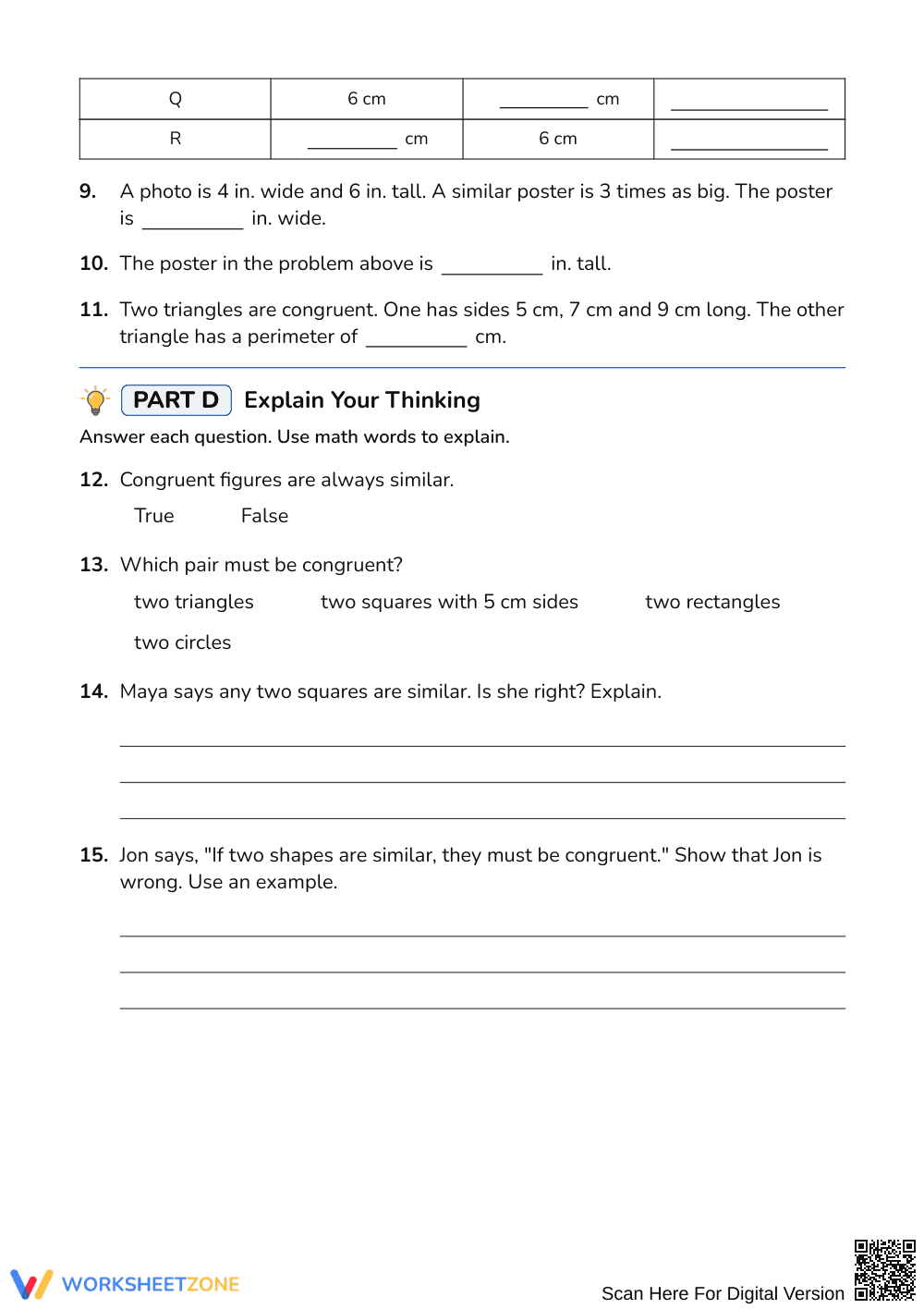
This 3-page assessment features 19 items across four parts. Part A reviews definitions through shape sorting and property checklists. Part B uses coordinate grids to evaluate translations and side lengths. Part C presents proportional ratio tables and scaling problems. Part D prompts written explanations and counterexamples. A complete 3-page answer key provides step-by-step solutions.
Skill Progression
- Guided practice (Tasks 1–4): Shape identification problems provide definitions, asking students to classify figure pairs and identify shared properties.
- Supported practice (Tasks 5–15): Grid tasks and ratio tables guide learners to calculate scale factors, track translations, and find dimensions.
- Independent practice (Tasks 16–19): Open-ended items challenge students to evaluate mathematical assertions and construct geometric counterexamples without hints.
This structure follows the gradual-release model, advancing students from foundational recognition to rigorous written justification.
Standards Alignment
This assessment targets middle school geometry standards requiring students to understand congruence and similarity via transformations. Students verify that figures are congruent through rigid motions and similar through dilations and rigid transformations. Supporting work connects directly to ratio and proportional relationships. Both standard codes can be copied directly into lesson plans, IEP goals, or district curriculum mapping tools.
How to Use It
Administer this 3-page worksheet following direct instruction on transformations as a summative assessment, or divide it across two days for targeted exam preparation. During administration, observe how students approach grid items in Part B to check if they recognize that translations preserve congruence. Students typically finish all 19 tasks within 35 to 45 minutes.
Who It's For
This worksheet is designed for Grade 8 math classes, pre-algebra courses, and high school geometry students needing prerequisite review. Support visual learners by providing tracing paper for overlaying figures in Parts A and B. Pair this task with a transformational geometry anchor chart detailing translations, reflections, and scale factors.
Differentiating between similar and congruent geometric figures is a critical milestone in middle school mathematics that establishes the foundation for high school trigonometry and analytic geometry. According to EdReports 2024, high-quality mathematics instructional materials must balance procedural fluency with conceptual reasoning and real-world modeling to develop enduring geometric understanding. This 19-problem assessment reinforces middle school geometric principles by progressing systematically from visual classification and transformation verification on a coordinate plane to proportional problem solving and written justifications. By prompting students to analyze scale factors and articulate formal counterexamples, the resource addresses persistent misconceptions identified in national assessments regarding the geometric properties of dilations versus rigid motions. Educators can use this structured three-page assessment and its comprehensive answer key to reliably measure student mastery, identify specific intervention needs, and support standards-based curriculum mapping across secondary mathematics classrooms.


