




























Similar vs. Congruent: Compare Strategies Guide
Paste this activity's link or code into your existing LMS (Google Classroom, Canvas, Teams, Schoology, Moodle, etc.).
Students can open and work on the activity right away, with no student login required.
You'll still be able to track student progress and results from your teacher account.
This Grade 8 math worksheet helps students distinguish between similar and congruent figures by analyzing and comparing solution strategies. Across 15 targeted problems, learners examine student reasoning, identify conceptual errors, evaluate side-length ratios, and determine which mathematical approach offers greater efficiency when classifying geometric shapes.
At a Glance
- Grade: Grade 8 · Subject: Middle School Mathematics
- Standard: Understand similarity and congruence using transformations, proportional reasoning, and side-length comparisons
- Skill Focus: Evaluating student solution methods, strategic efficiency, and geometric reasoning
- Format: 3 printable pages · 15 structured problems · Full answer key included · PDF
- Best For: Core classroom instruction, formative checks, and collaborative partner discourse
- Time: 35–45 instructional minutes
What's Inside
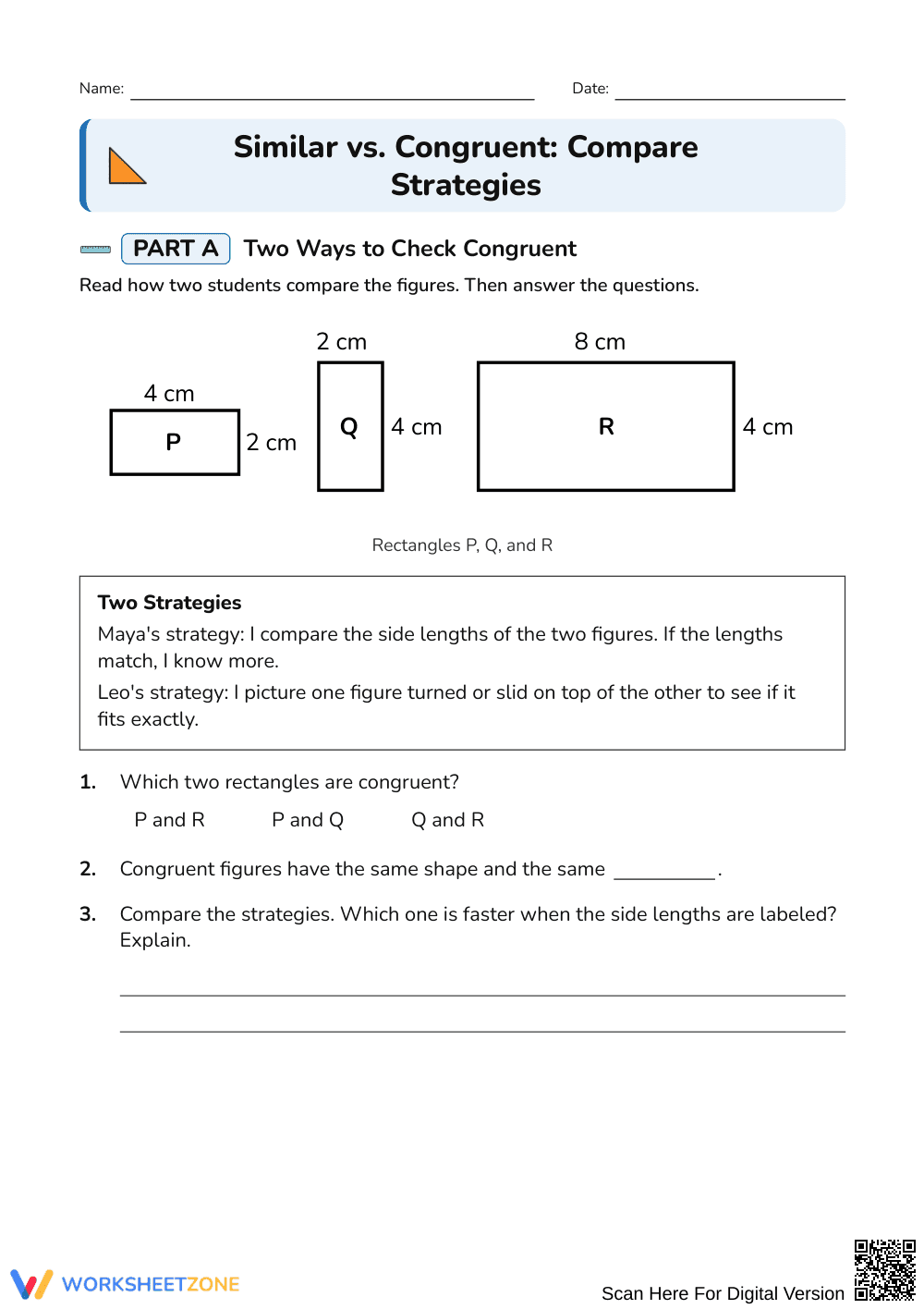
This 3-page printable resource features 15 structured problems divided into four progressive sections. Students evaluate sample student work from fictional peers, diagnose misconceptions about scaling and shape preservation, complete a sorting chart using side measurements, and analyze geometric transformations on a coordinate grid. A complete 3-page answer key provides worked explanations and sample rationales for each comparison question.
Skill Progression
- Guided Practice (Part A, Problems 1–3): Students review rectangle diagrams and peer approaches, identifying congruent pairs and explaining why numerical comparisons prove faster than mental rotation.
- Supported Practice (Parts B & C, Problems 4–9): Learners analyze scaling to spot misconceptions about figure size, then complete a classification table evaluating whether cutouts or numerical doubling is more efficient.
- Independent Practice (Part D, Problems 10–15): Using a coordinate grid, students determine similarity and justify why counting units provides clearer proof than physical sliding.
This sequence follows a gradual-release framework, moving students systematically from modeled peer strategies to independent justification.
Standards Alignment
This resource focuses on geometric similarity and congruence, requiring students to understand that figures are congruent if they share identical size and shape, and similar if side lengths are proportional under dilations. Supporting standards emphasize constructing viable arguments and critiquing peer reasoning. Both standard codes can be copied directly into lesson plans, IEP goals, or district curriculum mapping tools.
How to Use It
Deploy this worksheet during direct instruction for partner debate on solution efficiency, or assign it after instruction as a formative checkpoint. During work time, observe whether students rely on visual perception or apply ratio calculations. Students typically complete all 15 tasks within 35 to 45 minutes.
Who It's For
This worksheet serves Grade 8 mathematics students mastering geometric transformations and similarity criteria. For learners needing additional support, pair the activity with a visual transformation anchor chart showing rotations, translations, and scale factors. Advanced students can extend their thinking by writing algebraic coordinate rules for the grid figures in Part D.
Research by Fisher & Frey (2014) highlights that comparing worked examples and contrasting student solution strategies accelerates conceptual understanding and metacognitive monitoring in middle school mathematics. This Grade 8 geometry worksheet engages students in evaluating multiple solution methods, determining strategic efficiency, and distinguishing between similar and congruent figures. By analyzing both valid approaches and common student misconceptions regarding scale factors, learners move beyond rote memorization to build durable geometric reasoning. Rather than passively calculating dimensions, students explain why numerical ratios often provide faster confirmation of similarity than physical manipulation or visual inspection. The three-page progression of 15 structured tasks provides educators with clear formative evidence of student mastery regarding geometric transformations and proportional relationships. Integrating comparative strategy evaluation into daily practice strengthens mathematical discourse and equips learners to critique peer reasoning effectively across complex problem-solving contexts.


