


























Views
Plays
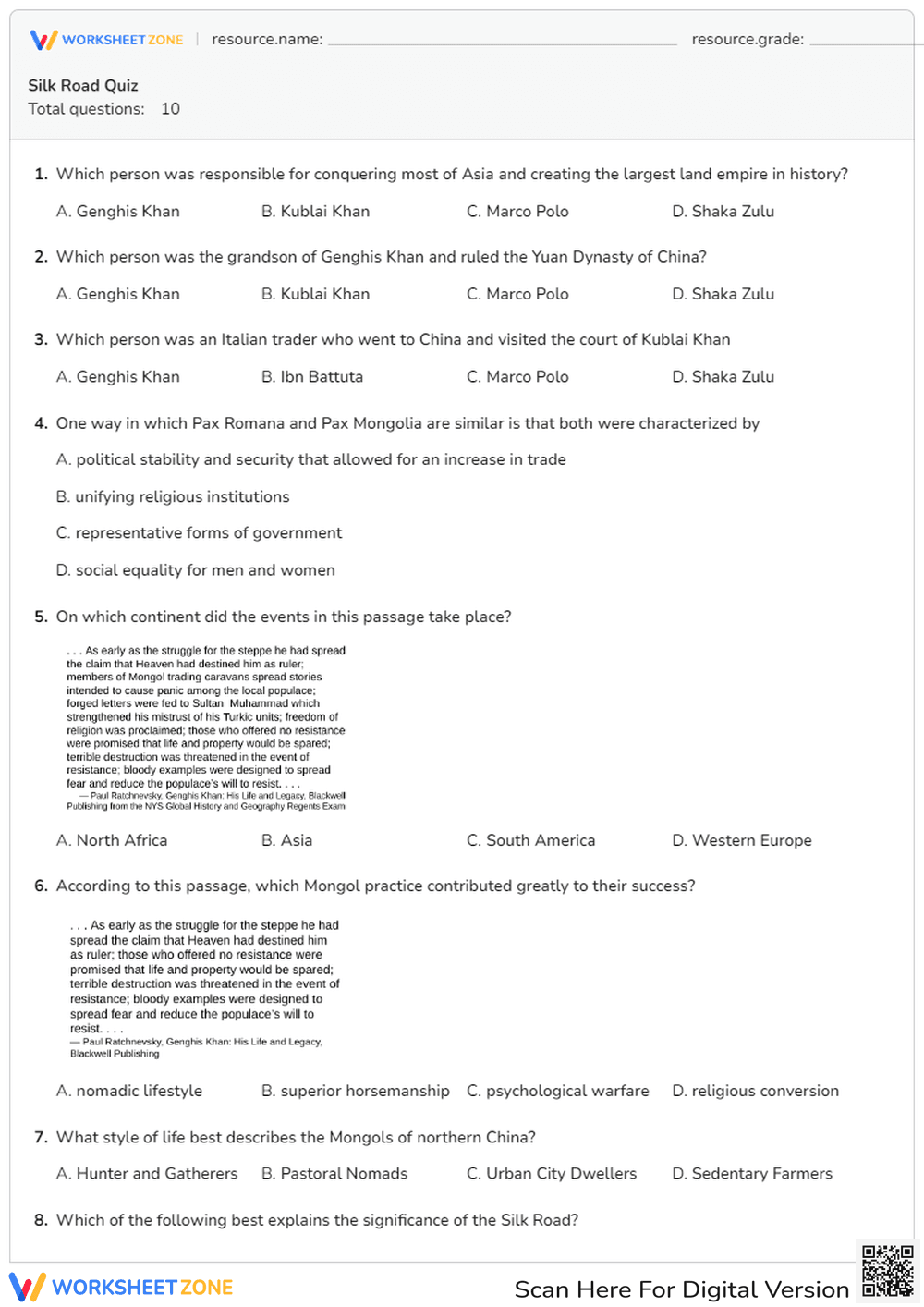
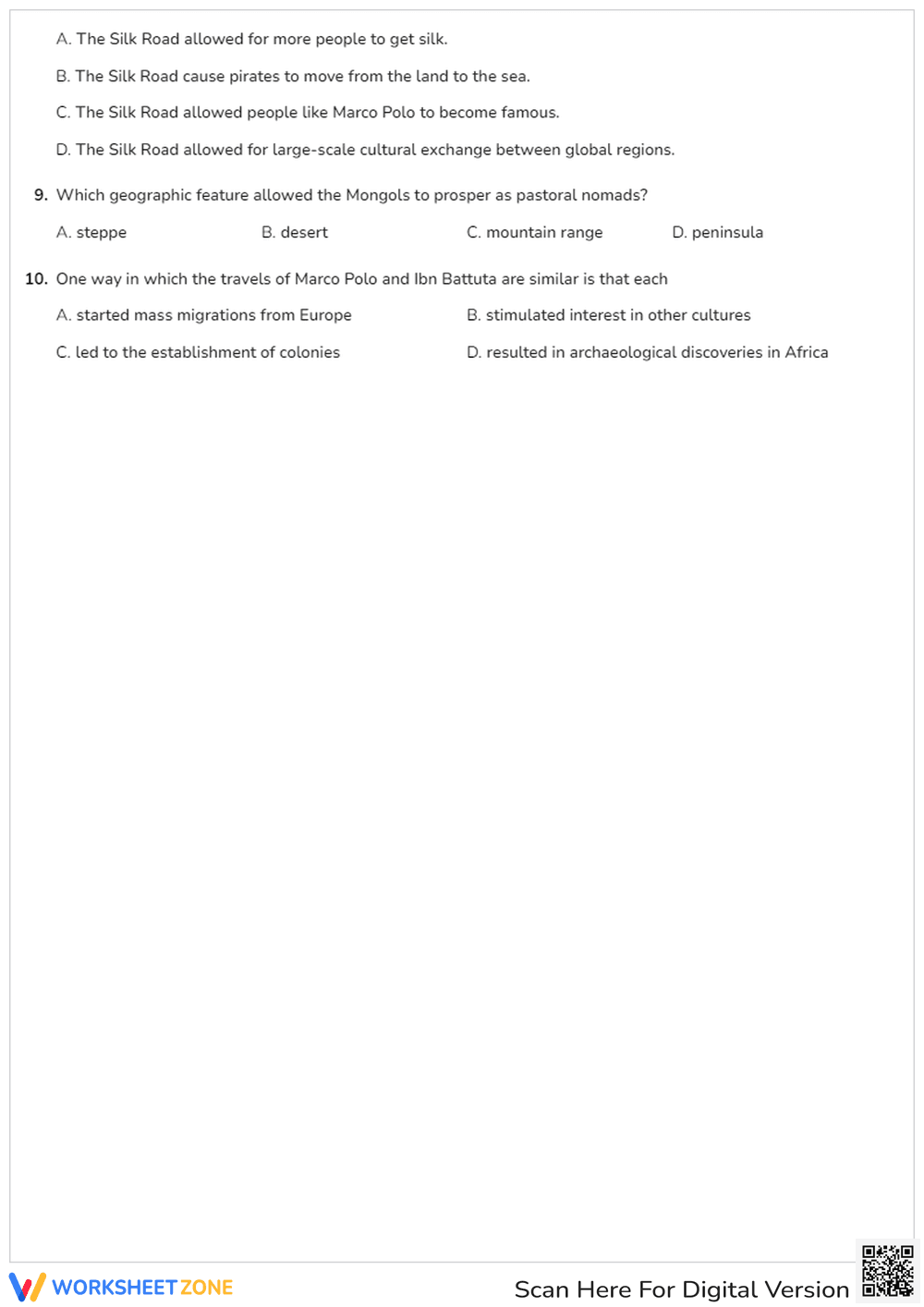

Silk Road Quiz | Grade 9 Essential History Worksheet
Paste this activity's link or code into your existing LMS (Google Classroom, Canvas, Teams, Schoology, Moodle, etc.).
Students can open and work on the activity right away, with no student login required.
You'll still be able to track student progress and results from your teacher account.
This Grade 9 Silk Road quiz provides a comprehensive assessment of the Mongol Empire's rise and the cultural impact of trans-Eurasian trade routes. Students analyze historical figures like Genghis Khan and Marco Polo while evaluating the significance of the Pax Mongolica. It is designed to measure retention of key historical developments in medieval Asia.
At a Glance
- Grade: 9 · Subject: World History
- Standard:
CCSS.ELA-LITERACY.RH.9-10.1— Cite specific textual evidence to support analysis of primary and secondary sources- Skill Focus: Historical Comprehension
- Format: 2 pages · 10 problems · Answer key included · PDF
- Best For: Formative assessment or quick sub plan
- Time: 15–20 minutes
The resource consists of a 2-page PDF featuring 10 high-quality multiple-choice questions. It includes a primary source excerpt regarding Mongol military tactics, requiring students to apply reading comprehension skills to historical contexts. The layout is clean and professional, featuring a dedicated space for student names and grades, with a full answer key for rapid grading.
Zero-Prep Workflow
This assessment is designed for immediate classroom implementation with a total teacher prep time of under 2 minutes. Simply print the 2-page document, distribute it to students for a 15-minute quiet assessment, and use the included answer key for a 30-second review per paper. Its self-contained nature makes it an ideal emergency sub plan or exit ticket for a unit on Asian trade.
Standards Alignment
Primary alignment is to `CCSS.ELA-LITERACY.RH.9-10.1`, which requires students to cite specific textual evidence to support analysis of primary and secondary sources. The quiz also supports RH.9-10.2 by asking students to determine the central ideas of information regarding the Silk Road's significance. Both standard codes can be copied directly into lesson plans, IEP goals, or district curriculum mapping tools.
How to Use It
Use this worksheet as a summative check after a lecture on the Mongol Empire or as a pre-assessment to gauge prior knowledge of medieval trade. During the activity, observe if students struggle with the text-based questions to identify needs for further literacy support. Expect students to complete the 10 tasks within 20 minutes to ensure a brisk instructional pace.
Who It's For
This resource is tailored for Grade 8, 9, and 10 World History students, including those in Regents-aligned or AP World History: Modern courses. It pairs naturally with a map-based activity of the Silk Road or a primary source reading of Marco Polo’s travels to provide a balanced instructional sequence for diverse learners.
According to the RAND AIRS 2024 report, structured assessments that integrate primary source excerpts significantly improve historical literacy and retention in secondary students. This Silk Road quiz utilizes the CCSS.ELA-LITERACY.RH.9-10.1 framework to ensure students are not just memorizing dates, but are actively analyzing the reasons behind historical shifts like the Pax Mongolica. By focusing on the plain-English skill of evidence-based reasoning, the 10 questions provide a reliable data point for formative tracking. Research from Fisher & Frey (2014) emphasizes that frequent, low-stakes quizzes help bridge the gap between initial instruction and long-term mastery. This resource serves as a validated tool for teachers looking to align their curriculum with rigorous state and national standards while maintaining a manageable classroom workflow. The inclusion of diverse figures like Ibn Battuta ensures a global perspective essential for modern history education.


