




























Views
Downloads
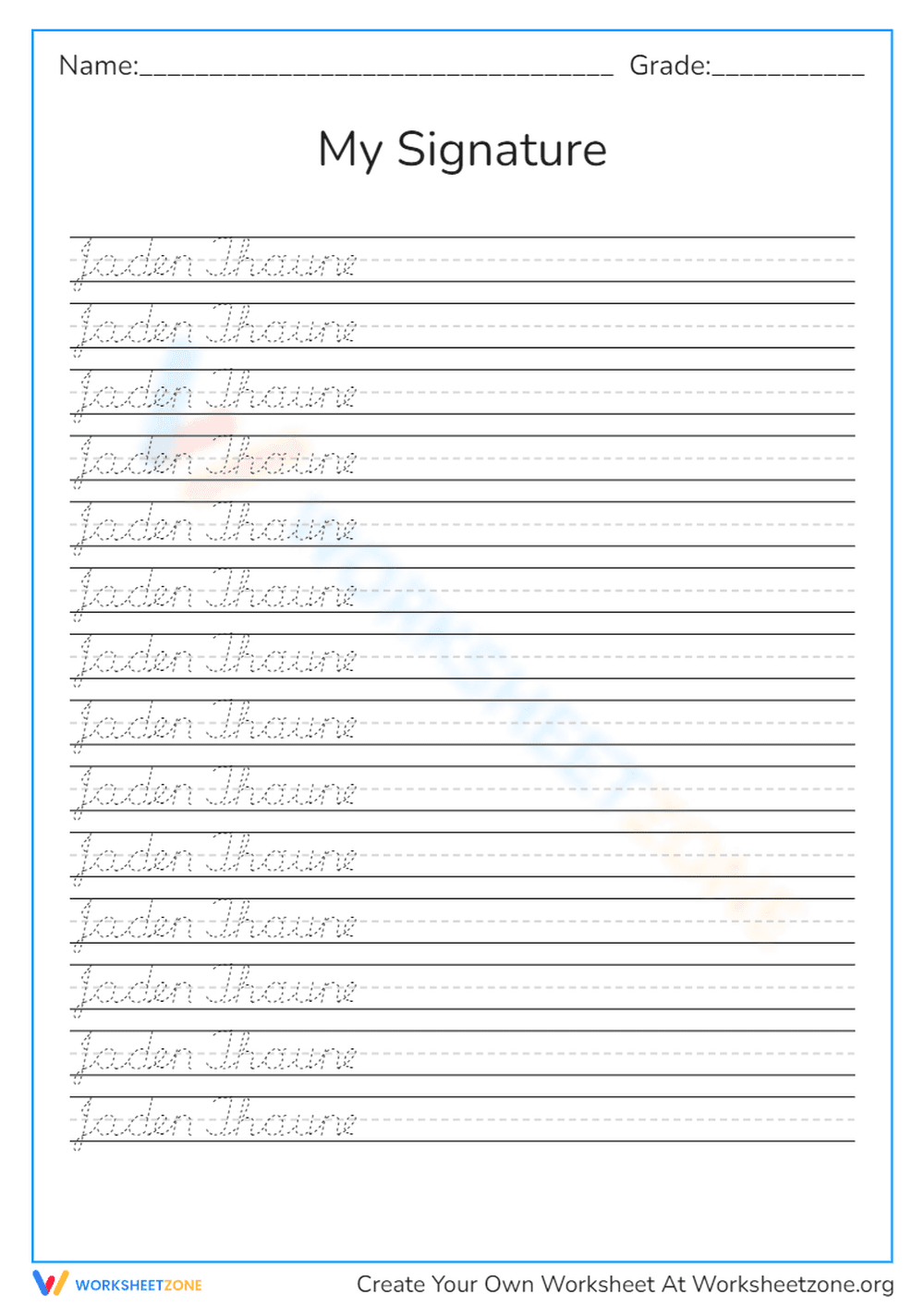

Printable Signature Practice Worksheet for Grades 2-3

Paste this activity's link or code into your existing LMS (Google Classroom, Canvas, Teams, Schoology, Moodle, etc.).
Students can open and work on the activity right away, with no student login required.
You'll still be able to track student progress and results from your teacher account.
This cursive signature practice worksheet helps elementary students master writing their names in cursive script. By tracing the target name multiple times, learners build muscle memory and fine motor control necessary for fluent handwriting. This resource provides immediate, structured practice to transition students from print to cursive signatures.
At a Glance
- Grade: Grade 2, Grade 3 · Subject: Handwriting
- Standard:
CCSS.ELA-LITERACY.L.3.1— Write legibly in cursive and print words clearly- Skill Focus: Cursive name tracing and signature development
- Format: 1 page · 14 problems · Answer key not applicable · PDF
- Best For: Morning work and handwriting warm-ups
- Time: 10–15 minutes
This single-page PDF features 14 identical tracing lines customized for cursive name practice. Each line displays the target name in a dotted cursive font, complete with guide lines to assist with letter height, slant, and spacing. The clean layout minimizes visual distractions, allowing young writers to focus entirely on pen control and letter connections.
This resource requires minimal teacher preparation and fits easily into daily routines:
- Print (1 minute): Select the page and print copies for your class or individual students.
- Distribute (1 minute): Hand out the sheets during morning arrival or transition times.
- Review (2 minutes): Walk the room to check pencil grip and stroke direction as students trace.
With under two minutes of total preparation, this worksheet serves as an excellent last-minute sub plan or independent desk activity.
Standards Alignment
This handwriting activity aligns with CCSS.ELA-LITERACY.L.3.1, which requires students to demonstrate command of the conventions of standard English grammar and usage when writing. Specifically, it supports cursive legibility and fine motor development. Both standard codes can be copied directly into lesson plans, IEP goals, or district curriculum mapping tools.
How to Use It
Use this worksheet during your morning routine as a quiet transition activity. Students complete the tracing lines independently while you take attendance. Alternatively, use it as a formative assessment tool during small-group instruction. Observe how students form difficult cursive connections, noting who needs extra support with letter joins. Expect completion within 10 to 15 minutes.
Who It's For
This practice sheet is designed for second and third-grade students learning cursive. It is ideal for occupational therapy sessions, English language learners, and students needing extra fine motor support. Pair this worksheet with a cursive alphabet anchor chart or direct instruction lesson on capital letter connections to reinforce learning.
Research from Fisher & Frey (2014) highlights the importance of structured, repetitive practice in developing motor automaticity for handwriting. When students trace cursive letters, they build the cognitive pathways necessary for fluent writing, which directly correlates with improved spelling and composition skills. This worksheet aligns with CCSS.ELA-LITERACY.L.3.1 by providing 14 targeted tracing lines that scaffold the transition from guided tracing to independent signature writing. By focusing on a single name, students receive high-frequency practice that builds confidence and muscle memory. Educators can utilize this tool to support fine motor development, ensuring students meet grade-level expectations for legibility and writing speed. The structured format allows teachers to easily monitor progress and integrate handwriting practice into daily ELA blocks without adding to lesson preparation time.


