


























Views
Downloads
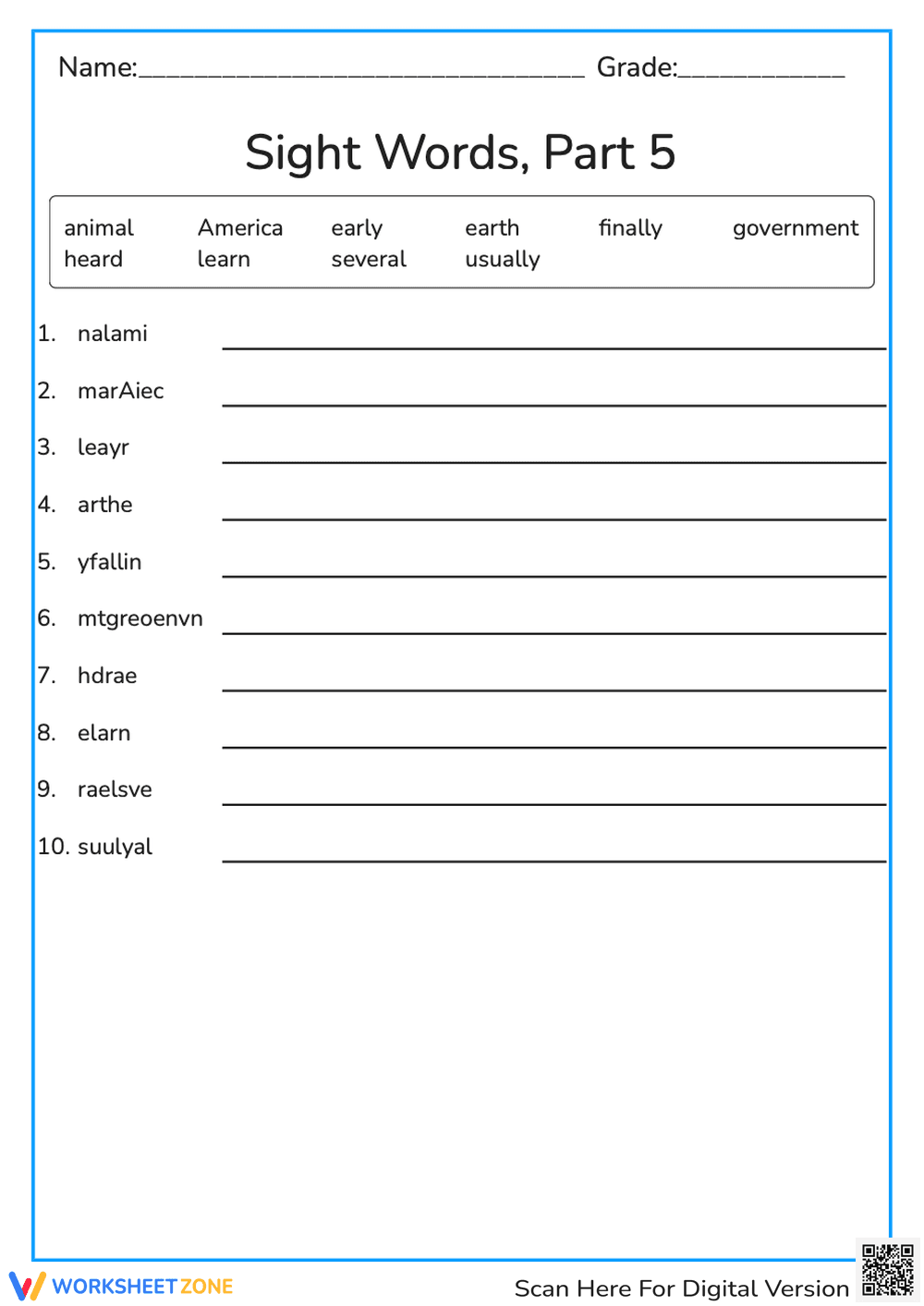

Printable Grade 2 Sight Word Scramble Worksheet
Paste this activity's link or code into your existing LMS (Google Classroom, Canvas, Teams, Schoology, Moodle, etc.).
Students can open and work on the activity right away, with no student login required.
You'll still be able to track student progress and results from your teacher account.
This Grade 2 sight word scramble worksheet provides students with 10 structured spelling tasks to improve word recognition and orthographic mapping. By unscrambling high-frequency words like "government" and "usually," learners reinforce their memory of complex spelling patterns. This resource ensures students can accurately identify and write essential vocabulary found in second-grade texts.
At a Glance
- Grade: 2 · Subject: ELA
- Standard:
CCSS.ELA-LITERACY.L.2.2.D— Generalize learned spelling patterns when writing words- Skill Focus: Sight word recognition and spelling
- Format: 1 page · 10 problems · Answer key included · PDF
- Best For: Independent practice or homework
- Time: 10–15 minutes
What's Inside
This single-page PDF features a clear word bank containing ten high-frequency words, including "America," "finally," and "several." Below the bank, ten numbered lines present scrambled versions of these words. The layout includes dedicated space for student names and grades, along with a comprehensive answer key for rapid grading or student self-correction.
Zero-Prep Workflow
- Print: Download and print the single-page PDF for your entire class in seconds.
- Distribute: Hand out the sheets during morning work, literacy centers, or as a transition activity.
- Review: Use the provided answer key for immediate feedback or have students peer-grade to reinforce correct spelling.
Total teacher preparation time is under 2 minutes, making this an ideal resource for sub plans or last-minute enrichment.
Standards Alignment
This resource aligns with `CCSS.ELA-LITERACY.L.2.2.D`, which requires students to generalize learned spelling patterns when writing words. It specifically targets high-frequency words that often deviate from standard phonetic rules. Both standard codes can be copied directly into lesson plans, IEP goals, or district curriculum mapping tools.
How to Use It
Assign this worksheet as a formative assessment after introducing "Part 5" of your sight word curriculum. It works best during the independent practice phase of a lesson. Teachers should observe if students are using the word bank strategically or attempting to solve the anagrams through phonemic awareness before checking the list. Expected completion time is 10 to 15 minutes.
Who It's For
This worksheet is designed for second-grade students mastering high-frequency vocabulary. It is also suitable for third-grade students needing RTI support or English Language Learners (ELLs) building foundational literacy. Pair this with a sight word anchor chart or a reading passage containing these specific words for maximum impact.
According to the RAND AIRS 2024 report, consistent exposure to high-frequency words through varied tasks like unscrambling significantly improves reading fluency and spelling accuracy in early elementary learners. This worksheet targets CCSS.ELA-LITERACY.L.2.2.D by requiring students to recognize and reconstruct 10 specific sight words, including "government" and "usually." By engaging in orthographic processing—the ability to form, store, and access spellings—students move beyond simple memorization toward mastery. Research from Fisher & Frey (2014) emphasizes that word work activities provide the necessary repetition for students to internalize irregular spelling patterns. This resource offers a structured, low-stakes environment for this cognitive work, making it an essential tool for Grade 2 literacy blocks. The inclusion of a word bank scaffolds the task, ensuring that students are practicing correct letter sequences rather than guessing, which is critical for long-term retention and writing proficiency.


