


























Views
Downloads

Essential Short Vowel Spelling Pretest | Grade 5-6 Aligned
Paste this activity's link or code into your existing LMS (Google Classroom, Canvas, Teams, Schoology, Moodle, etc.).
Students can open and work on the activity right away, with no student login required.
You'll still be able to track student progress and results from your teacher account.
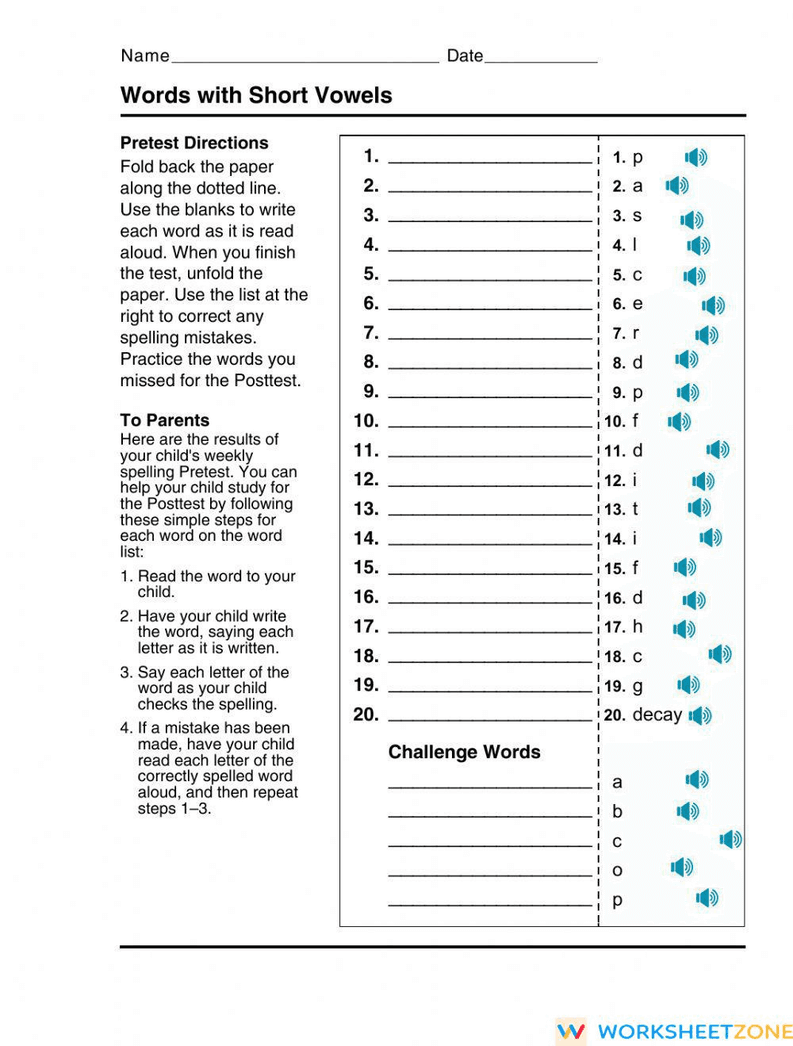
Mastering short vowel spelling is a fundamental step toward literacy proficiency in the middle grades. This worksheet provides a structured environment for students to identify and correct phonetic errors independently. By focusing on orthographic patterns, learners transition from auditory recognition to accurate written representation, ensuring they are prepared for more complex linguistic tasks in Grade 5 and beyond.
At a Glance
- Grade: 5 · Subject: English Language Arts
- Standard:
CCSS.ELA-LITERACY.L.5.2.e— Spell grade-appropriate words correctly, consulting references as needed to check spelling- Skill Focus: Short Vowel Orthographic Patterns
- Format: 1 page · 25 problems · Answer key included · PDF
- Best For: Weekly spelling pre-assessment and home practice
- Time: 10–15 minutes
This single-page resource is meticulously designed to facilitate a spelling pretest. It features 20 primary blanks for core vocabulary and 5 dedicated lines for challenge words, allowing for a comprehensive evaluation of student ability. The unique fold-back design includes a vertical dotted line, which hides the correctly spelled word list until the student is ready to self-correct. This tactile element encourages active engagement and immediate feedback.
Zero-Prep Workflow
The zero-prep workflow for this worksheet is designed to save teachers and parents valuable time. First, print the document (30 seconds). Second, have the student fold back the right-hand column along the dotted line (10 seconds). Third, read the words aloud as the student writes, then unfold for instant self-correction (10 minutes). The total preparation time is under 2 minutes, making it an ideal choice for busy classrooms or as an emergency sub plan.
Standards Alignment
This activity is directly aligned with CCSS.ELA-LITERACY.L.5.2.e, which requires students to spell grade-appropriate words correctly. By using the provided list as a reference for post-test correction, students also practice the secondary skill of consulting references to verify accuracy. Both standard codes can be copied directly into lesson plans, IEP goals, or district curriculum mapping tools to ensure instructional compliance.
How to Use It
For optimal results, use this worksheet as a formative assessment on Monday mornings to establish a baseline for the week's spelling list. A useful observation tip for teachers is to watch for students who hesitate on specific vowel-consonant clusters, as this often indicates a need for targeted phonics intervention. Most Grade 5 students will complete the full 25-word set in approximately 12 minutes during a guided session.
Who It's For
This resource is tailored for Grade 5 and Grade 6 students who are refining their foundational spelling skills. It is particularly effective for English Language Learners (ELL) who benefit from the auditory-to-visual connection emphasized in the parent-guided instructions. This worksheet pairs naturally with a weekly reading passage or a short vowel anchor chart to reinforce the phonetic patterns in a broader literary context.
Research by Fisher & Frey (2014) emphasizes the importance of immediate corrective feedback in the development of orthographic mastery. This worksheet applies those principles through its self-checking mechanism, which allows students to recognize and rectify spelling deviations in real-time. By bridging the gap between phonology and morphology, the resource supports the CCSS.ELA-LITERACY.L.5.2.e requirement for grade-level spelling accuracy. The inclusion of 20 core words plus 5 challenge words provides a scaffolded approach that addresses varying learner needs while maintaining high academic expectations. National data from NAEP assessments consistently highlights that students who engage in frequent, structured spelling practice demonstrate higher overall writing fluency. This tool serves as a critical component in a comprehensive literacy program, enabling educators to track progress through data-driven pre-assessment and post-test cycles. It remains a staple for teachers aiming to improve student outcomes through consistent, evidence-based phonics instruction.


