


























Views
Downloads
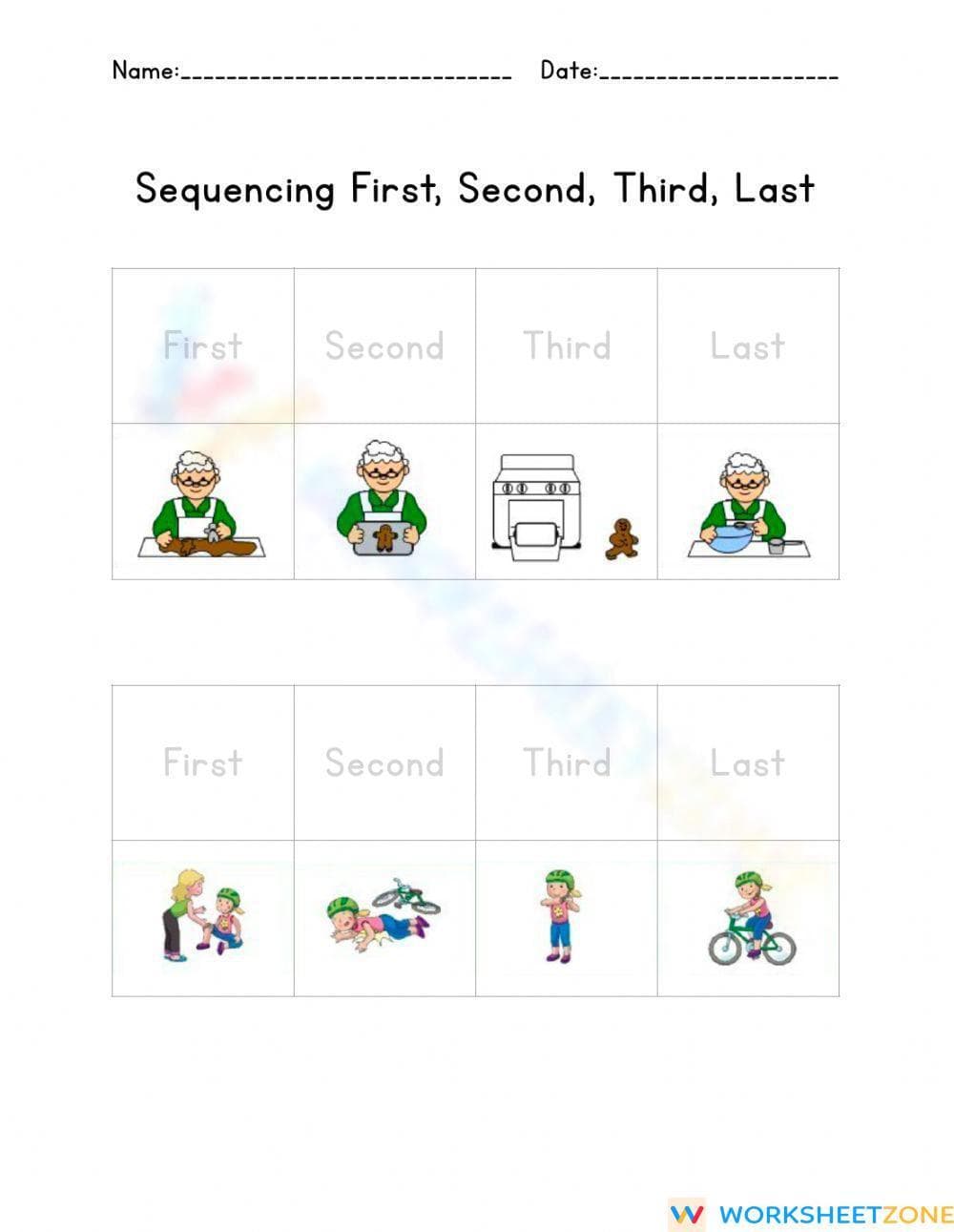

Grade K Sequencing — Printable No-Prep Worksheet
Paste this activity's link or code into your existing LMS (Google Classroom, Canvas, Teams, Schoology, Moodle, etc.).
Students can open and work on the activity right away, with no student login required.
You'll still be able to track student progress and results from your teacher account.
This worksheet provides essential practice in sequencing for early learners. Students will cut and paste or number pictures to correctly order the steps in two simple, four-part narratives: baking cookies and learning to ride a bike. It's a hands-on activity designed to build foundational comprehension and logical reasoning skills in a clear, visual format.
At a Glance
- Grade: K · Subject: ELA
- Standard:
CCSS.ELA-LITERACY.RL.K.3— Identify characters, settings, and major events in a story.- Skill Focus: Sequencing Events
- Format: 1 page · 2 problems · Answer key not included · PDF
- Best For: Literacy centers or independent practice
- Time: 10–15 minutes
What's Inside
This single-page PDF contains two distinct sequencing activities. Each activity presents a set of four picture cards that illustrate a familiar event. The layout is simple and uncluttered, with clear boxes labeled "First," "Second," "Third," and "Last" to guide students. There is no answer key, as the visual narratives are self-evident, making it perfect for quick formative assessment.
Zero-Prep Workflow
This resource is designed for maximum efficiency in the classroom. The workflow is simple:
- Print (30 seconds): Print the single, black-and-white friendly page for your group.
- Distribute (1 minute): Give students the worksheet, scissors, and glue. The task is visually intuitive, requiring little instruction.
- Review (5 minutes): Check work individually or review as a group. The entire activity requires less than 2 minutes of teacher prep, making it ideal for a sub plan.
Standards Alignment
This worksheet directly supports `CCSS.ELA-LITERACY.RL.K.3`, which requires students, with prompting and support, to identify major events in a story. By ordering the picture cards, students demonstrate their understanding of how events unfold. It also builds a foundation for the narrative skills required in `CCSS.ELA-LITERACY.W.K.3`. Both standard codes can be copied directly into lesson plans, IEP goals, or district curriculum mapping tools.
How to Use It
This worksheet is highly versatile. Use it as a follow-up activity after a read-aloud about a process, like baking or learning a new skill. It's an ideal task for independent literacy centers. For a formative assessment, observe which students can correctly identify the first and last steps without prompting; this can reveal their grasp of temporal concepts. The expected completion time is between 10 and 15 minutes.
Who It's For
This resource is perfect for Kindergarten and early first-grade students who are developing their understanding of narrative structure. It is also beneficial for Pre-K learners who are ready for a challenge or special education students who need clear, visual supports. Pair this worksheet with a simple anchor chart that defines the words "First, Next, Then, Last" to reinforce the vocabulary.
This sequencing worksheet provides targeted practice aligned with CCSS.ELA-LITERACY.RL.K.3, helping students identify and order major events in a story. The ability to understand and create sequences is a fundamental building block for both reading comprehension and writing composition. Research from Fisher & Frey (2014) emphasizes the importance of providing students with structured tasks that allow them to work with text and concepts in concrete ways. This print-and-go activity offers exactly that: a focused, hands-on tool for developing narrative logic. By engaging with two distinct visual stories—one about baking, one about riding a bike—students internalize the concept of temporal order. This skill is critical for later academic tasks that require summarizing, retelling, and analyzing more complex texts. The worksheet serves as a practical application of research-based principles for early literacy instruction.


