


























Views
Downloads
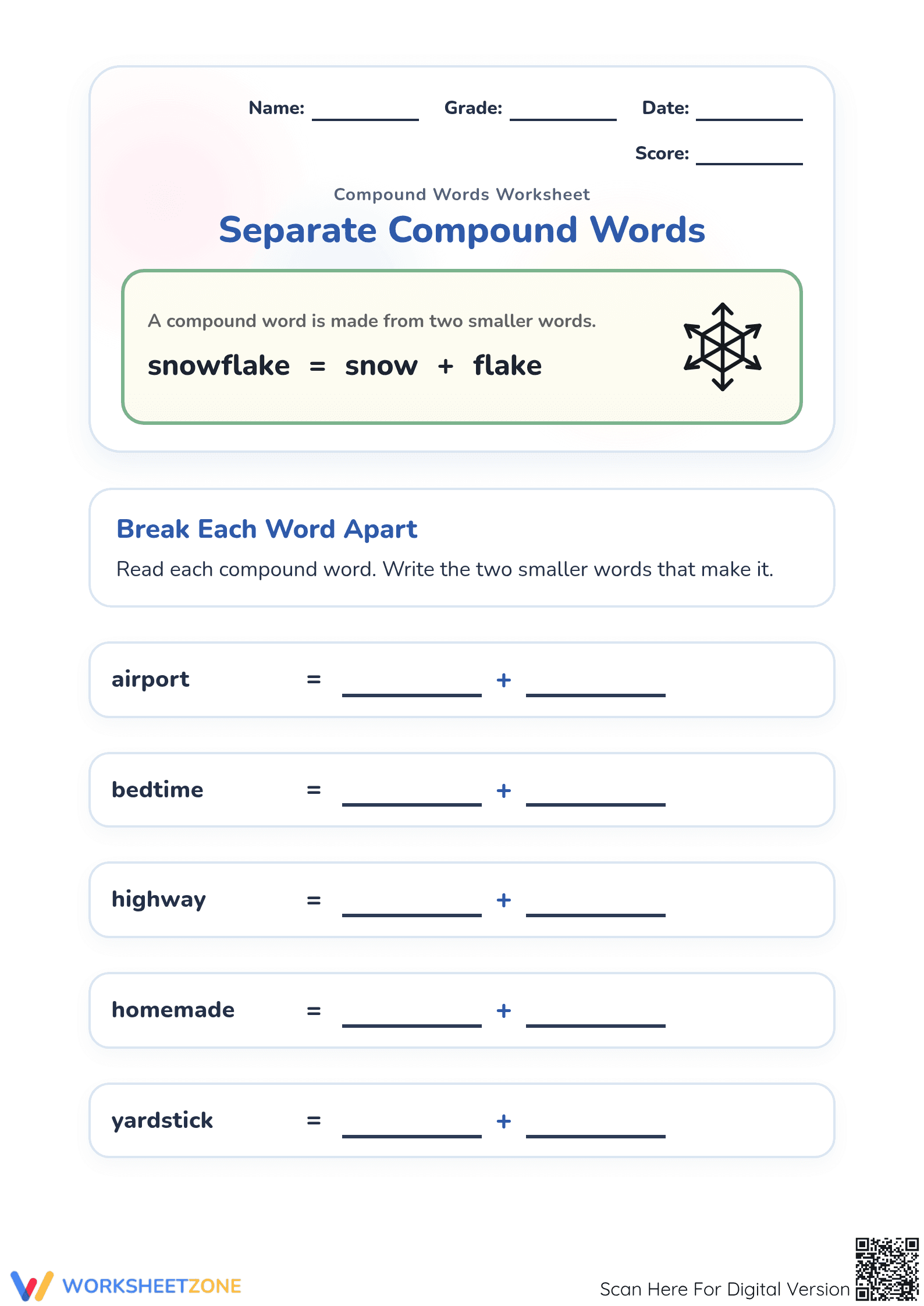


Essential Grade 1 Compound Words Worksheet | Printable
Paste this activity's link or code into your existing LMS (Google Classroom, Canvas, Teams, Schoology, Moodle, etc.).
Students can open and work on the activity right away, with no student login required.
You'll still be able to track student progress and results from your teacher account.
Compound word mastery begins with deconstructing complex terms into manageable components. This Grade 1 ELA worksheet focuses on the structural analysis of lexical units, enabling students to recognize how two distinct words merge to create new meaning. By practicing this skill, learners strengthen their decoding fluency and vocabulary acquisition through intentional deconstruction practice.
At a Glance
- Grade: 1 · Subject: ELA
- Standard:
L.2.4.D— Use knowledge of individual word meanings to predict the meaning of compound words- Skill Focus: Compound Word Deconstruction
- Format: 2 pages · 6 problems · Answer key included · PDF
- Best For: Independent practice and early literacy centers
- Time: 10–15 minutes
This two-page PDF resource provides a structured environment for young readers to explore six specific compound words: airport, bedtime, highway, homemade, yardstick, and suitcase. Each page features clear, large-print text and horizontal lines where students write the two component words. The included full answer key ensures immediate feedback and supports self-correction during independent work periods or literacy centers.
Implementing this resource is effortless. First, print the two-page document (30 seconds) for your class. Next, distribute the sheets (1 minute) after reviewing the "snowflake" example provided at the top of the page. Finally, use the answer key to review student work (under 1 minute) or project it for a quick whole-class check. Total preparation and grading time is minimized to under three minutes for educators.
Standards Alignment
The worksheet aligns with `CCSS.ELA-LITERACY.L.2.4.D`, focusing on using individual word meanings to predict compound word definitions. While officially a Grade 2 benchmark, this foundational practice is essential for Grade 1 students developing lexical awareness and word-solving strategies. This standard code can be copied directly into lesson plans, IEP goals, or district curriculum mapping tools for documentation.
How to Use It
Assign this worksheet during the independent practice phase of a lesson on word structures. It serves as an excellent formative assessment tool; teachers can observe if students correctly identify the boundary between root words, like "yard" and "stick." It also functions well as a sub-plan activity, taking approximately 12 minutes for most first graders to complete accurately without teacher intervention.
Who It's For
This resource is designed for first-grade students transitioning from basic CVC words to multi-syllabic structures. It is particularly beneficial for English Language Learners who need to visualize the "sum of parts" logic in English vocabulary. It pairs naturally with a classroom anchor chart displaying common compound word examples or a short informational passage about daily routines and household objects.
Compound word instruction is a cornerstone of morphological awareness, a critical predictor of reading comprehension success. According to the ScienceDirect TpT Analysis (2024), structured practice in deconstructing compound words helps students internalize the logic of English word formation, reducing cognitive load during decoding. By focusing on standard L.2.4.D, this worksheet provides the repetition required for students to move from rote memorization to functional linguistic analysis. Research by Fisher & Frey (2014) emphasizes that breaking words apart—known as structural analysis—is most effective when students are given clear examples followed by independent application. This worksheet utilizes that pedagogical framework, ensuring students build a robust mental lexicon. The printable format facilitates the tactile experience of writing, which reinforces the neural pathways associated with spelling and word recognition in early elementary learners.


