




























Views
Downloads
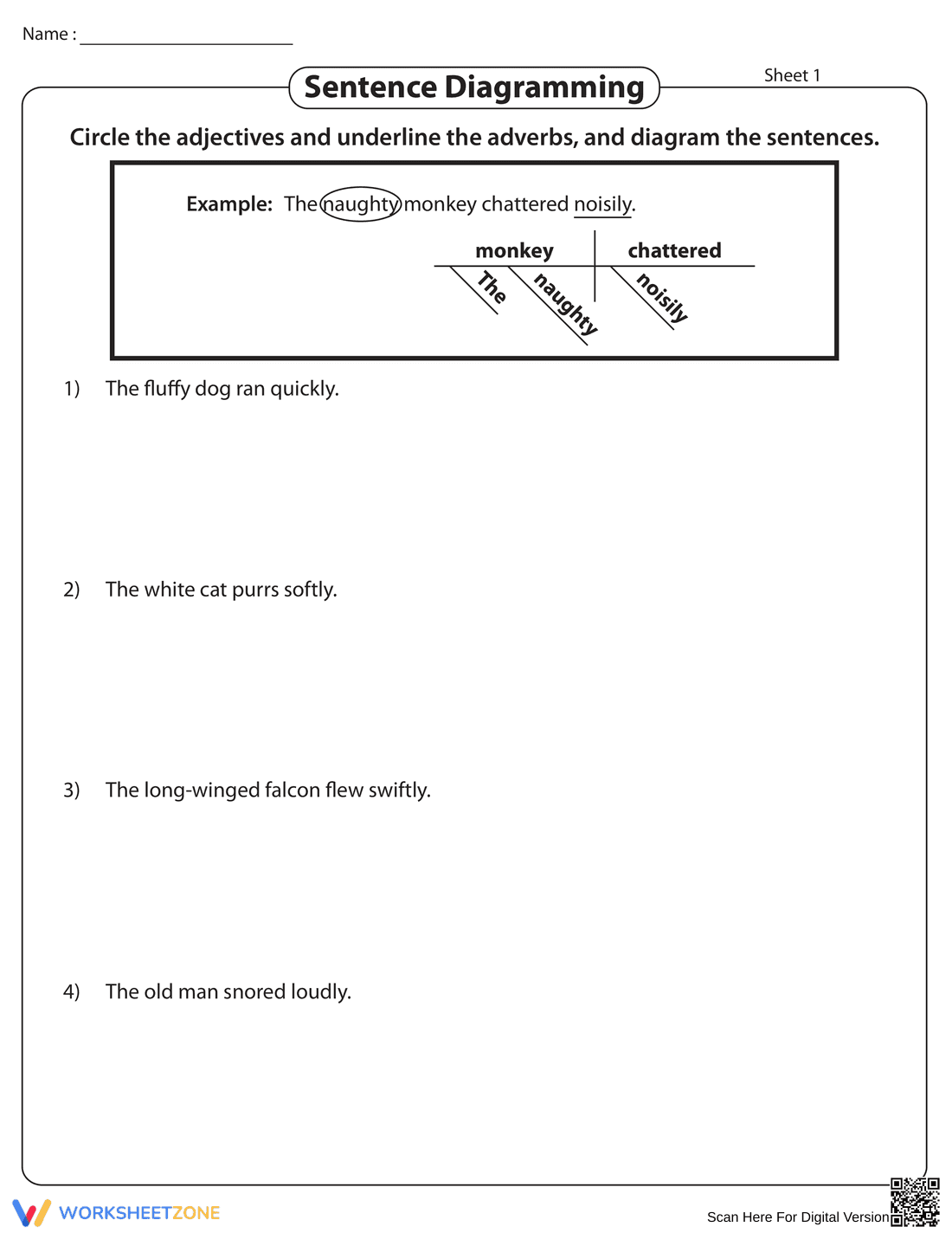

Essential Grade 3 Adjectives & Adverbs Diagramming Worksheet

Paste this activity's link or code into your existing LMS (Google Classroom, Canvas, Teams, Schoology, Moodle, etc.).
Students can open and work on the activity right away, with no student login required.
You'll still be able to track student progress and results from your teacher account.
This essential sentence diagramming worksheet provides a visual framework for Grade 3 students to identify and analyze modifiers. By isolating adjectives and adverbs within a sentence structure, learners develop a concrete understanding of how parts of speech interact. This resource helps students master grammatical relationships, leading to more sophisticated writing and enhanced reading comprehension.
At a Glance
- Grade: 3 · Subject: English Language Arts (ELA)
- Standard:
CCSS.ELA-LITERACY.L.3.1.A— Explain the function of adjectives and adverbs in sentences- Skill Focus: Sentence Diagramming Modifiers
- Format: 1 page · 4 problems · Answer key included · PDF
- Best For: Grammar reinforcement and visual learning
- Time: 15–20 minutes
The worksheet features a clear, step-by-step example of a diagrammed sentence to guide students through the process. It includes four unique sentences that require students to circle adjectives, underline adverbs, and then place each word on the correct line of the diagram. The layout provides ample space for students to draw their diagrams, ensuring the activity remains organized.
Zero-Prep Workflow
Teachers can implement this activity with minimal effort. First, print the single-page PDF, which takes seconds. Second, distribute the sheets and spend two minutes reviewing the worked example to clarify the circling and underlining symbols. Finally, review student work using the included answer key to provide immediate feedback. Total prep time is under two minutes.
Standards Alignment
This resource aligns with CCSS.ELA-LITERACY.L.3.1.A, requiring students to explain the function of nouns, pronouns, verbs, adjectives, and adverbs in general and in particular sentences. By visually separating modifiers, students demonstrate a functional understanding of grammatical roles. Both standard codes can be copied directly into lesson plans or district curriculum mapping tools.
How to Use It
Use this worksheet during the independent practice phase of a grammar lesson on modifiers. It serves as an excellent formative assessment to check if students can distinguish between descriptive words that modify nouns and those that modify verbs. For an observation tip, watch for students who struggle to place adverbs on the slanted line beneath the verb.
Who It's For
Designed for Grade 3 students, this resource is also suitable for Grade 4 and 5 students who need a visual refresher on sentence structure. It provides excellent support for visual learners and students who benefit from structured representations of language. Pair this worksheet with a short descriptive passage to have students practice identifying sentences from a real-world text.
Effective sentence diagramming serves as a cognitive scaffold, transforming abstract linguistic rules into a visible hierarchy that students can manipulate. Research from RAND AIRS 2024 indicates that visual grammar tools significantly improve a student's ability to identify syntactic relationships compared to traditional rote memorization. This worksheet focuses on CCSS.ELA-LITERACY.L.3.1.A, providing four structured tasks that require students to explain the function of adjectives and adverbs by placing them correctly within a diagram. By engaging with this spatial layout, learners move beyond simple identification toward a functional understanding of how modifiers add detail and precision to their writing. This method supports the development of complex sentence structures and aids in self-correction during the revision process. Educators can confidently use this printable as an evidence-based component of a comprehensive English Language Arts curriculum focused on linguistic mastery and syntactic clarity.


