


























Views
Plays
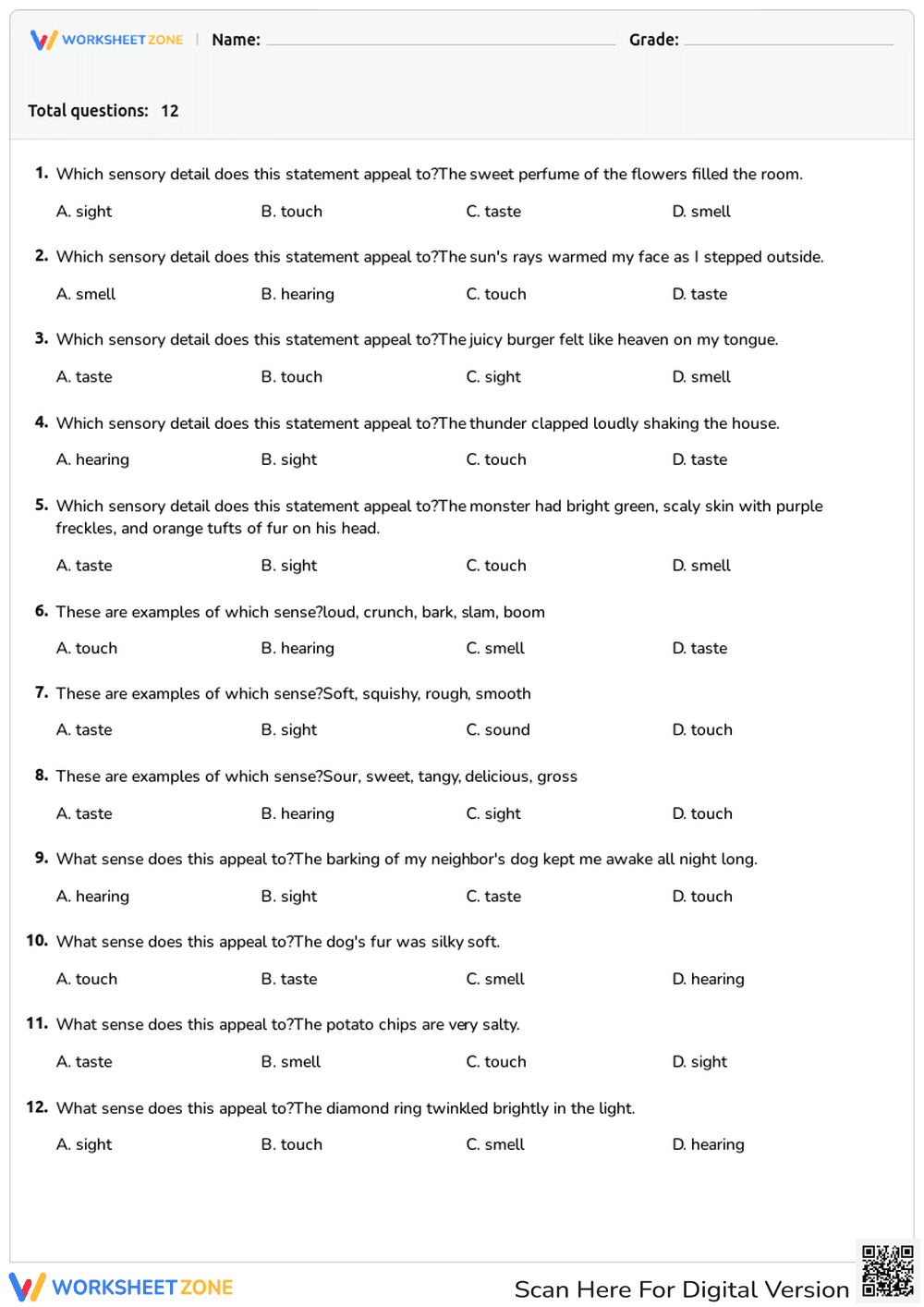

Grade 4 Sensory Words — Printable No-Prep Worksheet
Paste this activity's link or code into your existing LMS (Google Classroom, Canvas, Teams, Schoology, Moodle, etc.).
Students can open and work on the activity right away, with no student login required.
You'll still be able to track student progress and results from your teacher account.
This sensory words worksheet helps students identify descriptive language that appeals to the five senses. By analyzing 12 distinct scenarios, learners determine whether a statement evokes sight, sound, smell, taste, or touch. This practice is vital for developing descriptive writing skills and improving reading comprehension through the recognition of vivid imagery in text.
At a Glance
- Grade: 4 · Subject: ELA
- Standard:
CCSS.ELA-LITERACY.L.4.5— Identify and categorize words that appeal to the five senses in text- Skill Focus: Sensory Language Identification
- Format: 1 page · 12 problems · Answer key included · PDF
- Best For: Independent practice or virtual learning days
- Time: 15–20 minutes
The worksheet features 12 multiple-choice questions designed to test a student's ability to categorize descriptive phrases. The first five questions present full sentences, while the subsequent questions provide word lists or specific examples for categorization. This single-page PDF includes a clear layout and a dedicated space for student names and grades, making it easy to collect and grade.
This resource is designed for a zero-prep workflow. Step 1: Print the single-page PDF (30 seconds). Step 2: Distribute to students for independent work during a virtual learning day or as a bell-ringer (1 minute). Step 3: Review answers using the provided key for immediate feedback (5 minutes). Total teacher preparation time is under 2 minutes, making it an ideal sub plan or emergency assignment.
Aligned to CCSS.ELA-LITERACY.L.4.5, this worksheet focuses on word relationships and nuances. Specifically, it addresses the ability to recognize how specific words create sensory experiences for the reader. Both standard codes can be copied directly into lesson plans, IEP goals, or district curriculum mapping tools to ensure compliance with state and national frameworks.
Use this worksheet as a formative assessment after a lesson on descriptive writing. It is particularly effective as a "Virtual Learning Day" assignment because the instructions are self-explanatory. Teachers can observe which senses students struggle to distinguish, such as the overlap between touch and taste in certain culinary descriptions. Completion typically takes 15 to 20 minutes in a standard classroom setting.
This resource is ideal for Grade 3 through Grade 5 students who are refining their understanding of imagery. It works well for English Language Learners (ELLs) who need concrete examples of sensory adjectives. Pair this worksheet with a descriptive mentor text or an anchor chart featuring common sensory word banks for additional support during the instructional block.
According to the RAND AIRS 2024 report, structured practice in identifying sensory language significantly enhances a student's ability to decode complex literary texts. This worksheet targets CCSS.ELA-LITERACY.L.4.5 by requiring students to categorize 12 specific linguistic examples into the five primary sensory domains. Research from Fisher & Frey (2014) suggests that isolating word relationships through multiple-choice identification provides a necessary scaffold before students are asked to generate original descriptive prose. By focusing on the nuances of "twinkled" versus "salty," students build a robust vocabulary that supports both reading fluency and creative writing. This 1-page resource serves as a reliable tool for measuring student mastery of sensory imagery in a concise, measurable format. The inclusion of an answer key ensures that data collection for progress monitoring is efficient and accurate for classroom teachers.


