


























Views
Plays



Sensory Words Worksheet | Grade 1 Essential Practice
Paste this activity's link or code into your existing LMS (Google Classroom, Canvas, Teams, Schoology, Moodle, etc.).
Students can open and work on the activity right away, with no student login required.
You'll still be able to track student progress and results from your teacher account.
This Grade 1 sensory words worksheet helps students identify and apply descriptive adjectives related to the five senses. By connecting vivid imagery with specific vocabulary terms like fragrant, luminous, and grainy, learners strengthen their ability to describe the world around them. This resource ensures students move beyond basic descriptors to more precise language.
At a Glance
- Grade: 1 · Subject: ELA
- Standard:
CCSS.ELA-LITERACY.L.1.6— Use words and phrases acquired through reading and responding to texts- Skill Focus: Sensory Adjectives
- Format: 3 pages · 10 problems · Answer key included · PDF
- Best For: Vocabulary building and descriptive writing support
- Time: 15–20 minutes
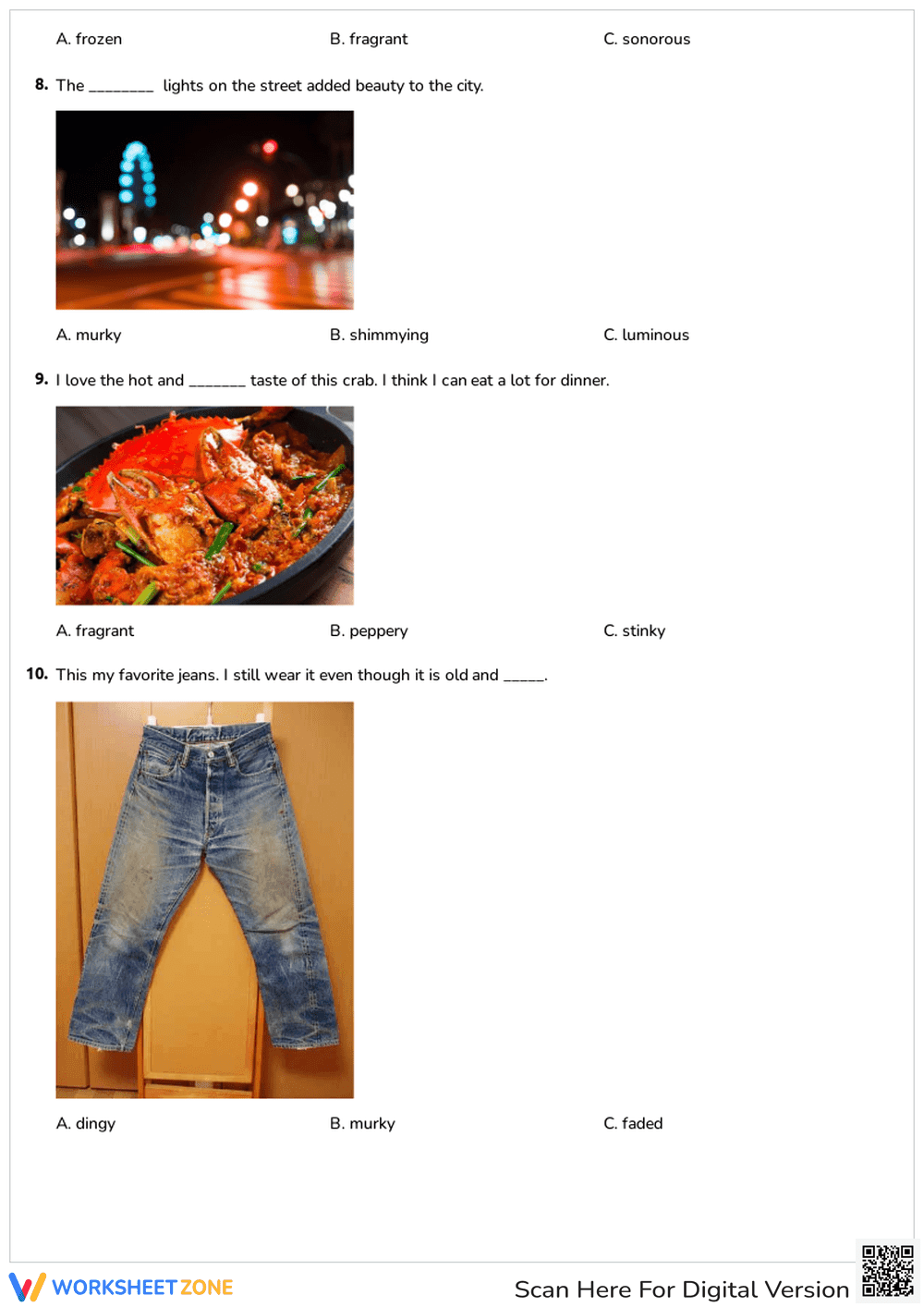
The packet contains three pages featuring ten high-quality color photographs paired with fill-in-the-blank sentences. Each question provides three multiple-choice options, challenging students to select the adjective that best matches the visual context. The layout is clean and spacious, making it accessible for early readers and writers who are still developing fine motor skills and reading stamina.
Skill Progression
- Guided practice: The first three items use familiar food items like mangoes and herbs to introduce the concept of taste and smell descriptors with clear visual cues.
- Supported practice: Items 4 through 7 expand into more complex sensory experiences, such as texture and unpleasant odors, requiring students to infer meaning from character reactions.
- Independent practice: The final set of problems focuses on abstract visual and tactile qualities like luminous and faded, pushing students to apply their knowledge to diverse contexts.
This gradual-release approach ensures students build confidence before tackling more sophisticated vocabulary in their own writing.
Standards Alignment
This resource is primarily aligned with `CCSS.ELA-LITERACY.L.1.6`, which requires students to use words and phrases acquired through conversations, reading, and being read to. It also supports the development of descriptive language skills found in early writing standards. Both standard codes can be copied directly into lesson plans, IEP goals, or district curriculum mapping tools.
How to Use It
Use this worksheet during a direct instruction lesson on descriptive writing to provide immediate application of new vocabulary. It serves as an excellent formative assessment tool; teachers should observe if students can explain why a specific word like nauseating fits the image of trash better than other options. Expected completion time is between 15 and 20 minutes.
Who It's For
This material is designed for first-grade students but is highly effective for English Language Learners (ELL) who benefit from the strong visual-to-word association. It pairs naturally with a mentor text about the five senses or a classroom sensory bin activity where students touch and smell real objects before completing the page.
Research from Fisher & Frey (2014) emphasizes that vocabulary acquisition is most effective when new words are anchored to visual representations and specific contexts. This worksheet applies that principle by using 10 distinct photographic prompts to bridge the gap between abstract adjectives and concrete sensory experiences. By requiring students to choose between competing descriptors, the activity promotes deeper cognitive processing than simple rote memorization. According to the RAND AIRS 2024 report on early literacy, high-utility vocabulary instruction that includes sensory language significantly improves a student's later reading comprehension and narrative writing quality. This resource provides the structured repetition necessary for Grade 1 students to internalize CCSS.ELA-LITERACY.L.1.6 standards. The inclusion of diverse sensory categories—sight, smell, taste, and touch—ensures a comprehensive review that supports foundational language development across the primary curriculum.


