


























Views
Plays
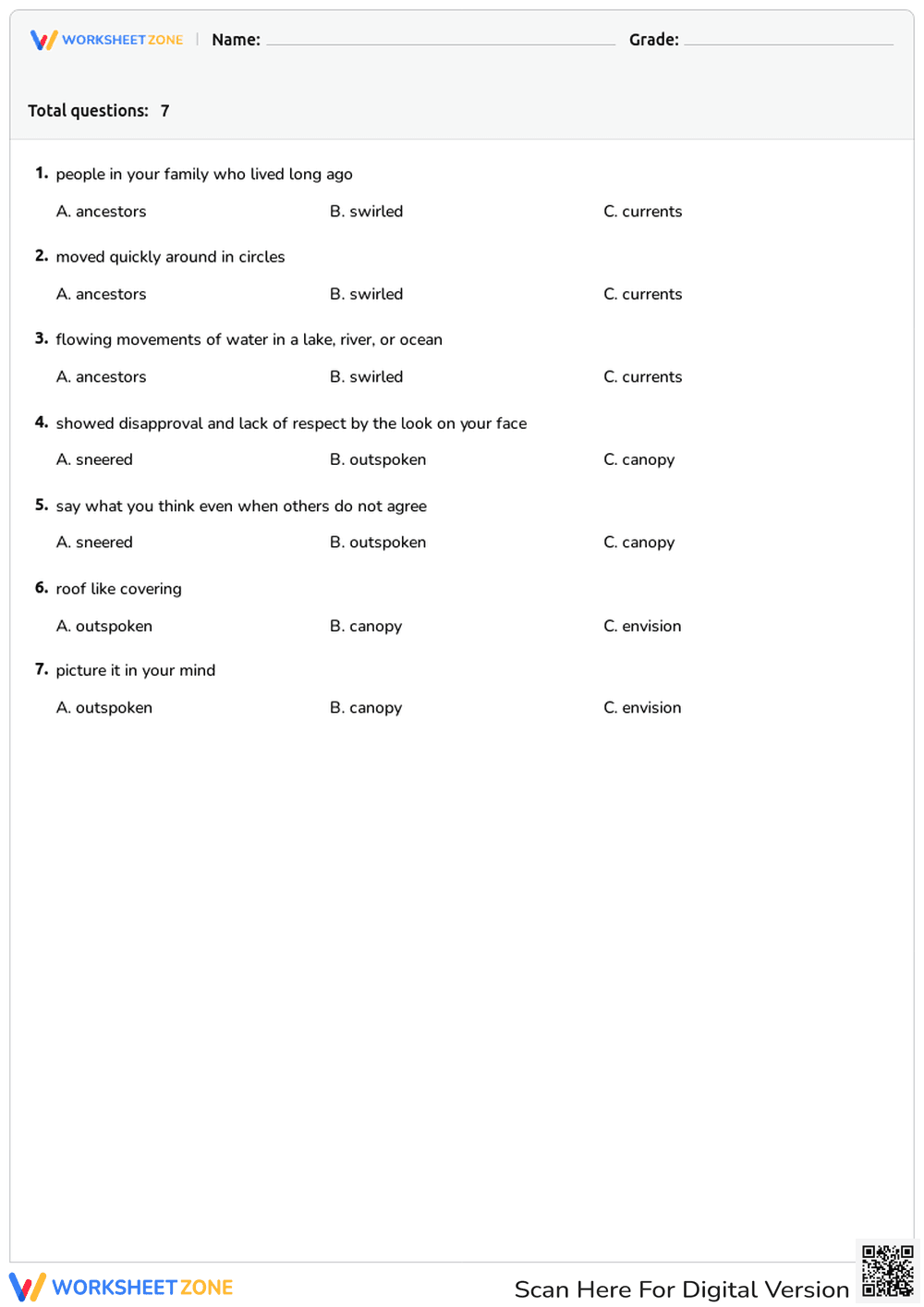

Printable Seeds of Change Vocabulary | Grade 3
Paste this activity's link or code into your existing LMS (Google Classroom, Canvas, Teams, Schoology, Moodle, etc.).
Students can open and work on the activity right away, with no student login required.
You'll still be able to track student progress and results from your teacher account.
This Grade 3 vocabulary worksheet provides students with targeted practice identifying the meanings of key terms from the text Seeds of Change. By matching definitions to the correct vocabulary words, learners strengthen their reading comprehension and context clue skills. The straightforward multiple-choice format ensures focused, independent skill building.
At a Glance
- Grade: 3 · Subject: ELA
- Standard:
CCSS.ELA-LITERACY.L.3.4— Determine the meaning of unknown words.- Skill Focus: Vocabulary Definition Matching
- Format: 1 page · 7 problems · PDF
- Best For: Independent practice or quick assessment
- Time: 10–15 minutes
Inside this resource, educators will find a single-page assessment featuring seven multiple-choice questions. Each item presents a clear, student-friendly definition, prompting learners to select the matching vocabulary word from three distinct options. The targeted word list includes terms such as ancestors, currents, outspoken, and canopy, directly supporting environmental science units. The clean layout minimizes visual distractions.
Zero-Prep Workflow
This resource is designed for immediate classroom implementation with minimal teacher setup.
- Print (1 minute): Simply download the PDF and print a class set. The black-and-white design is ink-friendly and copies perfectly.
- Distribute (1 minute): Hand out the assessment as a warm-up, exit ticket, or independent reading center activity.
- Review (3 minutes): The multiple-choice format allows for rapid grading or whole-class peer review.
Total teacher preparation time is under two minutes, making this an ideal, self-explanatory activity for emergency sub plans or busy instructional days.
Standards Alignment
This worksheet is aligned to CCSS.ELA-LITERACY.L.3.4: Determine or clarify the meaning of unknown and multiple-meaning word and phrases based on grade 3 reading and content, choosing flexibly from a range of strategies. It also supports cross-curricular connections to environmental science topics. Both standard codes can be copied directly into lesson plans, IEP goals, or district curriculum mapping tools.
How to Use It
Deploy this worksheet after a whole-class read-aloud or direct instruction on the target vocabulary words. It serves as an excellent formative assessment to gauge retention before moving on to complex comprehension tasks. As a formative observation tip, watch to see if students immediately recognize the correct term or if they rely on the process of elimination among the three choices. Expected completion time is a brief 10 to 15 minutes, fitting easily into standard literacy blocks.
Who It's For
This resource is primarily designed for third-grade students developing their academic vocabulary. The straightforward multiple-choice structure provides built-in scaffolding, making it accessible for English Language Learners and students requiring modified assessments. Pair this worksheet directly with a reading passage about Wangari Maathai or an anchor chart detailing environmental science terminology to maximize student success.
Mastering academic and domain-specific vocabulary is a critical component of reading comprehension and overall literacy development in elementary education. According to the RAND AIRS 2024 report on reading interventions, explicit vocabulary instruction combined with structured retrieval practice significantly improves students' ability to access complex informational texts. This worksheet directly supports CCSS.ELA-LITERACY.L.3.4 by requiring students to determine the meaning of unknown words through targeted recall and definition matching. By isolating the vocabulary terms in a low-stakes, multiple-choice format, learners can solidify their foundational knowledge before applying these words in broader writing or discussion contexts. Regular exposure to and assessment of tier-two and tier-three vocabulary words ensures that students build the robust mental lexicon necessary for advanced academic achievement across all subject areas, bridging the gap between simple decoding and deep reading comprehension.


