


























Views
Downloads

Grade 3 Seed Detectives — Printable No-Prep Worksheet
Paste this activity's link or code into your existing LMS (Google Classroom, Canvas, Teams, Schoology, Moodle, etc.).
Students can open and work on the activity right away, with no student login required.
You'll still be able to track student progress and results from your teacher account.
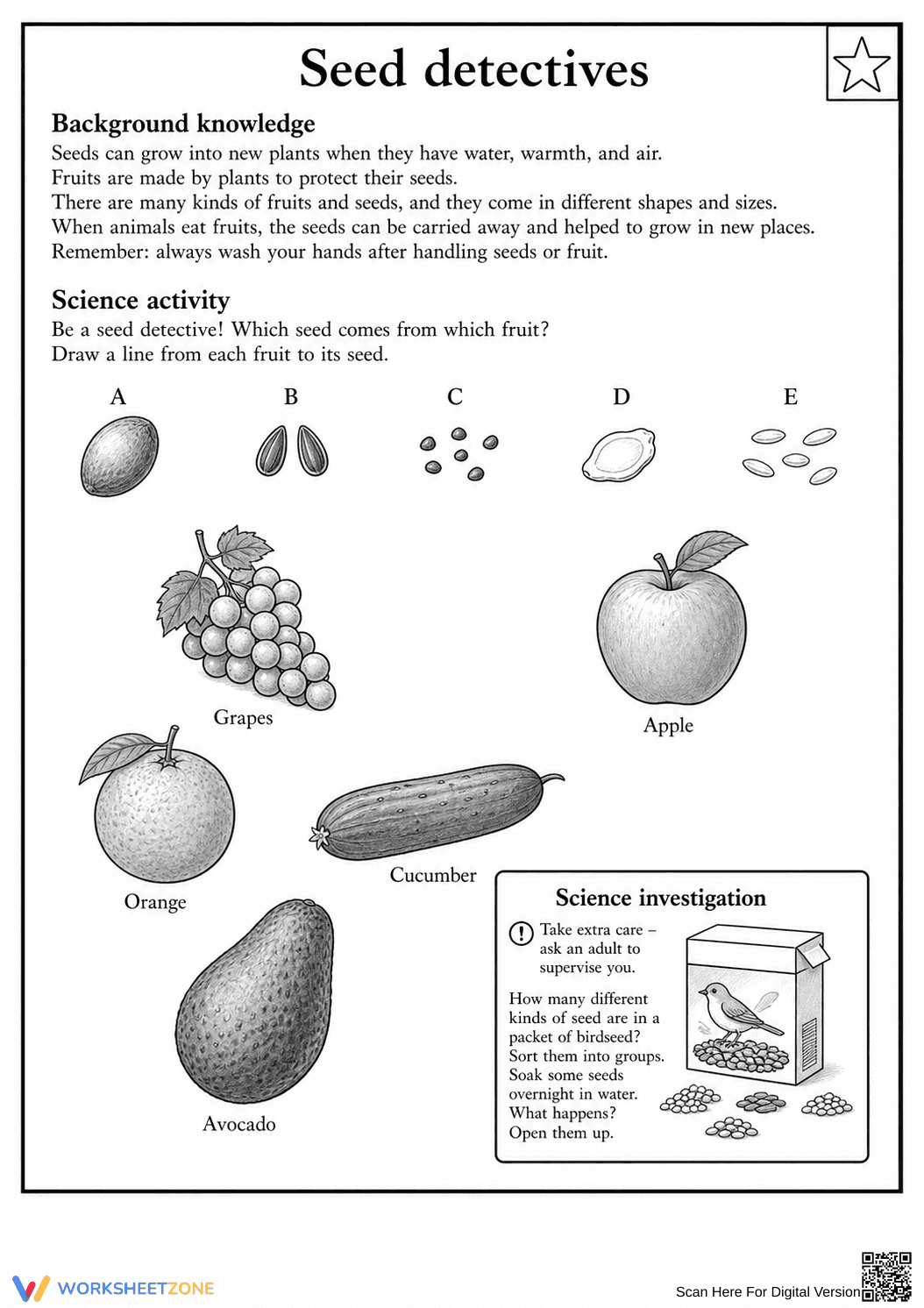
Identifying the connection between seeds and the fruits they produce is a fundamental step in understanding plant life cycles. This Grade 3 science worksheet engages students as seed detectives, challenging them to observe physical characteristics and match five different fruits to their corresponding seeds to build foundational botanical knowledge.
At a Glance
- Grade: 3 · Subject: Science
- Standard:
3-LS1-1— Describe unique plant life cycles starting from seeds- Skill Focus: Seed and fruit identification
- Format: 1 page · 5 problems · Answer key included · PDF
- Best For: Independent science centers or sub plans
- Time: 15–20 minutes
This single-page science resource features a brief background knowledge section explaining germination and fruit formation to activate prior learning. The main activity consists of five matching tasks where students draw lines from labeled fruits—including grapes, apples, oranges, cucumbers, and avocados—to their specific seeds. A secondary science investigation box provides an extension activity involving birdseed sorting and overnight seed soaking to encourage hands-on discovery. A complete answer key is included for easy grading.
This worksheet is designed for immediate classroom deployment with a total teacher prep time of under two minutes. First, print the single-page PDF (30 seconds). Second, distribute to students as a self-contained activity that includes all necessary background vocabulary (30 seconds). Finally, review the matches using the included answer key for instant formative feedback (60 seconds). Its self-explanatory layout makes it an ideal choice for emergency sub plans or quick science centers.
This resource aligns with 3-LS1-1, requiring students to develop models to describe that organisms have unique and diverse life cycles but all have in common birth, growth, reproduction, and death. By identifying seeds as the starting point of plant life and understanding their protective fruit casing, students build foundational knowledge for reproductive cycles. Both standard codes can be copied directly into lesson plans, IEP goals, or district curriculum mapping tools.
Use this activity during the exploration phase of plant biology lessons to reinforce direct instruction. It also works exceptionally well as an exit ticket after fruit dissections to verify the generalization of findings. Teachers can observe students during the matching process to formatively assess their understanding of physical traits and seed diversity. Students typically complete the matching task in 10 to 15 minutes, with the extension providing a high-engagement option for early finishers.
This resource is tailored for third-grade students developing scientific observation skills. It includes clear labels for ELA support and distinct visual cues for visual learners or students needing accommodations. The content pairs perfectly with a plant life cycle reading passage or classroom anchor charts showing the stages from a tiny seed to a mature, fruit-bearing plant.
The Seed Detectives worksheet provides a structured approach to botanical observation, aligning with the Next Generation Science Standards for Grade 3. By requiring students to match specific fruits to their seeds, the activity reinforces the concept of reproduction and the protective role of fruit in the plant life cycle. According to the RAND AIRS 2024 report on elementary science pedagogy, hands-on visual matching tasks significantly improve long-term retention of biological structures in young learners. This worksheet bridges the gap between abstract life cycle diagrams and real-world specimens. It emphasizes precise identification skills, which are critical for meeting standard 3-LS1-1 requirements to describe unique plant life cycles starting from seeds. The inclusion of an extension experiment involving birdseed further supports inquiry-based learning models, ensuring that students move from simple identification to active investigation of natural phenomena.


