


























0
Views
0
Downloads

0.0
0
Save
0 Likes
Seasonal Homonyms Worksheet
0 Views
0 Downloads
Paste this activity's link or code into your existing LMS (Google Classroom, Canvas, Teams, Schoology, Moodle, etc.).
Students can open and work on the activity right away, with no student login required.
You'll still be able to track student progress and results from your teacher account.
Information
Description
What It Is:
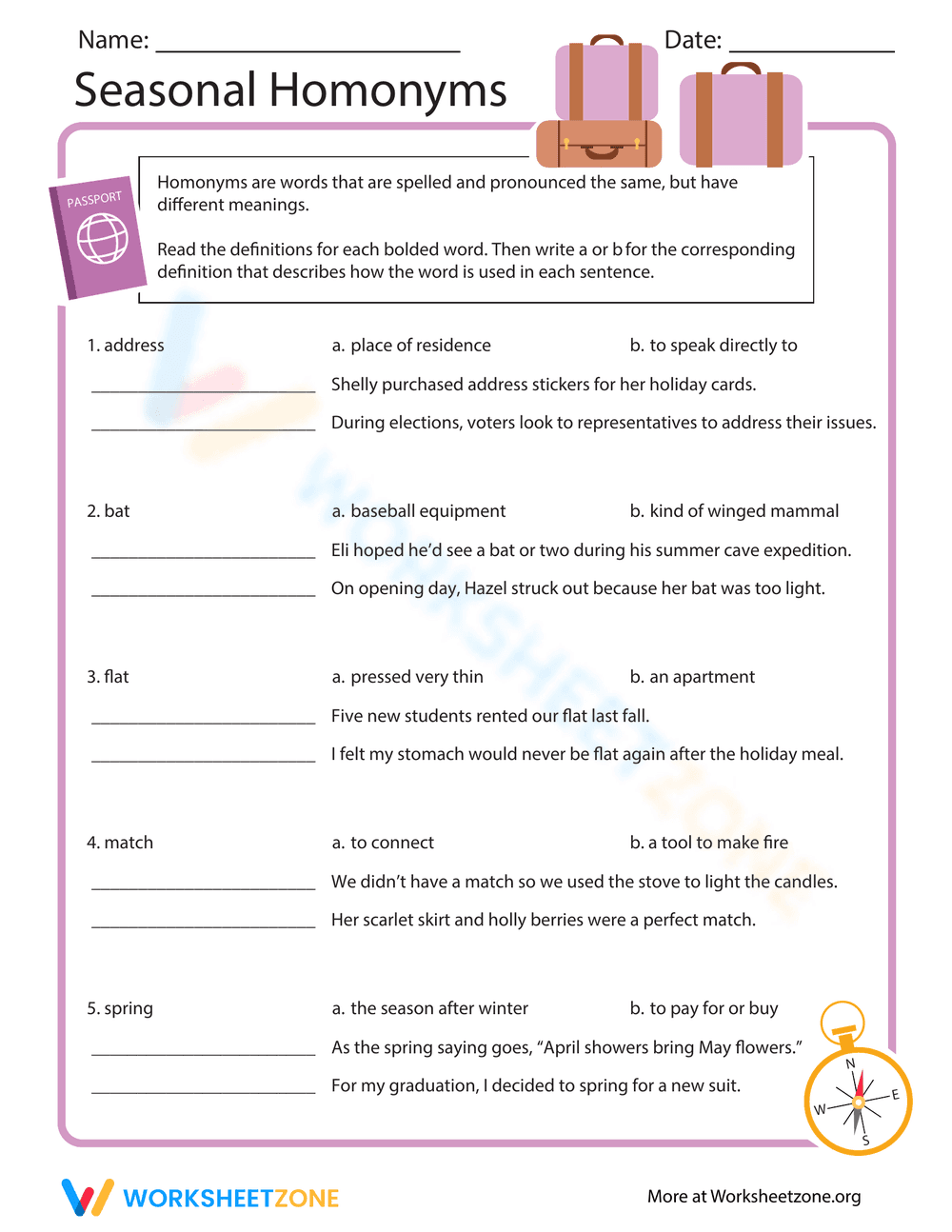
This is an educational worksheet focused on teaching students about homonyms. The worksheet presents five different words (address, bat, flat, match, and spring), each with two different definitions labeled 'a' and 'b'. Students are instructed to read sentences containing the target word and then choose the definition (a or b) that best fits the context of the sentence. There are two sentences for each word.
Grade Level Suitability:
This worksheet is suitable for grades 3-5. The vocabulary and sentence structures are appropriate for this age range, and the concept of homonyms is typically introduced during these grades. The activity reinforces reading comprehension and vocabulary skills.
Why Use It:
This worksheet helps students develop a deeper understanding of homonyms and improve their reading comprehension skills. It encourages critical thinking as students analyze the context of each sentence to determine the correct definition of the homonym. It strengthens vocabulary and enhances the ability to discern the subtle differences in word meanings.
How to Use It:
Students should read the definition of homonyms at the top of the page. Then, for each numbered question, they need to read both sentences provided. After reading the sentences, they should determine which definition (a or b) best fits how the bolded word is used in the sentences and write the corresponding letter on the blank line provided.
Target Users:
This worksheet is ideal for elementary school students in grades 3-5 who are learning about homonyms or need reinforcement in vocabulary and reading comprehension. It can be used in the classroom, as homework, or for homeschooling purposes. It's also helpful for students who need extra practice with context clues.
This is an educational worksheet focused on teaching students about homonyms. The worksheet presents five different words (address, bat, flat, match, and spring), each with two different definitions labeled 'a' and 'b'. Students are instructed to read sentences containing the target word and then choose the definition (a or b) that best fits the context of the sentence. There are two sentences for each word.
Grade Level Suitability:
This worksheet is suitable for grades 3-5. The vocabulary and sentence structures are appropriate for this age range, and the concept of homonyms is typically introduced during these grades. The activity reinforces reading comprehension and vocabulary skills.
Why Use It:
This worksheet helps students develop a deeper understanding of homonyms and improve their reading comprehension skills. It encourages critical thinking as students analyze the context of each sentence to determine the correct definition of the homonym. It strengthens vocabulary and enhances the ability to discern the subtle differences in word meanings.
How to Use It:
Students should read the definition of homonyms at the top of the page. Then, for each numbered question, they need to read both sentences provided. After reading the sentences, they should determine which definition (a or b) best fits how the bolded word is used in the sentences and write the corresponding letter on the blank line provided.
Target Users:
This worksheet is ideal for elementary school students in grades 3-5 who are learning about homonyms or need reinforcement in vocabulary and reading comprehension. It can be used in the classroom, as homework, or for homeschooling purposes. It's also helpful for students who need extra practice with context clues.


