




























Views
Downloads


Scrambled Sentences Worksheet | Grade 1-3 Essential

Paste this activity's link or code into your existing LMS (Google Classroom, Canvas, Teams, Schoology, Moodle, etc.).
Students can open and work on the activity right away, with no student login required.
You'll still be able to track student progress and results from your teacher account.
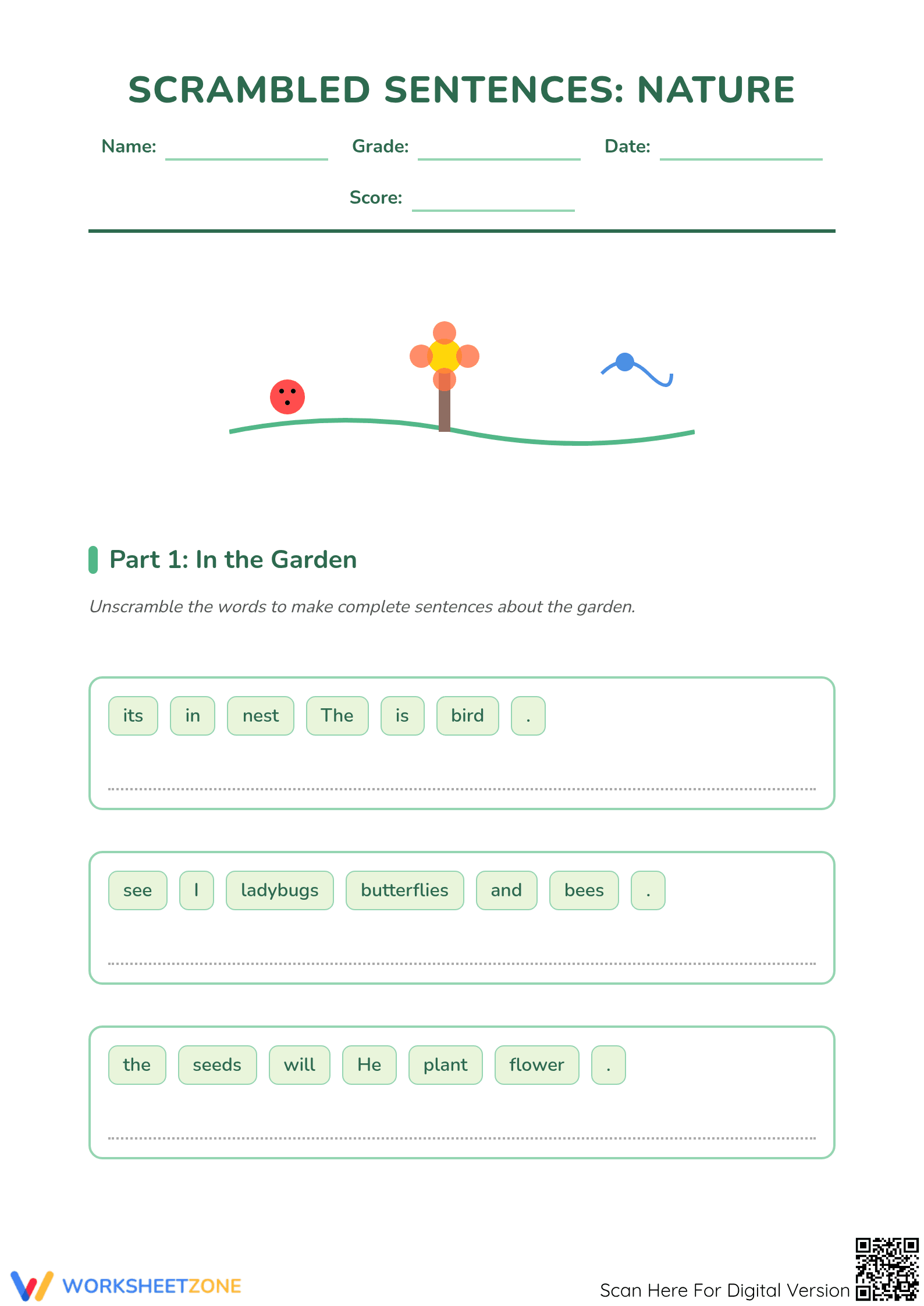
This Grade 1-3 scrambled sentences worksheet helps students master basic syntax and sentence construction by organizing jumbled words into coherent thoughts. By focusing on word order and punctuation, learners develop the critical thinking skills necessary for clear written communication. This resource provides immediate practice in identifying subject-verb relationships through engaging, illustrated prompts.
At a Glance
- Grade: 1-3 · Subject: ELA
- Standard:
CCSS.ELA-LITERACY.L.1.1.J— Produce and expand complete simple and compound sentences in response to prompts- Skill Focus: Sentence structure and syntax
- Format: 1 page · 4 problems · Answer key included · PDF
- Best For: Literacy centers and morning work
- Time: 10–15 minutes
The worksheet contains 4 distinct sentence-building tasks, each supported by a high-quality illustration that provides context for the scrambled words. Each problem features words enclosed in clear boxes to help students visually separate the components of the sentence. The layout includes dedicated space for writing the final sentence, encouraging neatness and proper letter formation. A comprehensive answer key is provided for quick grading.
Zero-Prep Workflow
The zero-prep design allows for immediate classroom implementation. First, print the single-page PDF (30 seconds). Second, distribute the worksheet to students during a literacy block or as a transition activity (1 minute). Third, review the completed sentences as a whole group to reinforce capitalization and punctuation rules (5 minutes). This workflow minimizes teacher administrative time while maximizing student engagement with core grammar concepts.
Standards Alignment
This resource is primarily aligned with `CCSS.ELA-LITERACY.L.1.1.J`, which focuses on producing and expanding complete simple and compound sentences. It also supports L.2.1 and L.3.1 by reinforcing the conventions of standard English grammar and usage. Both standard codes can be copied directly into lesson plans, IEP goals, or district curriculum mapping tools.
How to Use It
Use this worksheet as a formative assessment after a direct instruction lesson on sentence parts. It is particularly effective in literacy centers where students can work independently or in pairs to solve the word puzzles. Teachers should observe if students correctly identify the capitalized word as the sentence starter, which serves as a key indicator of their understanding of mechanics.
Who It's For
This resource is designed for early elementary students in Grades 1 through 3 who are refining their understanding of English syntax. It is an excellent tool for English Language Learners (ELLs) who need structured practice with word order. Pair this worksheet with a mentor text or a sentence-building anchor chart to provide additional scaffolding for struggling writers.
According to Fisher & Frey (2014), the ability to manipulate sentence structures through unscrambling activities is a foundational component of syntactic awareness. This worksheet targets CCSS.ELA-LITERACY.L.1.1.J by requiring students to organize discrete word units into logical, grammatically correct sequences. Research from the NAEP indicates that early mastery of sentence-level mechanics directly correlates with later proficiency in complex composition. By providing visual anchors alongside scrambled text, this resource reduces cognitive load, allowing Grade 1-3 learners to focus specifically on word order and punctuation placement. The 4-task format provides a manageable entry point for formative assessment, ensuring that teachers can quickly identify students who struggle with subject-verb-object patterns. This evidence-based approach to grammar instruction facilitates the transition from oral language to formal written expression, providing a stable framework for developing writers to practice essential linguistic conventions in a structured, low-stakes environment.


