


























Views
Downloads
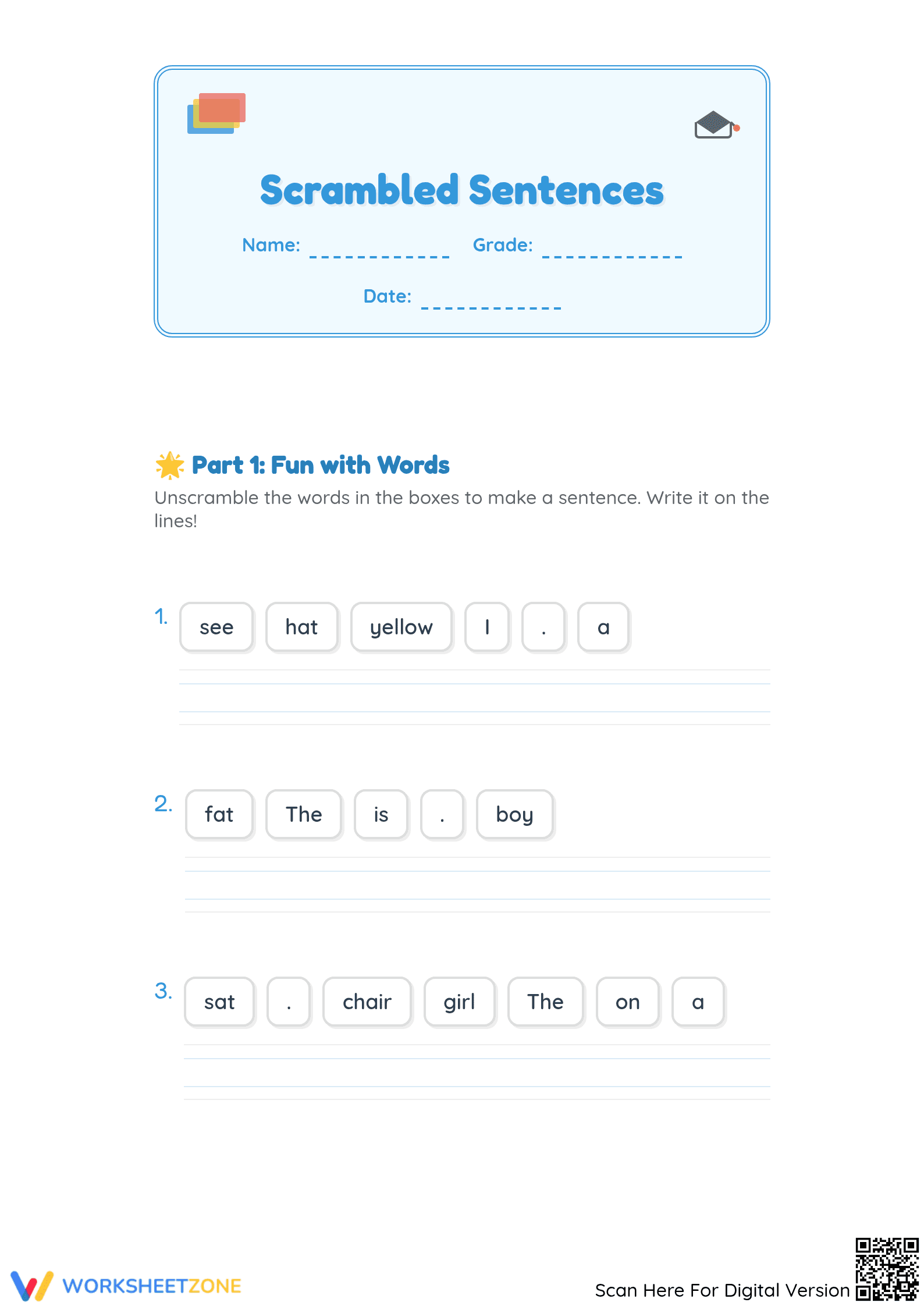


Scrambled Sentences Worksheet | Essential Grade 1-3 ELA
Paste this activity's link or code into your existing LMS (Google Classroom, Canvas, Teams, Schoology, Moodle, etc.).
Students can open and work on the activity right away, with no student login required.
You'll still be able to track student progress and results from your teacher account.
This Scrambled Sentences worksheet helps early elementary students master the fundamentals of syntax and word order. By rearranging jumbled words into coherent thoughts, learners develop a practical understanding of how subjects, verbs, and modifiers interact. This activity directly supports reading fluency and writing clarity through hands-on practice with five distinct sentence-building challenges.
At a Glance
At a Glance
- Grade: 1-3 · Subject: ELA
- Standard:
CCSS.ELA-LITERACY.L.1.1.J— Produce and expand complete simple and compound declarative and interrogative sentences- Skill Focus: Sentence Unscrambling
- Format: 1 page · 5 problems · Answer key included · PDF
- Best For: Morning work or literacy centers
- Time: 10–15 minutes
What's Inside
Inside this resource, you will find a clean, one-page layout featuring five scrambled sentence tasks. Each task provides a set of words in individual boxes, including punctuation marks, to guide the student. The worksheet includes primary-ruled lines to encourage neat handwriting and proper letter formation as students transcribe their corrected sentences. A full answer key is provided for quick grading.
Zero-Prep Workflow
This resource is designed for a zero-prep workflow. First, print the single-page PDF (30 seconds). Next, distribute the sheets to your students during your literacy block or as a transition activity (1 minute). Finally, review the completed sentences as a whole group or use the included answer key for rapid individual assessment (under 1 minute). Total teacher preparation time is less than two minutes, making it an ideal sub-plan component.
Standards Alignment
This worksheet aligns with `CCSS.ELA-LITERACY.L.1.1.J`, which requires students to produce and expand complete simple and compound sentences. It also supports `CCSS.ELA-LITERACY.L.2.1.F` by reinforcing the use of complete sentences rather than fragments. Both standard codes can be copied directly into lesson plans, IEP goals, or district curriculum mapping tools.
How to Use It
Use this worksheet as a formative assessment after a lesson on sentence structure. Observe if students correctly place the capitalized word at the beginning and the punctuation at the end. It also serves as an excellent "early finisher" task or a reliable morning work activity. Expect students to complete the five tasks in approximately 10 to 15 minutes depending on their writing speed.
Who It's For
This resource is ideal for Grade 1 through Grade 3 students, particularly those who struggle with word order or punctuation placement. It is highly effective for English Language Learners (ELL) who need visual cues for syntax. Pair this worksheet with a sentence-building anchor chart or a shared reading passage to reinforce the concept of a complete thought.
Research from Fisher & Frey (2014) emphasizes the importance of scaffolded writing tasks in developing linguistic competence. This worksheet applies these principles by providing the necessary vocabulary while requiring students to apply cognitive effort to organize the syntax. By focusing on CCSS.ELA-LITERACY.L.1.1.J, the activity bridges the gap between word recognition and sentence production. According to the RAND AIRS 2024 report, structured practice in sentence manipulation significantly improves reading comprehension by familiarizing students with common syntactic patterns. This 5-task exercise provides the repetition needed for students to internalize the "capital-subject-verb-punctuation" framework. The inclusion of punctuation as a movable element ensures that students view periods and question marks as integral parts of the sentence structure rather than afterthoughts. This targeted approach to language conventions builds the foundational skills necessary for more complex writing tasks in later elementary grades.


