


























Views
Downloads


Scrambled Sentences Worksheet | Grade 1-3 Essential
Paste this activity's link or code into your existing LMS (Google Classroom, Canvas, Teams, Schoology, Moodle, etc.).
Students can open and work on the activity right away, with no student login required.
You'll still be able to track student progress and results from your teacher account.
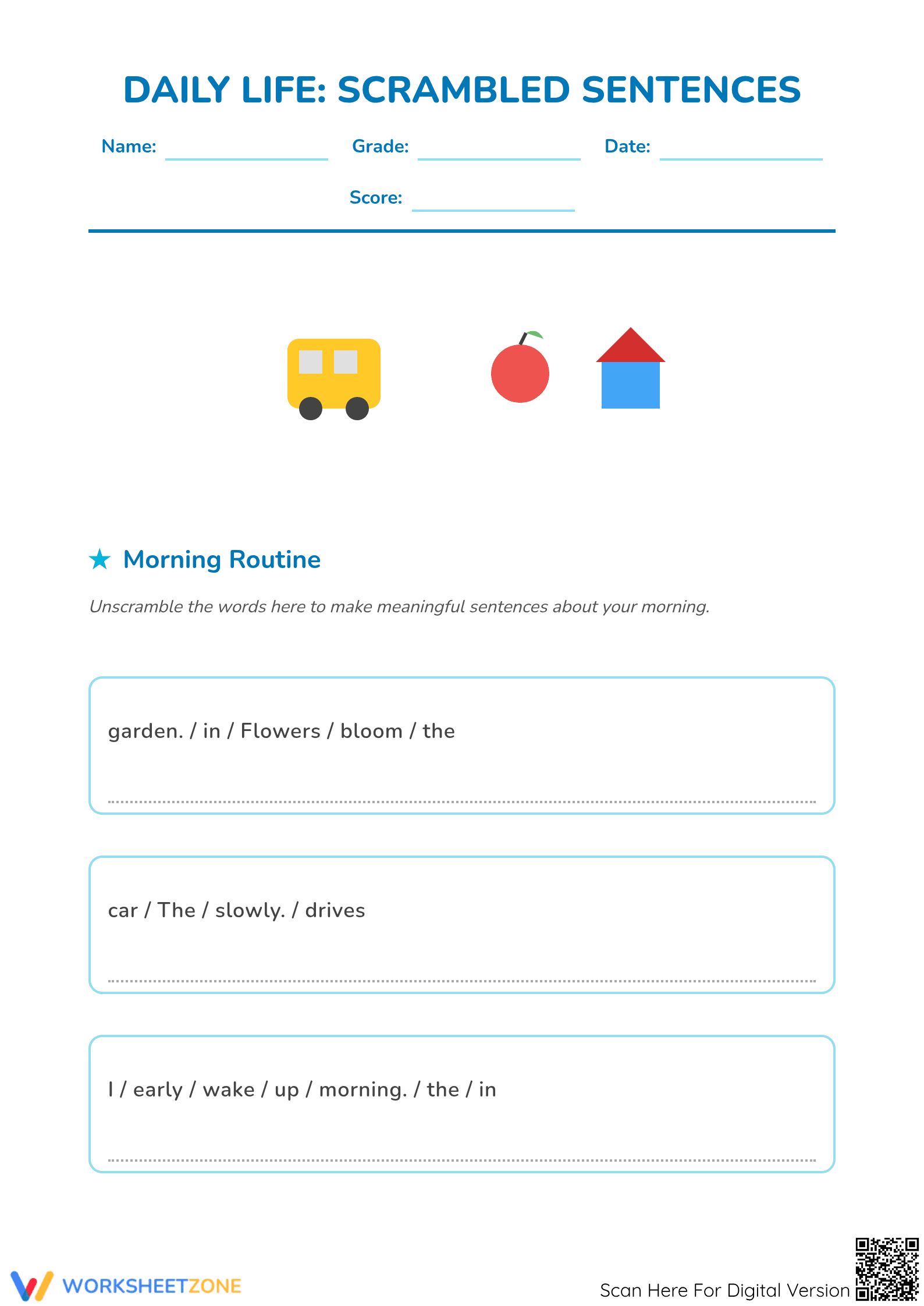
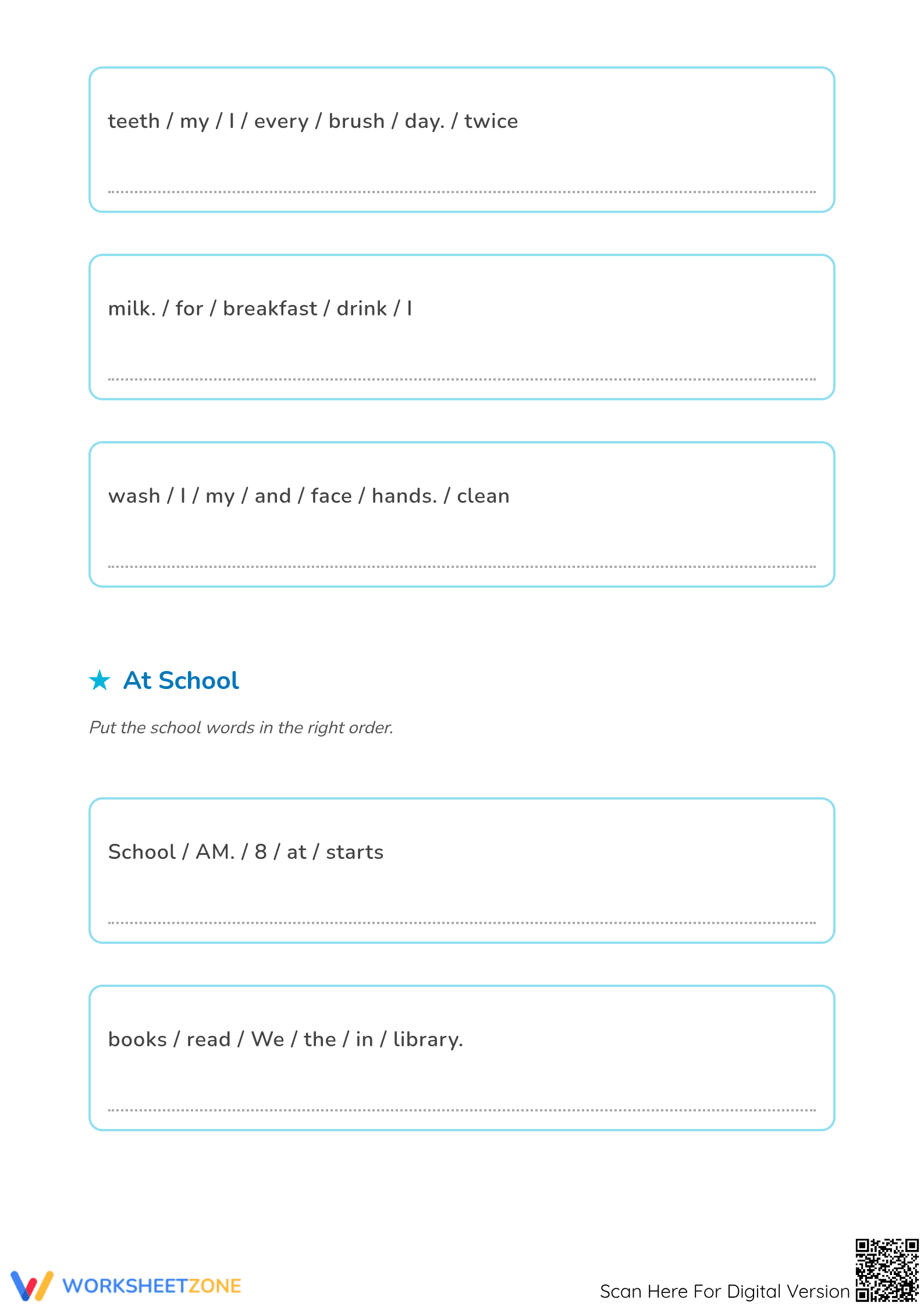
This Grade 1-3 sentence scramble worksheet helps students master syntax and word order by rearranging jumbled phrases into coherent thoughts. By focusing on subject-verb-object patterns, learners develop the foundational writing skills necessary for clear communication. Students will practice identifying capitalization cues and punctuation marks to successfully reconstruct five unique sentences.
At a Glance
- Grade: 1-3 · Subject: ELA
- Standard:
CCSS.ELA-LITERACY.L.1.1.J— Produce and expand complete simple and compound declarative sentences in response to prompts- Skill Focus: Sentence structure and syntax
- Format: 1 page · 5 problems · Answer key included · PDF
- Best For: Morning work or literacy centers
- Time: 10–15 minutes
Inside this resource, you will find a single-page layout featuring five distinct sentence-building tasks. Each task provides a set of scrambled words accompanied by a colorful visual aid to provide context and support comprehension. The worksheet includes clear writing lines for student responses and utilizes visual cues like capitalized first words and ending punctuation to guide the unscrambling process.
This resource is designed for a zero-prep workflow to save valuable instructional time. First, print the single-page PDF in under 30 seconds. Next, distribute the sheets to your students during your literacy block or as a transition activity. Finally, review the completed sentences as a whole group to provide immediate feedback on word order and grammar. It is an ideal solution for unexpected sub plans.
This worksheet aligns with CCSS.ELA-LITERACY.L.1.1.J, which requires students to produce and expand complete simple and compound declarative sentences. By requiring students to organize words into a logical sequence, the activity reinforces the understanding of how parts of speech function within a sentence. This standard code can be copied directly into lesson plans, IEP goals, or district curriculum mapping tools.
Use this worksheet as a formative assessment after a lesson on sentence parts. Observe if students recognize that the capitalized word starts the sentence and the word with the period ends it. It also works well as a fast-finisher activity or homework assignment. Expect students to complete the five tasks in approximately 10 to 15 minutes depending on their reading level.
This resource is perfect for first through third-grade students who are developing their writing fluency. It is particularly helpful for English Language Learners (ELLs) who need practice with English word order. Pair this worksheet with a sentence-building anchor chart or a short reading passage to reinforce the concept of complete thoughts and proper punctuation usage.
Effective sentence construction is a cornerstone of early literacy development, as highlighted in the Fisher & Frey (2014) framework for gradual release of responsibility. This worksheet specifically targets CCSS.ELA-LITERACY.L.1.1.J by challenging students to unscramble words to form meaningful sentences. Research from the NAEP indicates that students who master basic syntax in early elementary grades demonstrate significantly higher writing proficiency in later years. By engaging with these 5 structured tasks, learners practice the cognitive process of organizing thoughts into conventional English patterns. This activity serves as a bridge between word recognition and paragraph composition. The inclusion of visual supports aligns with best practices for scaffolded instruction, ensuring that students can access the content regardless of their current reading stamina. This resource provides a measurable way to track progress toward foundational ELA standards and supports the development of critical thinking skills through linguistic analysis.


