


























1 / 2
0
Views
0
Downloads


0.0
0
Save
0 Likes
Share
Science Worksheet for 2nd Graders
0 Views
0 Downloads
Paste this activity's link or code into your existing LMS (Google Classroom, Canvas, Teams, Schoology, Moodle, etc.).
Students can open and work on the activity right away, with no student login required.
You'll still be able to track student progress and results from your teacher account.
Information
Description
What It Is:
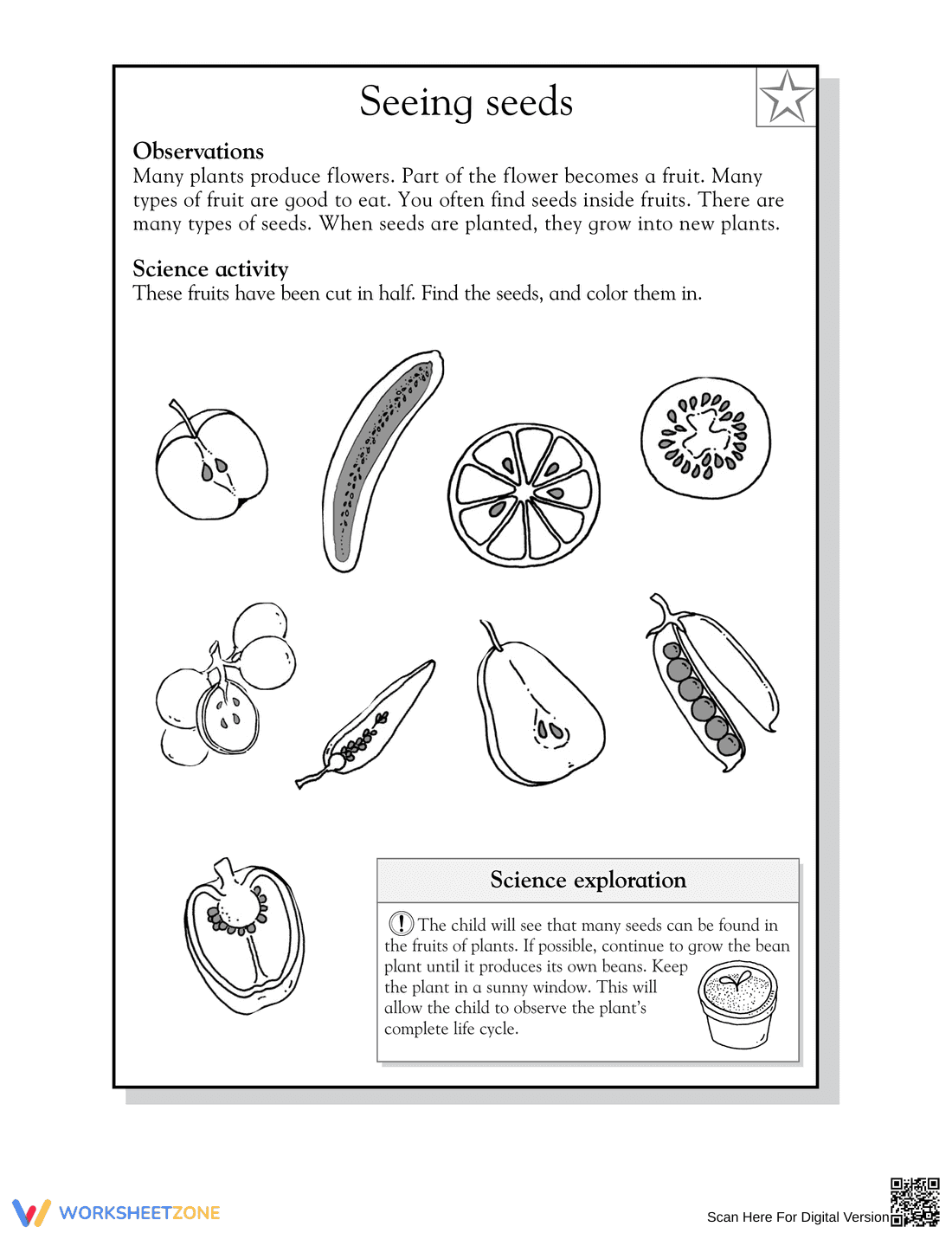
This is a science worksheet titled 'Seeing Seeds.' It includes observations about how plants produce flowers and fruits, and how seeds are found inside fruits. The science activity section shows line drawings of various fruits cut in half, such as an apple, cucumber, orange, tomato, grapes, beans, pear, and pepper. The task is to find the seeds within the fruits and color them in. A 'Science exploration' section provides instructions for a hands-on activity involving soaking bean seeds, planting them, and observing their growth.
Grade Level Suitability:
This worksheet is suitable for kindergarten through 2nd grade. The coloring activity and simple observations are appropriate for younger children, while the bean seed planting experiment can be adapted for slightly older children to encourage observation and recording skills.
Why Use It:
This worksheet helps children learn about the life cycle of plants, specifically the relationship between flowers, fruits, and seeds. It encourages observation skills through both the coloring activity and the planting experiment. It also promotes hands-on learning and scientific inquiry.
How to Use It:
First, read the 'Observations' section aloud to the student. Then, have the student examine the fruit drawings, identify the seeds, and color them in. Finally, guide the student through the 'Science exploration' activity, ensuring adult supervision. Encourage the student to draw what they observe each day as the bean seeds grow.
Target Users:
This worksheet is designed for elementary school students, particularly those in kindergarten through 2nd grade. It is also useful for parents and teachers looking for engaging science activities that promote observation and hands-on learning about plants and seeds.
This is a science worksheet titled 'Seeing Seeds.' It includes observations about how plants produce flowers and fruits, and how seeds are found inside fruits. The science activity section shows line drawings of various fruits cut in half, such as an apple, cucumber, orange, tomato, grapes, beans, pear, and pepper. The task is to find the seeds within the fruits and color them in. A 'Science exploration' section provides instructions for a hands-on activity involving soaking bean seeds, planting them, and observing their growth.
Grade Level Suitability:
This worksheet is suitable for kindergarten through 2nd grade. The coloring activity and simple observations are appropriate for younger children, while the bean seed planting experiment can be adapted for slightly older children to encourage observation and recording skills.
Why Use It:
This worksheet helps children learn about the life cycle of plants, specifically the relationship between flowers, fruits, and seeds. It encourages observation skills through both the coloring activity and the planting experiment. It also promotes hands-on learning and scientific inquiry.
How to Use It:
First, read the 'Observations' section aloud to the student. Then, have the student examine the fruit drawings, identify the seeds, and color them in. Finally, guide the student through the 'Science exploration' activity, ensuring adult supervision. Encourage the student to draw what they observe each day as the bean seeds grow.
Target Users:
This worksheet is designed for elementary school students, particularly those in kindergarten through 2nd grade. It is also useful for parents and teachers looking for engaging science activities that promote observation and hands-on learning about plants and seeds.


