


























Views
Downloads

Symmetry Drawing Worksheet | Printable Grade 2 Math
Paste this activity's link or code into your existing LMS (Google Classroom, Canvas, Teams, Schoology, Moodle, etc.).
Students can open and work on the activity right away, with no student login required.
You'll still be able to track student progress and results from your teacher account.
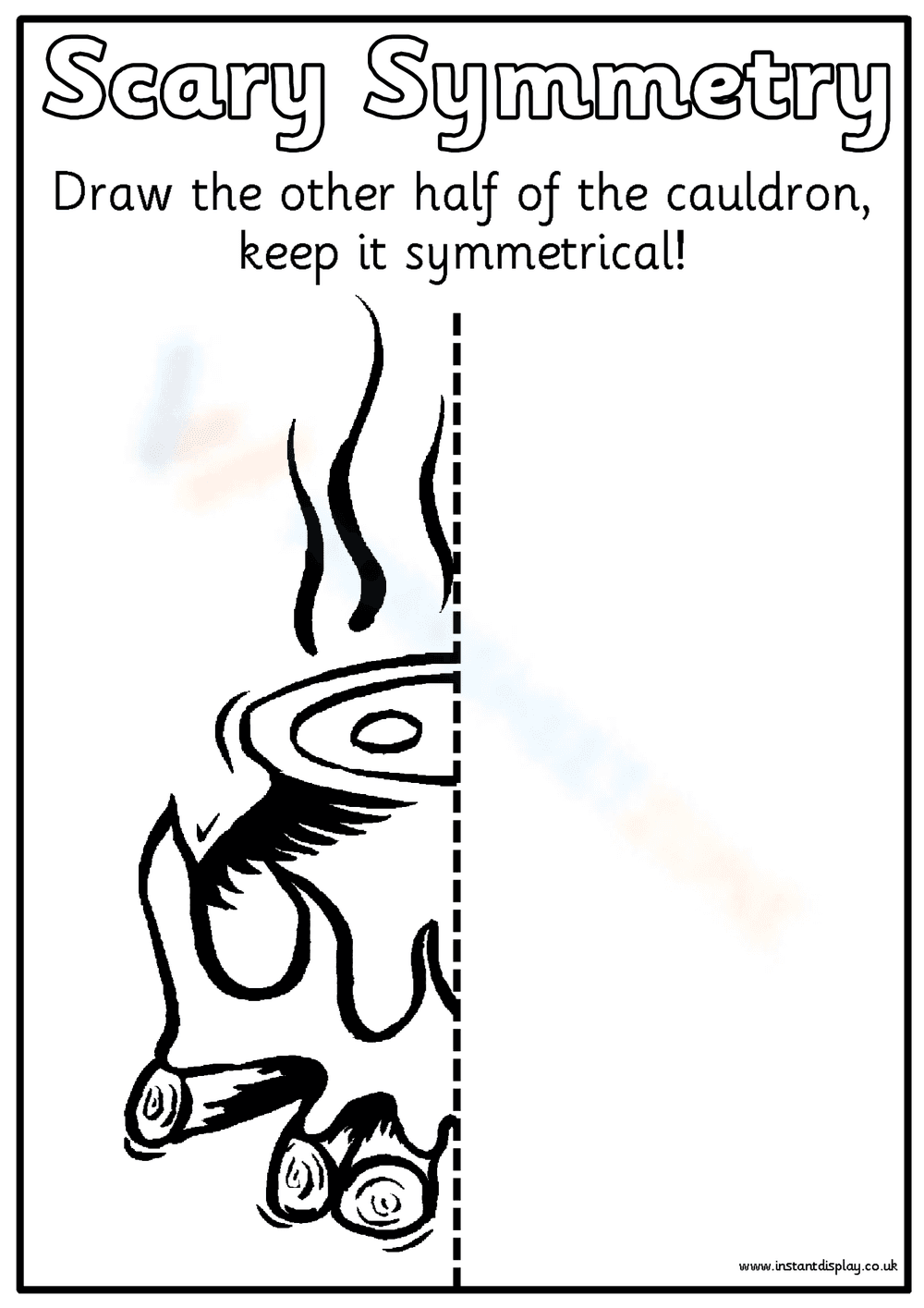
This Halloween-themed symmetry worksheet provides early elementary students with an engaging way to practice spatial reasoning and geometry skills. By completing the missing half of a spooky cauldron, learners develop fine motor control and a practical understanding of reflectional symmetry. The visual format makes abstract geometric concepts accessible and enjoyable.
At a Glance
- Grade: 1-3 · Subject: Math
- Standard:
CCSS.MATH.CONTENT.2.G.A.1— Draw shapes having specified attributes- Skill Focus: Line symmetry and spatial reasoning
- Format: 1 page · 1 problem · No answer key needed · PDF
- Best For: Morning work or math centers
- Time: 10–15 minutes
This single-page resource features a large, clear illustration of a Halloween cauldron split down the middle with a dashed line of symmetry. The left side provides the complete drawing, including details like flames, logs, and smoke, while the right side is left blank for the student to complete. The bold outlines and simple shapes make it an ideal introductory task for young artists and mathematicians. No answer key is required.
This resource requires zero teacher preparation.
- Print (1 minute): Simply download the PDF and print a class set. The black-and-white design is highly ink-efficient.
- Distribute (1 minute): Hand out the sheets along with pencils and optional coloring supplies. The instructions are self-explanatory.
- Review (1 minute): Walk around the room to observe students' spatial awareness as they mirror the image.
With a total prep time of under two minutes, this activity is an excellent addition to any emergency sub plan or last-minute holiday center rotation.
This activity aligns with CCSS.MATH.CONTENT.2.G.A.1: "Recognize and draw shapes having specified attributes, such as a given number of angles or a given number of equal faces." It also builds foundational skills for later symmetry expectations. Both standard codes can be copied directly into lesson plans, IEP goals, or district curriculum mapping tools.
Use this as independent morning work or a quiet transition activity. In math centers, students can use a small mirror along the dashed line to check their work. As a formative assessment observation tip, watch how students approach the task: do they count the flames and logs, or do they estimate the distances? This reveals their developing spatial reasoning strategies. Expect most students to complete the drawing in 10 to 15 minutes.
Designed for early elementary students developing fine motor and geometry skills. It naturally supports differentiation; students who need more scaffolding can use a ruler to measure distances from the center line, while advanced learners can be challenged to add their own symmetrical background details. This worksheet pairs wonderfully with a direct instruction lesson on reflectional symmetry or a read-aloud of a Halloween-themed picture book.
Developing spatial reasoning through visual arts integration is a critical component of early childhood mathematics. When students engage with CCSS.MATH.CONTENT.2.G.A.1 to draw shapes having specified attributes, they are actively building the cognitive frameworks required for advanced geometry. According to a comprehensive EdReports 2024 analysis of elementary math curricula, integrating drawing tasks with geometric concepts significantly improves students' ability to mentally manipulate two-dimensional figures. This cauldron symmetry activity provides a low-stakes, highly engaging environment for learners to test their spatial predictions and refine their fine motor control. By mirroring the complex shapes of the flames and logs across the central axis, young students transition from passive shape recognition to active geometric construction. This foundational practice ensures they are adequately prepared for more rigorous mathematical modeling in upper elementary grades.


