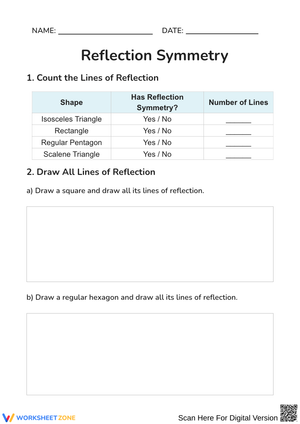
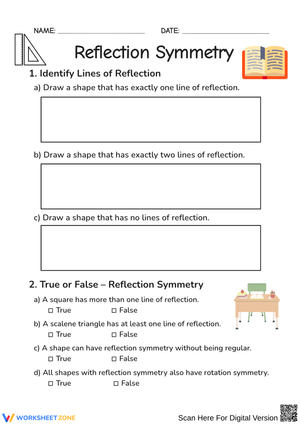
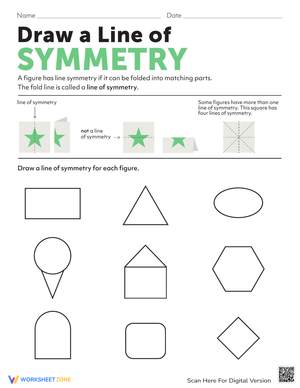
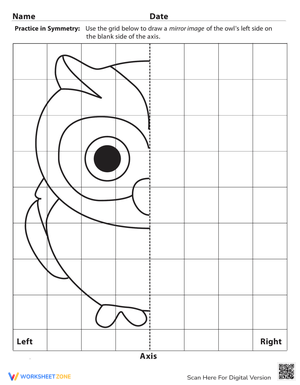
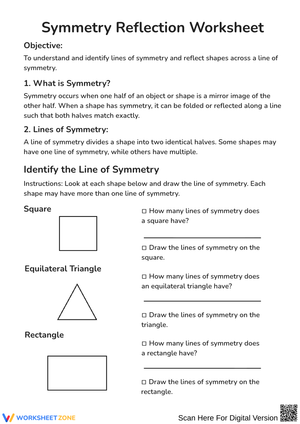
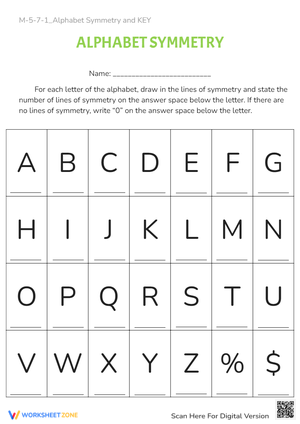
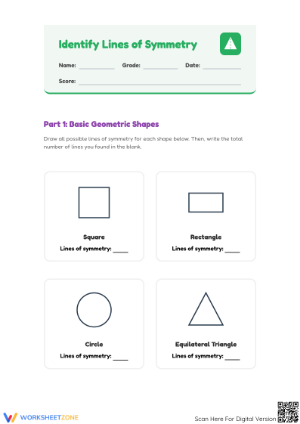
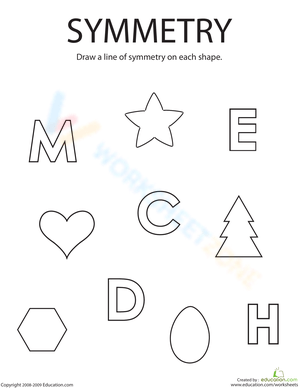
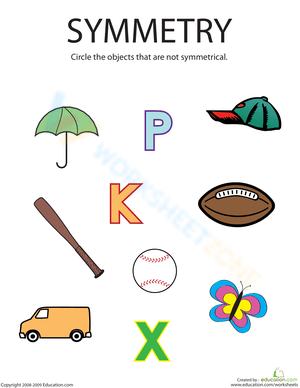
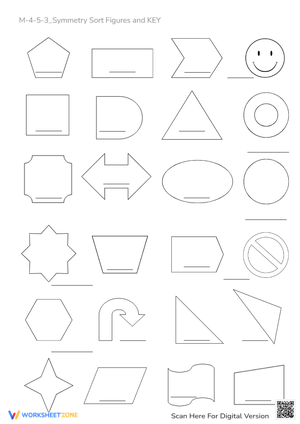
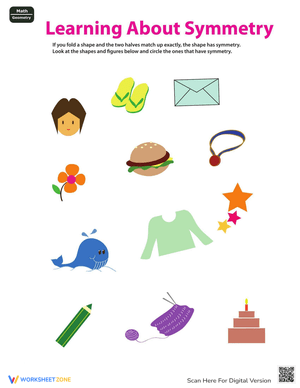
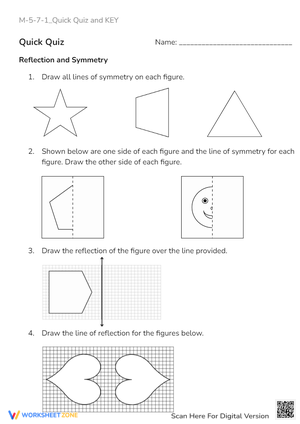
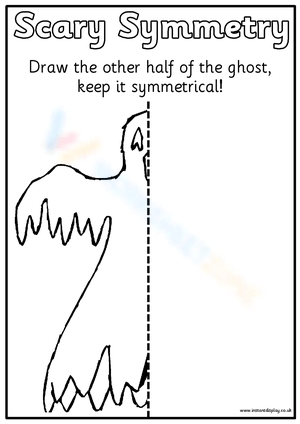
These lines of symmetry worksheets give teachers a print-ready bank of geometry practice spanning the full range from second-grade shape recognition through fifth-grade work with regular polygons — without requiring any assembly or adaptation before handing them out. Each page targets a specific phase of the concept so students build understanding in sequence rather than encountering symmetry as a single undifferentiated task.
Concepts Covered Across these Lines of Symmetry Workshets
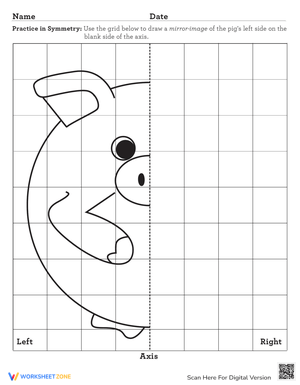
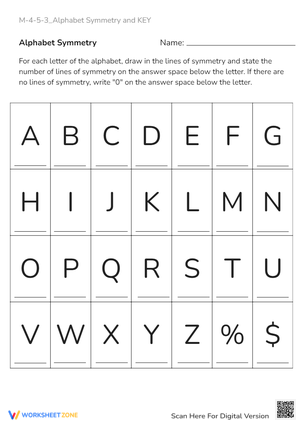
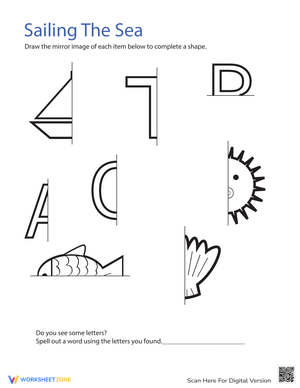
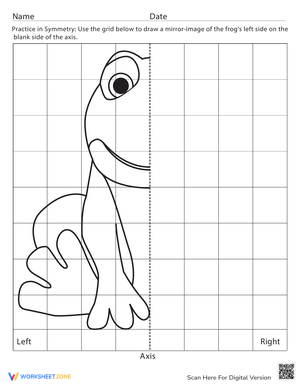
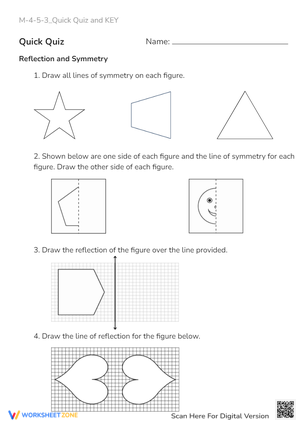
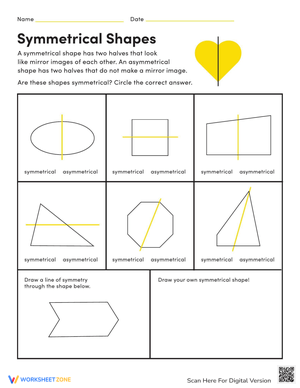
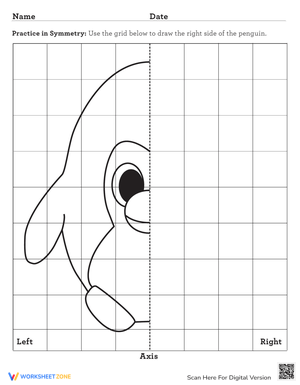
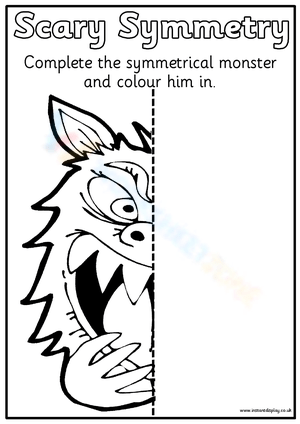
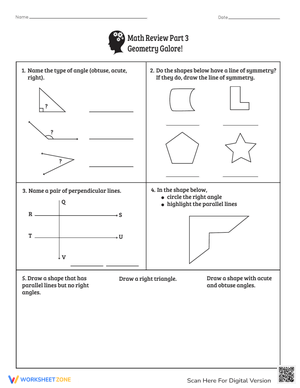
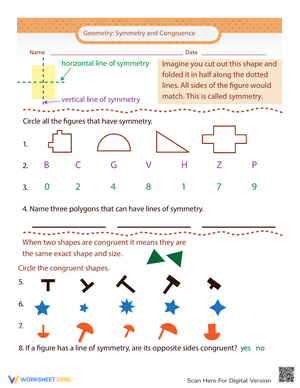
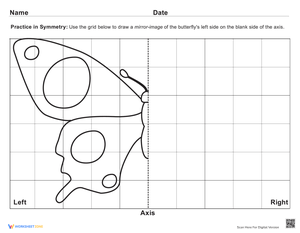
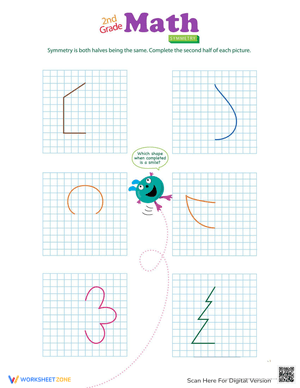
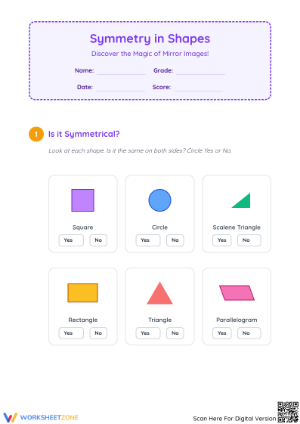
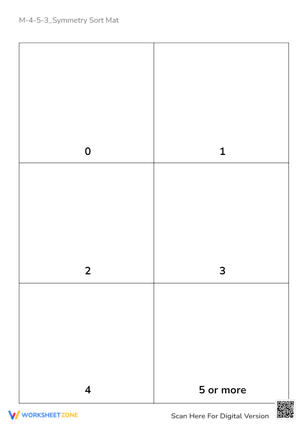
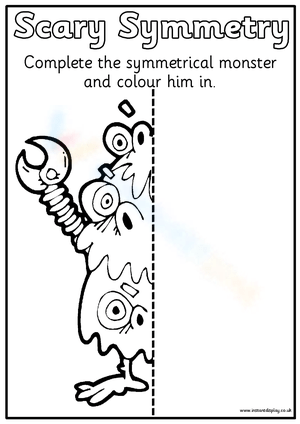
The worksheets move through four distinct skill layers. In the earliest pages, students identify whether a shape has a line of symmetry at all — a sorting task that forces a binary decision before any drawing begins. From there, students draw a single symmetry line on familiar regular shapes: squares, equilateral triangles, rectangles, and the letters of the alphabet, which offer surprising variety. (Capital letters alone span shapes with vertical symmetry like A and T, horizontal symmetry like B and E, both axes like H and X, and no symmetry at all like F and G.) The third layer asks students to find and draw all lines of symmetry on a given figure — five on a regular pentagon, six on a hexagon — which requires them to rotate their thinking rather than assume a single vertical axis is the answer. The fourth layer is "complete the figure": half a shape appears on one side of a dashed line and students reconstruct the mirror half, a task that builds spatial reasoning while producing instant self-assessment feedback when the two halves don't align cleanly.
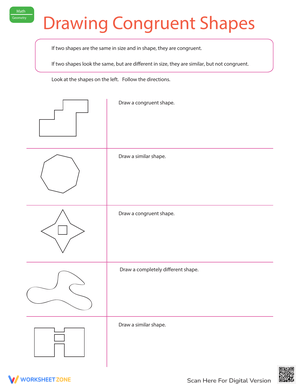
Irregular polygons and composite shapes appear in the more advanced pages. These are the figures that expose shallow understanding fastest, because a student who has been pattern-matching on regular shapes can't rely on visual familiarity — they have to reason about whether each candidate line actually produces two congruent halves.
Standard Alignment: 4.G.A.3
Common Core Standard 4.G.A.3 asks fourth graders to recognize a line of symmetry for a two-dimensional figure and to identify figures with line symmetry. The core pages in this set address that standard directly. The earlier pages targeting basic shape recognition provide access for students who need more foundational work, and the pages involving multiple lines of symmetry and irregular polygons extend the standard for students who have mastered the baseline expectation. Teachers using this set for a fourth-grade unit can assign the core pages with confidence that the skill being practiced matches the standard being assessed.
Where These Worksheets Fit in a Geometry Lesson Plan
The practical home for most of these pages is the stretch between initial instruction and assessment — the three to five days when students need varied repetition but the teacher is circulating and conferring rather than re-explaining from the front. A single worksheet at the right level takes most fourth graders eight to twelve minutes, which fits cleanly into a station rotation block. Set up one station with the worksheet, a second with paper shapes students fold and cut to physically verify their answers, and a third with small mirrors they hold against a shape's edge. Students rotating through all three arrive at the assessment with both procedural fluency and a concrete mental model to fall back on.
Exit tickets drawn from these pages work well at the end of the introductory lesson. Four shapes, three minutes, and the teacher has immediate formative data before planning the next day. The pages that ask students to draw all lines of symmetry on a regular polygon function better as independent practice than as exit tickets — they take longer and the errors students make are more diagnostic than pass/fail.
"Complete the Figure" Worksheet Format Specifically Fit These Grade Levels
Cognitive load theory offers a useful lens here. When a student is asked to identify a line of symmetry on a complete shape, the whole figure is present and they're making a judgment. When half the shape is missing and they must reconstruct it, they hold the symmetry line in working memory while simultaneously executing fine motor control across a grid. That dual demand is harder — which is why students who sail through identification tasks sometimes freeze on completion tasks — but it also produces durable learning. The act of drawing the mirror half forces students to coordinate their understanding of symmetry with spatial action rather than just recognition.
Dot-grid and graph-paper backgrounds matter enormously here. Students working on plain white paper tend to produce mirror halves that drift off-axis, which makes it impossible to tell whether their error is conceptual or just imprecision. Grid lines convert the task into a series of coordinate decisions — "this point is two squares right and one square up from the line, so its mirror is two squares left and one square up" — that students can execute systematically.
Error Patterns Worth Anticipating
The most persistent mistake in student work is marking a rectangle's diagonal as a line of symmetry. Students see a line cutting the shape in half and assume it qualifies. A paper rectangle folded along its diagonal disproves this in about ten seconds — the corners don't meet — but without that physical check, the error recurs on every new worksheet. Building one fold-test into the warm-up before any symmetry worksheet session pays off across the whole unit.
The second pattern appears specifically with circles: students draw one vertical line and move on. They've learned that shapes have lines of symmetry and implicitly assume there's a fixed number. A brief demonstration — fold a paper circle in half, show the fold, then rotate the circle and fold again, and again — makes infinite symmetry tangible in a way that a definition on a worksheet never quite achieves. After that demonstration, the worksheet question about circles becomes a record of what they saw rather than an abstract claim they're taking on faith.
A subtler error surfaces in composite shapes. Students will correctly identify that a square and an equilateral triangle each have lines of symmetry, then assume their combination inherits the same lines. Whether it does depends entirely on how the two shapes are joined. Worksheets that include composite figures give teachers a low-stakes way to surface this assumption before it shows up on an assessment.
Scaling the Pages for Different Learners
Students who are still developing number-spatial coordination benefit from pages where the symmetry line is already drawn and they decide only whether it correctly divides the figure. That narrows the task to judgment without requiring drawing precision. Students who need extension work beyond the grade-level standard can be directed to the irregular polygon pages or assigned a challenge: given a shape with zero lines of symmetry, alter it minimally to create exactly one. That open-ended constraint requires them to reason backward from the definition, which is a substantially different cognitive task than anything a worksheet prompt typically asks.
Frequently Asked Questions
Do I need mirrors or manipulatives to use these pages effectively?
The worksheets function without any materials — students can reason through each item with a pencil alone. That said, having a few small mirrors available at a station dramatically reduces conceptual errors for students who are still building the mental model. A mirror held along a proposed symmetry line immediately confirms or refutes the student's answer, which is more efficient than teacher correction after the fact.
What's the right grade to introduce multiple lines of symmetry?
Most students are ready to work with multiple lines of symmetry in fourth grade, when 4.G.A.3 introduces the concept formally. Introducing it in third grade as enrichment is reasonable for students who have the regular shapes solidly. Pushing it into second grade tends to produce surface-level completion rather than understanding — second graders can often count lines they've been told to draw without yet grasping why a given line qualifies.
How do I handle the rectangle diagonal misconception at scale?
Rather than correcting it individually, build the fold test into a whole-class moment early in the unit. Display a rectangle, ask students to vote on whether the diagonal is a line of symmetry, then fold a large paper rectangle along the diagonal in front of the class. The visual mismatch — corners sticking out, edges failing to align — registers in a way that circled corrections on a returned worksheet do not. After that moment, students tend to self-correct before marking diagonals.













 Interactive Worksheet Maker
 Quiz Maker
 Word Search Maker
 Crossword Puzzle Maker
 Word Scramble Generator
 Sentence Scramble Generator
 Handwriting Worksheet Generator
 Name Tracing Generator
 Fill In The Blank Generator