


























Views
Downloads
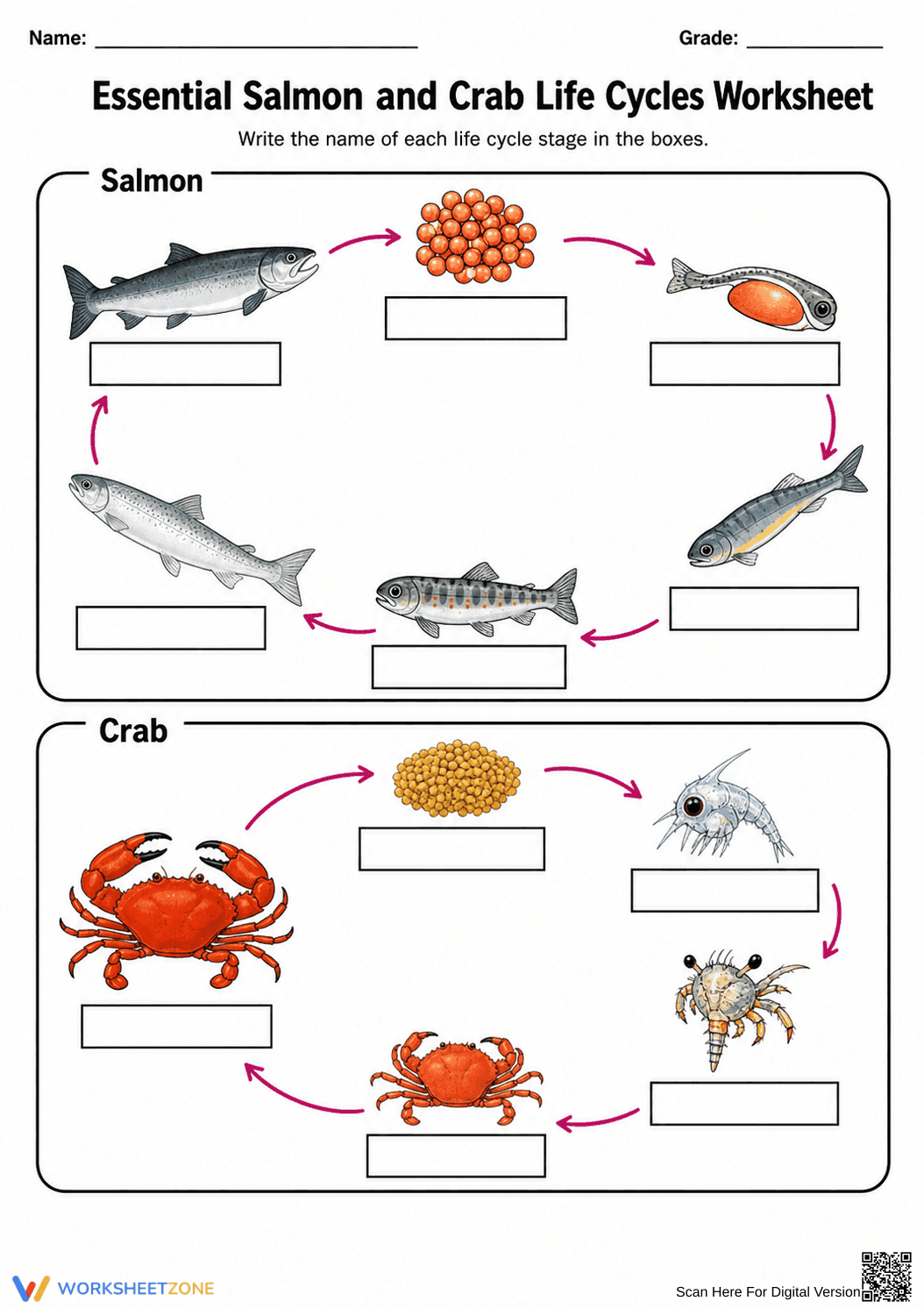

Grade 6 Animal Life Cycles — Printable No-Prep Worksheet
Paste this activity's link or code into your existing LMS (Google Classroom, Canvas, Teams, Schoology, Moodle, etc.).
Students can open and work on the activity right away, with no student login required.
You'll still be able to track student progress and results from your teacher account.
This essential science worksheet helps students master the stages of animal development by labeling the life cycles of a salmon and a crab. By visually mapping these biological progressions, learners build a concrete understanding of how organisms grow, transition between developmental phases, and eventually reach reproductive maturity.
At a Glance
- Grade: 6 · Subject: Science
- Standard:
MS-LS1-4— Model and explain the stages of animal growth and reproduction.- Skill Focus: Labeling animal life cycles
- Format: 1 page · 11 problems · Answer key included · PDF
- Best For: Independent practice or sub plans
- Time: 10–15 minutes
This single-page resource features two biological diagrams. The top section illustrates the cyclical progression of a salmon, providing six blank text boxes to identify each developmental phase from egg to adult. The bottom section mirrors this format with a crab life cycle, offering five blank boxes to label its larval and adult stages. A complete answer key is included for accurate grading.
Designed for maximum efficiency, this resource requires zero teacher setup:
- Print (1 minute): Simply download the PDF and print a class set. The clear diagrams reproduce beautifully in both color and grayscale.
- Distribute (1 minute): Hand out the worksheets as a warm-up activity, science center task, or independent review assignment.
- Review (3 minutes): Display the included answer key on your smartboard for quick, whole-class self-correction.
With a total prep time of under two minutes, this self-explanatory diagram activity is an ideal, stress-free addition to any emergency sub plan.
This worksheet aligns with MS-LS1-4, supporting students as they use evidence to explain how characteristic animal behaviors and specialized structures affect successful reproduction. It reinforces general life science concepts regarding organism growth. Both standard codes can be copied directly into lesson plans, IEP goals, or district curriculum mapping tools.
Deploy this worksheet during direct instruction as a guided note-taking tool, allowing students to fill in stages as you introduce them. Alternatively, assign it as an independent post-lesson assessment. As a formative assessment tip, observe whether students correctly sequence the intermediate larval stages, as these are often the most easily confused phases. Expected completion time ranges from 10 to 15 minutes.
This resource is primarily designed for middle school science students studying biology, ecosystems, or animal development. To support diverse learners, teachers can provide a separate word bank on the board for students who need spelling or vocabulary scaffolding. It pairs perfectly with an introductory direct instruction lesson on aquatic ecosystems or a reading passage detailing the incredible migratory journey of the Pacific salmon.
Integrating visual models into life science instruction significantly enhances student comprehension of complex biological processes. According to a ScienceDirect TpT Analysis, utilizing structured diagrams with targeted labeling tasks reduces cognitive load and allows learners to focus specifically on sequential relationships and domain-specific vocabulary. This worksheet directly supports MS-LS1-4 by requiring students to model and explain the stages of animal growth and reproduction through the specific examples of salmon and crabs. By actively engaging with these visual representations, students transition from passive observation to active cognitive processing, solidifying their understanding of how organisms develop over time. The clear, cyclical format reinforces the continuous nature of biological life cycles, providing a foundational framework that students can apply to more advanced ecological and evolutionary concepts in future science coursework.


