


























Views
Downloads

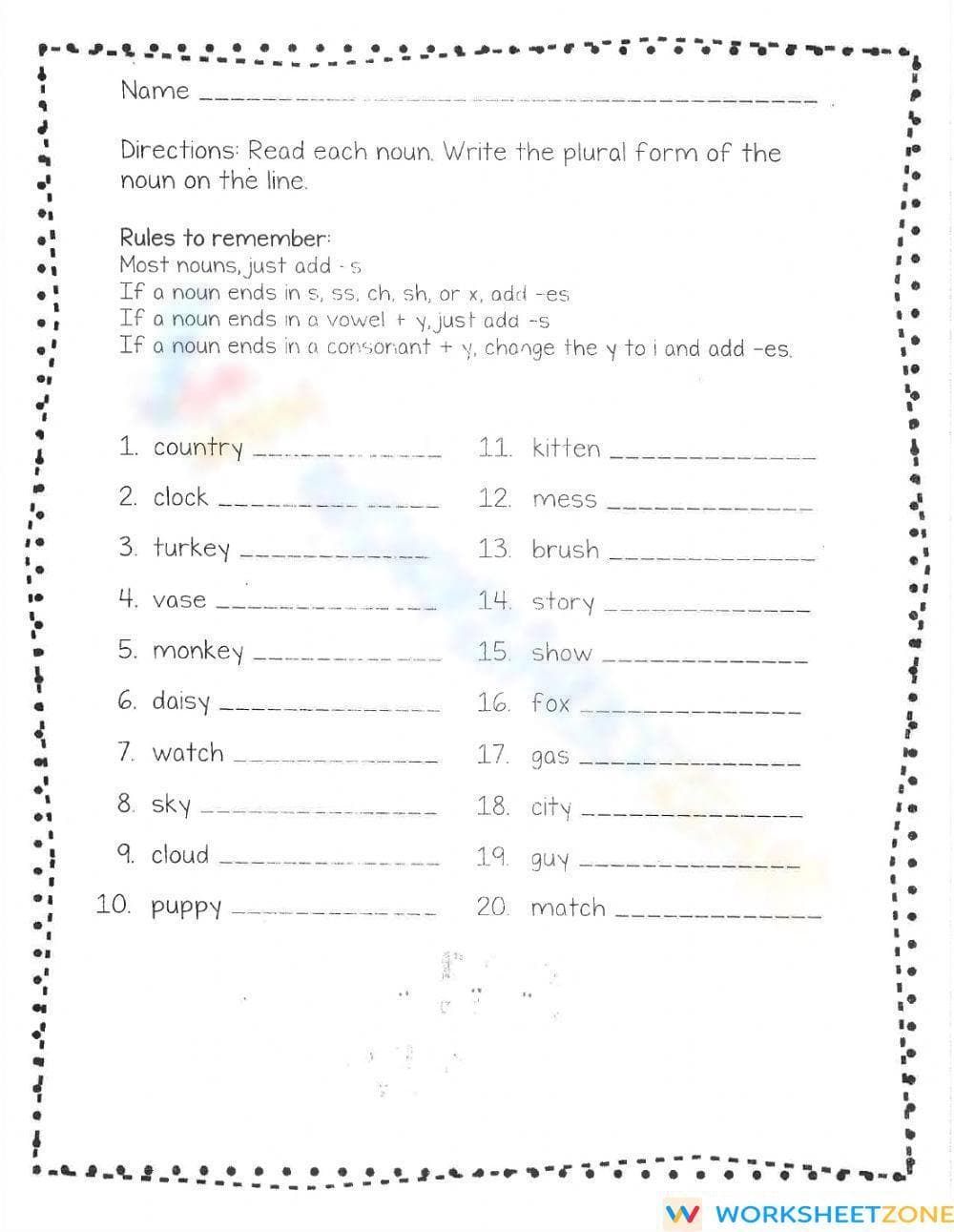

Printable Plural Nouns Worksheet | Grade 3 ELA
Paste this activity's link or code into your existing LMS (Google Classroom, Canvas, Teams, Schoology, Moodle, etc.).
Students can open and work on the activity right away, with no student login required.
You'll still be able to track student progress and results from your teacher account.
This essential worksheet provides targeted practice for third-grade students learning to form regular plural nouns. Through a series of clear and structured exercises, learners will master the rules for adding -s and -es to singular nouns, building a foundational skill for accurate and effective writing.
At a Glance
- Grade: 3 · Subject: ELA / Language
- Standard:
CCSS.ELA-LITERACY.L.3.1.b— Form regular and irregular plural nouns.- Skill Focus: Forming Regular Plural Nouns (-s, -es)
- Format: 2 pages · 32 problems · Answer key included · PDF
- Best For: Independent practice, grammar centers, homework
- Time: 15–20 minutes
A Clear Path to Plural Mastery
This two-page resource contains 32 fill-in-the-blank problems focused on pluralization rules. The first page introduces basic rules for adding -s and -es. The second page expands on these, adding rules for words ending in -y. A complete answer key is provided for easy grading or self-correction.
- Guided Practice: The worksheet begins with clearly stated rules and examples for forming plurals (e.g., cup-cups, latch-latches), giving students a reference point for the initial 12 problems.
- Supported Practice: The second page re-states the rules and adds complexity, including nouns ending in -y, providing support as students work through another 20 items.
- Independent Practice: Students apply their knowledge across 32 unique nouns, demonstrating their ability to select and apply the correct pluralization rule independently. This follows a proven gradual-release model.
Aligned for Impact
This worksheet is directly aligned with CCSS.ELA-LITERACY.L.3.1.b, which requires students to "Form regular and irregular plural nouns." It provides focused practice on the most common regular pluralization patterns. Both standard codes can be copied directly into lesson plans or curriculum mapping tools.
Flexible for Your Classroom
Use this resource as independent practice after a direct instruction lesson on plural nouns. It also functions perfectly as a station activity or a quick homework assignment. For formative assessment, observe which rule (e.g., words ending in -ch/-sh, words ending in -y) proves most challenging for students. Expected completion time is 15-20 minutes.
Built for Grade 3 Learners
This worksheet is ideal for third-grade students, but can also serve as a review for fourth graders or an advanced challenge for second graders. Pair this activity with a classroom anchor chart displaying the key pluralization rules for students to reference as they work.
This resource provides targeted practice for a foundational language convention, forming plural nouns, as specified in CCSS.ELA-LITERACY.L.3.1.b. Mastering pluralization is a critical component of syntactic accuracy and written expression. Research consistently shows that explicit and systematic instruction in foundational skills is highly effective for young learners. According to the RAND AIRS 2024 report on literacy, structured practice opportunities are essential for moving skills from initial acquisition to fluent application. By providing 32 distinct practice items, this worksheet helps students internalize grammatical rules through repetition, which is a key principle in building automaticity. This allows cognitive resources to be freed up for more complex writing tasks, such as developing ideas and organizing text. The worksheet serves as a practical tool for implementing evidence-based instruction in the elementary classroom, supporting students in developing the conventional accuracy needed for clear communication.


