


























0
Views
0
Downloads

0.0
0
Save
0 Likes
Share
Exploring the Concept of Rolling
0 Views
0 Downloads
Paste this activity's link or code into your existing LMS (Google Classroom, Canvas, Teams, Schoology, Moodle, etc.).
Students can open and work on the activity right away, with no student login required.
You'll still be able to track student progress and results from your teacher account.
Information
Description
What It Is:
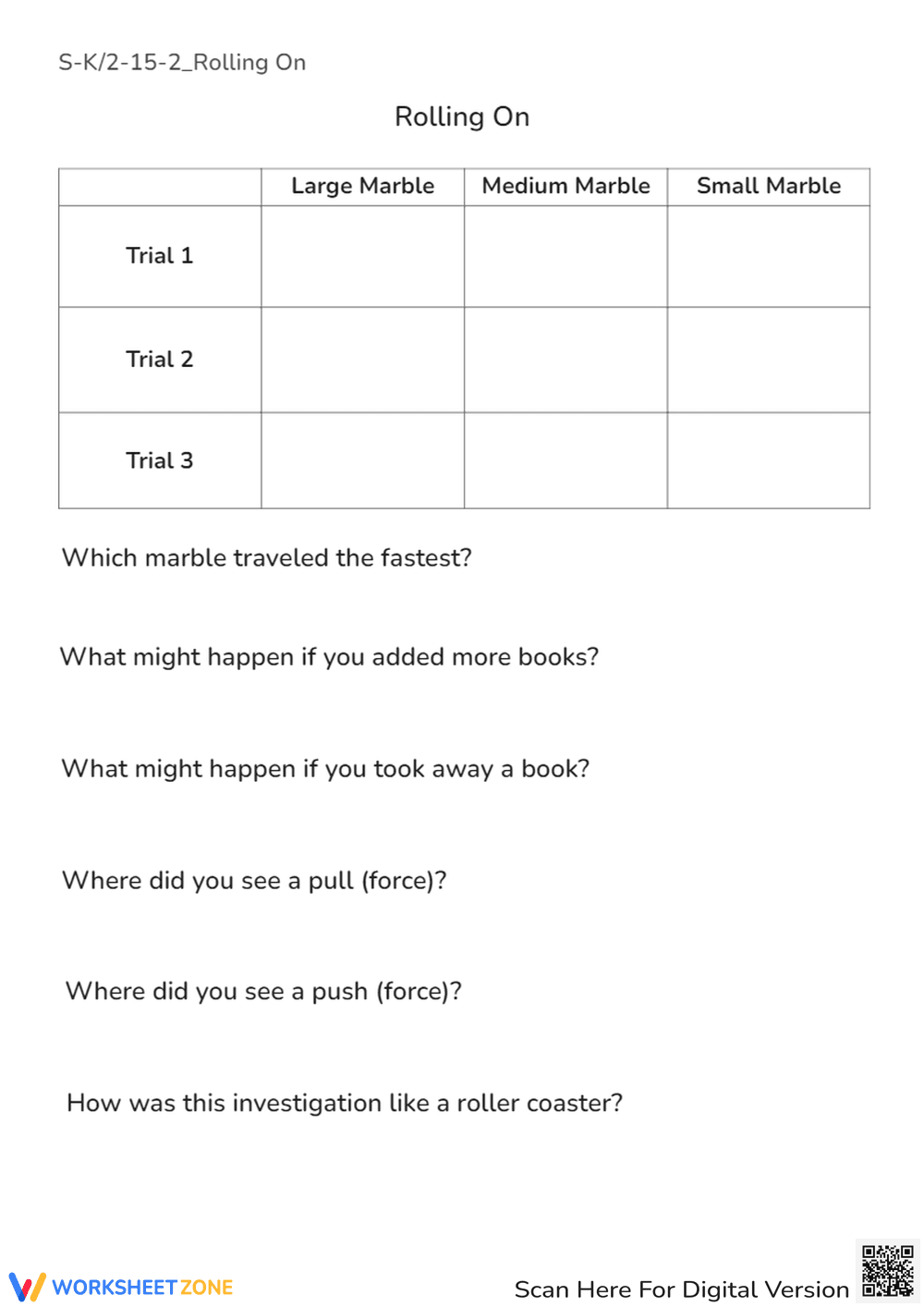
This is a science worksheet titled 'Rolling On' designed for an experiment involving rolling marbles of different sizes (large, medium, and small). It includes a table to record the results of three trials for each marble size. Below the table are open-ended questions prompting students to analyze the experiment, consider the impact of changing variables (adding or removing books), identify examples of push and pull forces, and relate the investigation to the concept of a roller coaster.
Grade Level Suitability:
This worksheet is suitable for Kindergarten to 2nd grade. The concepts of force, motion, and observation are introduced at this level. The simple questions and table format make it accessible for young learners.
Why Use It:
This worksheet encourages hands-on learning and critical thinking about physics concepts. It promotes observation skills, data recording, and the ability to make connections between scientific experiments and real-world phenomena like roller coasters. It also helps students understand the concepts of push and pull forces.
How to Use It:
First, conduct the marble rolling experiment, varying the size of the marble. Students should record their observations in the table for each trial. Then, guide students through the questions, encouraging them to explain their reasoning and make predictions about changing the experiment's parameters.
Target Users:
This worksheet is designed for elementary school students, particularly those in Kindergarten through 2nd grade, as well as teachers and parents looking for engaging science activities. It is also suitable for homeschoolers exploring basic physics concepts.
This is a science worksheet titled 'Rolling On' designed for an experiment involving rolling marbles of different sizes (large, medium, and small). It includes a table to record the results of three trials for each marble size. Below the table are open-ended questions prompting students to analyze the experiment, consider the impact of changing variables (adding or removing books), identify examples of push and pull forces, and relate the investigation to the concept of a roller coaster.
Grade Level Suitability:
This worksheet is suitable for Kindergarten to 2nd grade. The concepts of force, motion, and observation are introduced at this level. The simple questions and table format make it accessible for young learners.
Why Use It:
This worksheet encourages hands-on learning and critical thinking about physics concepts. It promotes observation skills, data recording, and the ability to make connections between scientific experiments and real-world phenomena like roller coasters. It also helps students understand the concepts of push and pull forces.
How to Use It:
First, conduct the marble rolling experiment, varying the size of the marble. Students should record their observations in the table for each trial. Then, guide students through the questions, encouraging them to explain their reasoning and make predictions about changing the experiment's parameters.
Target Users:
This worksheet is designed for elementary school students, particularly those in Kindergarten through 2nd grade, as well as teachers and parents looking for engaging science activities. It is also suitable for homeschoolers exploring basic physics concepts.


