


























Views
Downloads

Freshwater Ecosystems Worksheet | Grade 6-12 Essential
Paste this activity's link or code into your existing LMS (Google Classroom, Canvas, Teams, Schoology, Moodle, etc.).
Students can open and work on the activity right away, with no student login required.
You'll still be able to track student progress and results from your teacher account.
Students analyze the critical role of aquatic ecology and conservation efforts through this comprehensive reading comprehension resource. By examining a real-world article on Pennsylvania waterways, learners identify how human activities influence freshwater health and biodiversity. This activity ensures students can connect scientific theory to practical environmental management and professional ecological careers.
At a Glance
- Grade: 6-12 · Subject: Science
- Standard:
MS-ESS3-3— Apply scientific principles to monitor and minimize human impact on the environment- Skill Focus: Freshwater Ecosystem Conservation
- Format: 3 pages · 10 problems · Answer key included · PDF
- Best For: Environmental science units and literacy integration
- Time: 40–50 minutes
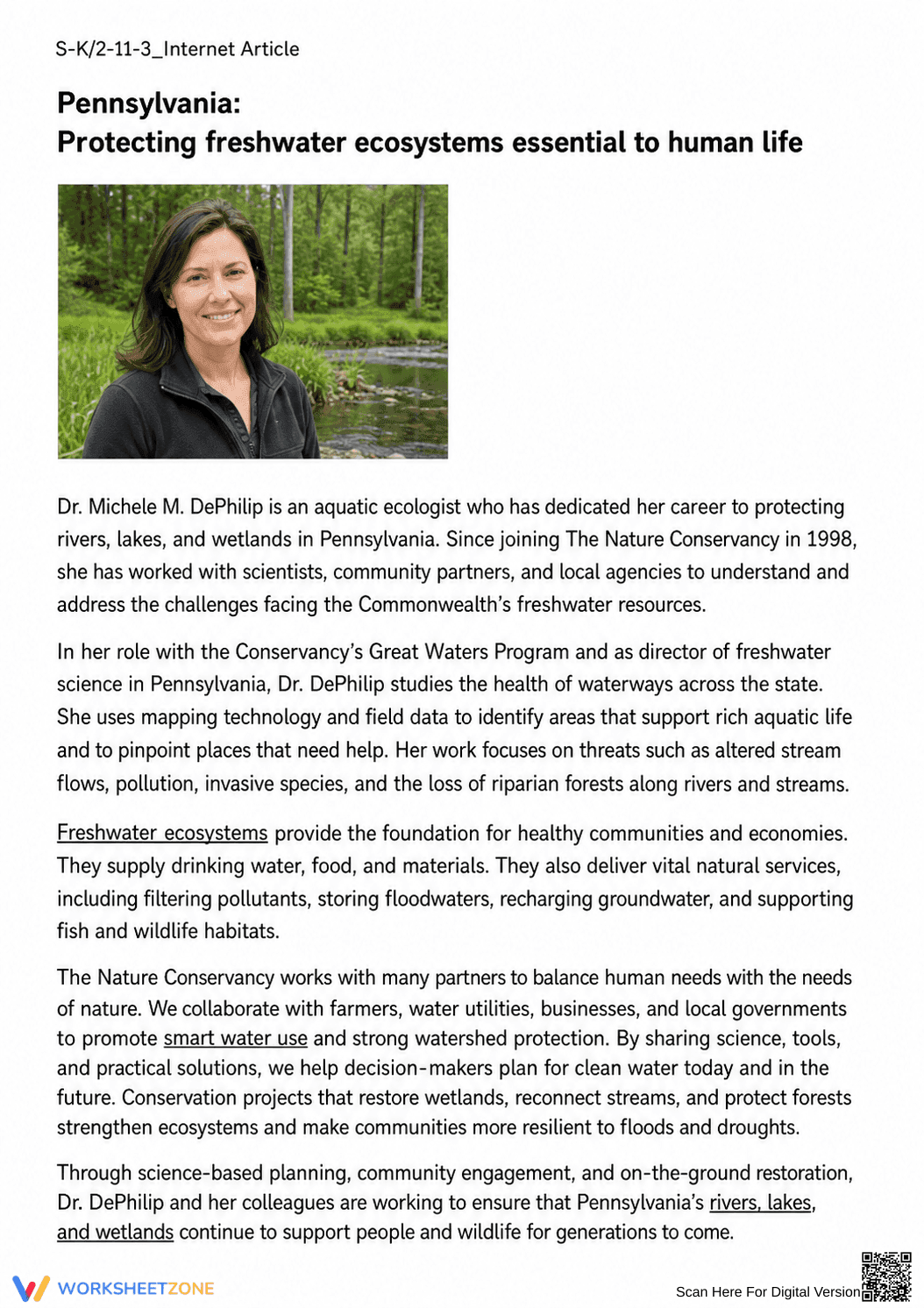
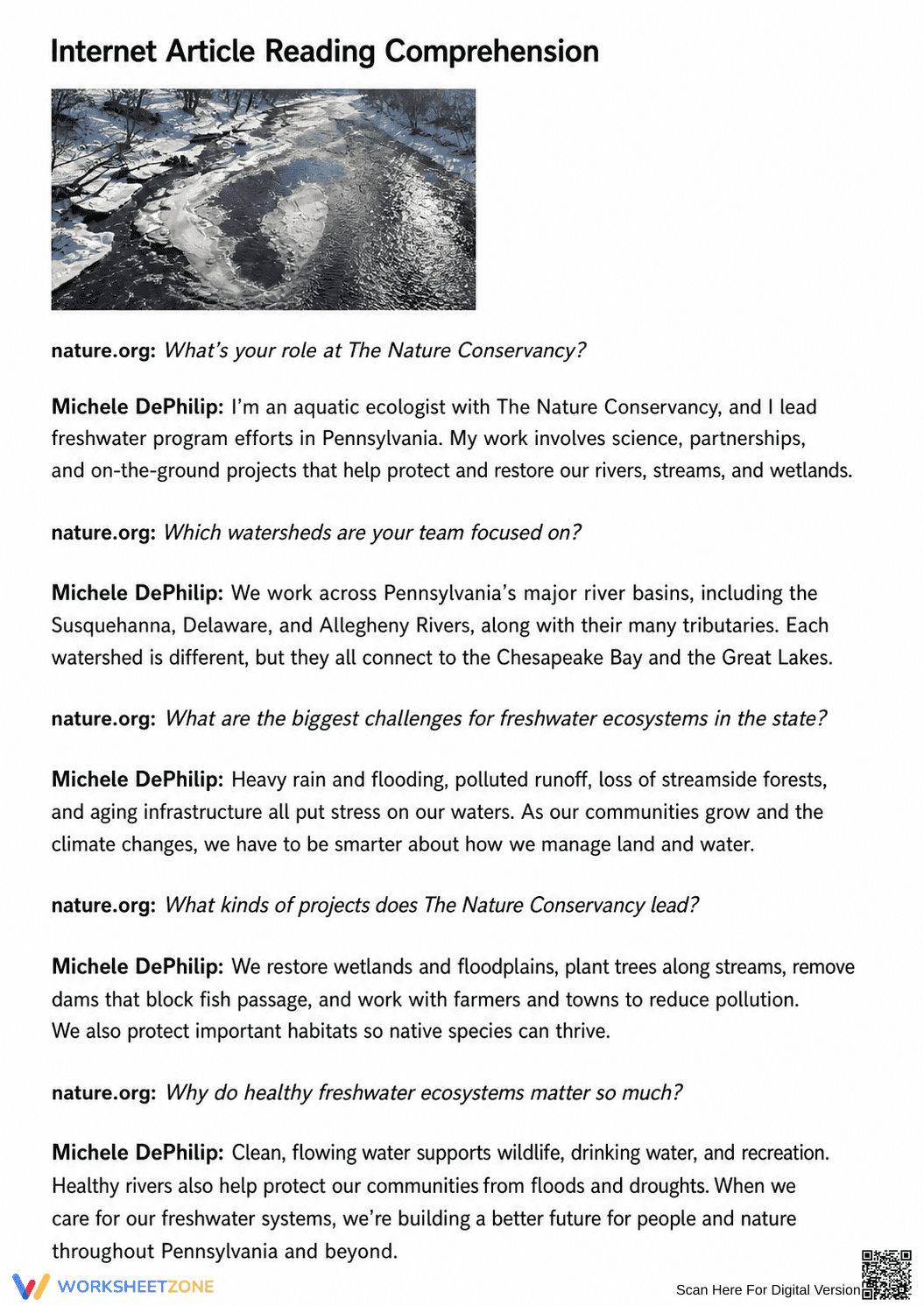
This 3-page instructional resource features a detailed interview and article format focusing on the work of The Nature Conservancy. It includes high-quality imagery of river systems and professional ecologists to provide visual context. The layout is designed for clarity, featuring a structured Q&A section that breaks down complex environmental challenges into manageable segments for secondary students.
Skill Progression
- Guided Practice: Students begin by identifying key vocabulary and the primary roles of an aquatic ecologist using 3 text-dependent identification tasks.
- Supported Practice: Learners analyze 4 specific threats to freshwater systems, such as invasive species and pollution, using evidence directly from the provided interview.
- Independent Practice: The final 3 tasks require students to synthesize information to explain the long-term benefits of sustainable water management for human communities.
This gradual-release approach moves students from basic recall to high-level analysis of environmental interdependence.
Standards Alignment
This resource is aligned to `MS-ESS3-3`, which requires students to apply scientific principles to design a method for monitoring and minimizing a human impact on the environment. It also supports literacy in science by requiring students to cite specific textual evidence to support analysis of science and technical texts. Both standard codes can be copied directly into lesson plans, IEP goals, or district curriculum mapping tools.
How to Use It
This worksheet serves as an effective formative assessment during a unit on ecology or human impact. Assign it after an introductory lecture on watersheds to allow students to see those concepts applied in a professional context. Teachers should observe if students can distinguish between natural ecosystem functions and human-led restoration efforts. Expect a completion time of 45 minutes for most middle school learners.
Who It's For
This resource is designed for middle and high school science students, particularly those in Earth Science or Biology courses. It provides necessary scaffolding for general education classrooms while offering enough technical depth for advanced learners. It pairs naturally with a local watershed map or an anchor chart detailing the water cycle and human intervention points.
According to the RAND AIRS 2024 report, integrating high-interest informational texts into science curricula significantly improves both domain-specific literacy and the retention of complex ecological concepts. This worksheet addresses the MS-ESS3-3 standard by requiring students to evaluate how scientific planning and community engagement mitigate environmental degradation. By focusing on the specific work of Dr. Michele M. DePhilip, the resource provides a concrete model of the scientific method applied to large-scale conservation. Research indicates that exposure to professional STEM pathways through reading increases student engagement in environmental stewardship. This 3-page document provides the necessary 10 tasks to ensure students move beyond surface-level reading to a deep understanding of freshwater biodiversity and sustainable management. It remains a vital tool for secondary educators looking to bridge the gap between textbook theory and real-world environmental science applications.


