




























Views
Downloads

Plant Life Cycle Worksheet | Essential Kindergarten Science

Paste this activity's link or code into your existing LMS (Google Classroom, Canvas, Teams, Schoology, Moodle, etc.).
Students can open and work on the activity right away, with no student login required.
You'll still be able to track student progress and results from your teacher account.
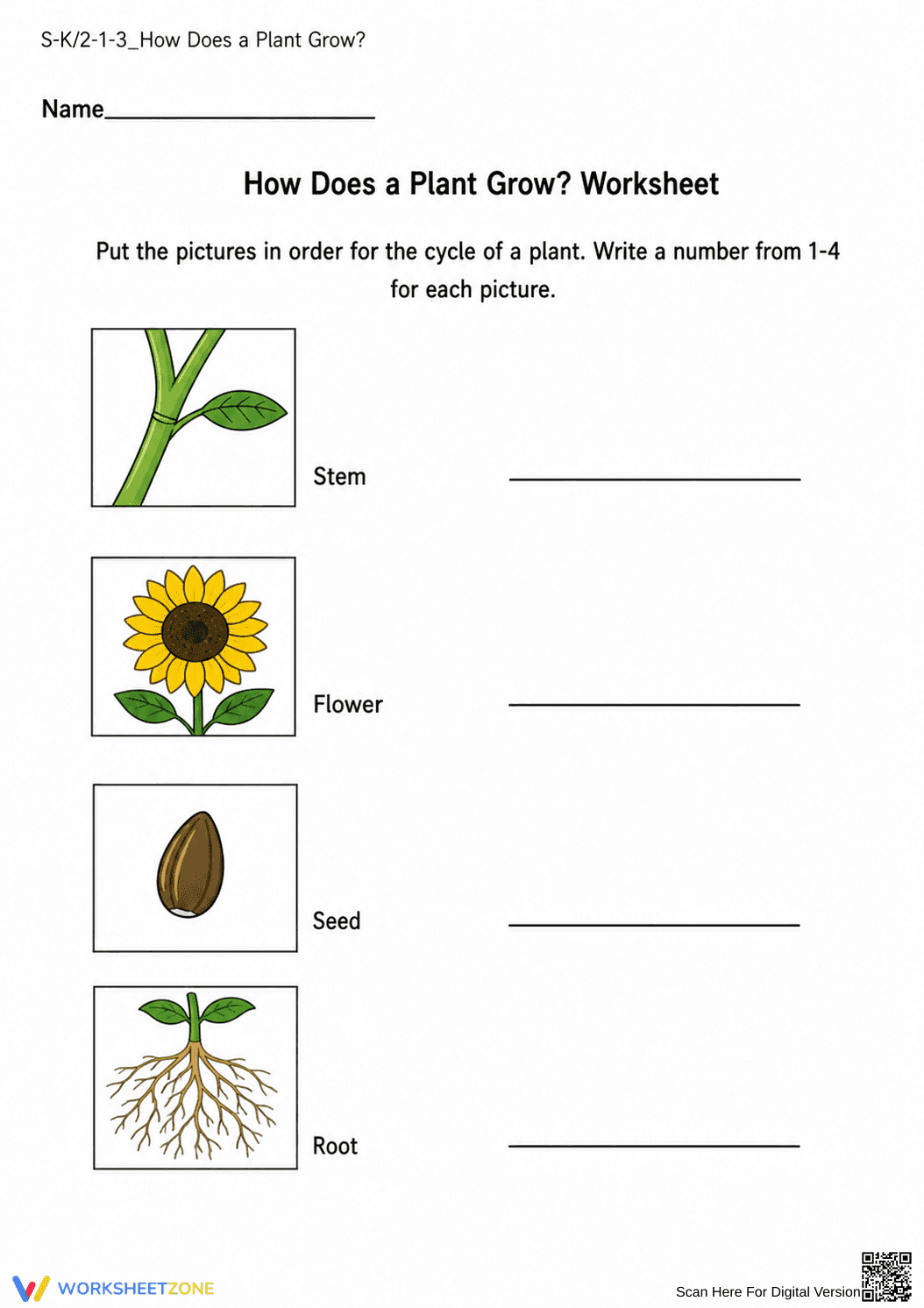
This Kindergarten science worksheet helps students master the plant life cycle by sequencing four key stages of growth. Students identify and order the seed, root, stem, and flower to demonstrate their understanding of biological patterns. It provides a clear, visual way for early learners to grasp how living things change over time while reinforcing basic scientific vocabulary.
At a Glance
- Grade: Kindergarten · Subject: Science
- Standard:
K-LS1-1— Use observations to describe patterns of what plants need to survive and grow- Skill Focus: Sequencing plant growth stages
- Format: 1 page · 4 problems · Answer key included · PDF
- Best For: Introduction to life cycles and sequencing
- Time: 10–15 minutes
This single-page PDF features four high-contrast illustrations representing the primary stages of a plant's development: the seed, the root system, the emerging stem, and the mature flower. Each image is paired with a clear text label and a dedicated line for numbering. The layout is designed specifically for young learners, featuring large targets for writing and distinct visual cues that reduce cognitive load during the sequencing process.
Zero-Prep Workflow
- Print: Select the single-page PDF and print enough copies for your group in under 30 seconds.
- Distribute: Hand out the sheets along with pencils or crayons for optional coloring to extend the activity (1 minute).
- Review: Use the included answer key to quickly check student sequencing or review as a whole class to facilitate discussion (1 minute).
This resource is ideal for emergency sub plans or as a quick formative assessment after a garden walk or classroom observation.
Standards Alignment: This resource is aligned with K-LS1-1, focusing on the observable patterns of plant growth and development. By identifying the progression from seed to flower, students build the foundational knowledge required for later life science standards regarding reproduction and inheritance. Both standard codes can be copied directly into lesson plans, IEP goals, or district curriculum mapping tools.
How to Use It: Use this worksheet during the "Explain" phase of a 5E lesson model after students have observed real seeds sprouting in the classroom. It serves as an excellent check for understanding to ensure students can translate 3D observations into a 2D sequence. Expect most Kindergarten students to complete the numbering in approximately 12 minutes, making it a perfect transition activity.
Who It's For: This activity is designed for Kindergarten students, though it is also suitable for Pre-K learners or 1st-grade students needing a review of basic plant anatomy. It pairs naturally with a classroom bean-planting project or a read-aloud of a botanical picture book to provide a concrete connection to the curriculum.
According to the NAEP science framework, early exposure to life cycles helps students develop the mental models necessary for understanding complex biological systems. This worksheet targets the K-LS1-1 standard by requiring students to observe and sequence the growth patterns of a flowering plant. Research from Fisher & Frey (2014) emphasizes that visual sequencing tasks in early childhood support both scientific literacy and general cognitive development. By numbering the seed, root, stem, and flower, students engage in evidence-based reasoning about the natural world. This 1-page resource provides a structured environment for students to practice these essential skills without the distraction of complex text. Educators can use this tool to document student progress toward mastery of life science concepts in accordance with NGSS guidelines.


