


























Views
Downloads

Rounding and Ordering Decimals Worksheet | Grade 5 Essential
Paste this activity's link or code into your existing LMS (Google Classroom, Canvas, Teams, Schoology, Moodle, etc.).
Students can open and work on the activity right away, with no student login required.
You'll still be able to track student progress and results from your teacher account.
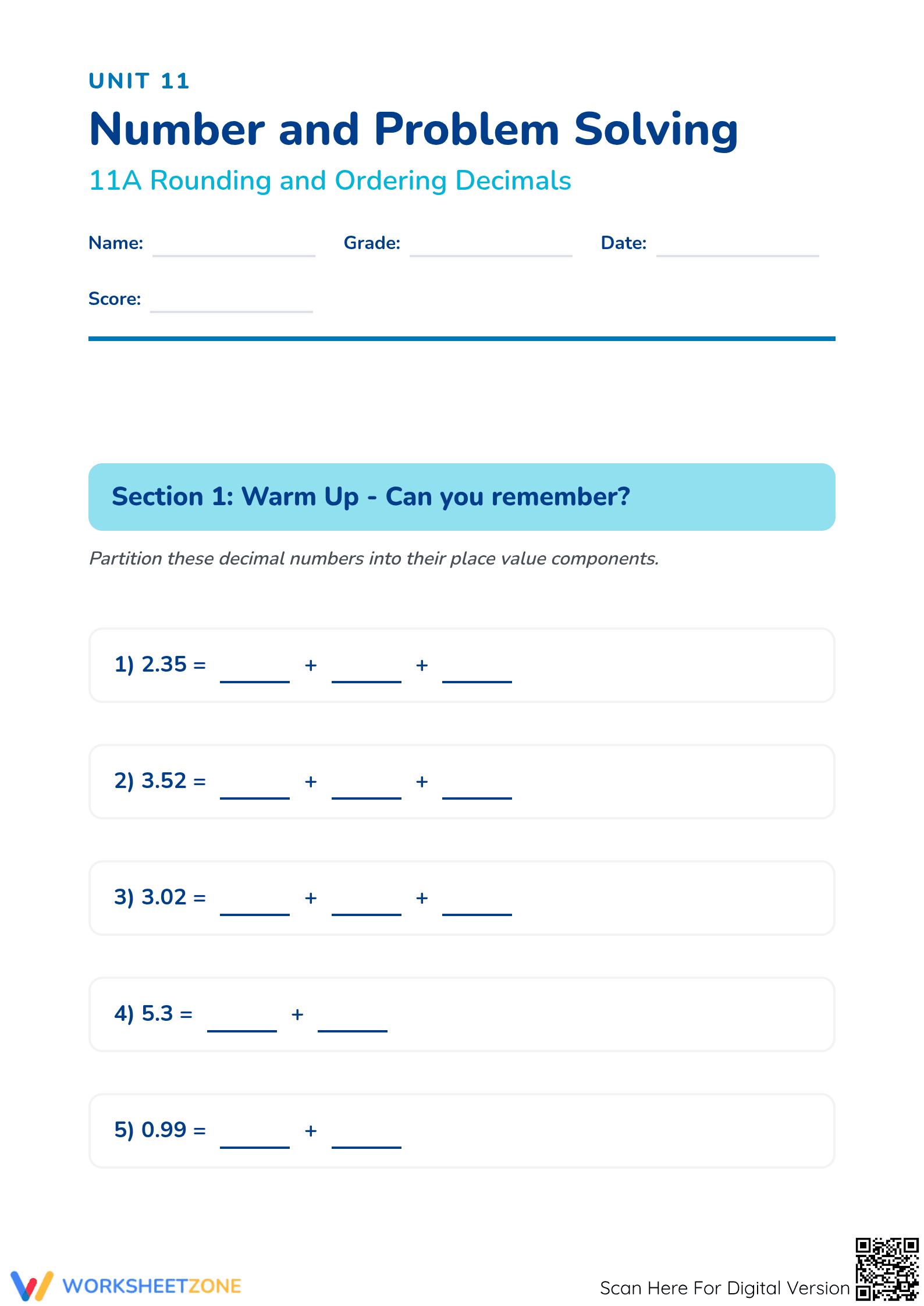
This decimals worksheet empowers Grade 5 students to master rounding and ordering numerical values. By engaging with structured practice, learners develop a deep understanding of place value and numerical relationships. This printable resource ensures students can confidently manipulate decimal numbers in real-world contexts while building a strong foundation for future algebraic concepts.
At a Glance
- Grade: 5 · Subject: Math
- Standard:
CCSS.MATH.CONTENT.5.NBT.A.4— Use place value understanding to round decimals to any place- Skill Focus: Rounding and ordering decimals
- Format: 4 pages · 50 problems · Answer key included · PDF
- Best For: Independent practice and decimal mastery assessment
- Time: 30–45 minutes
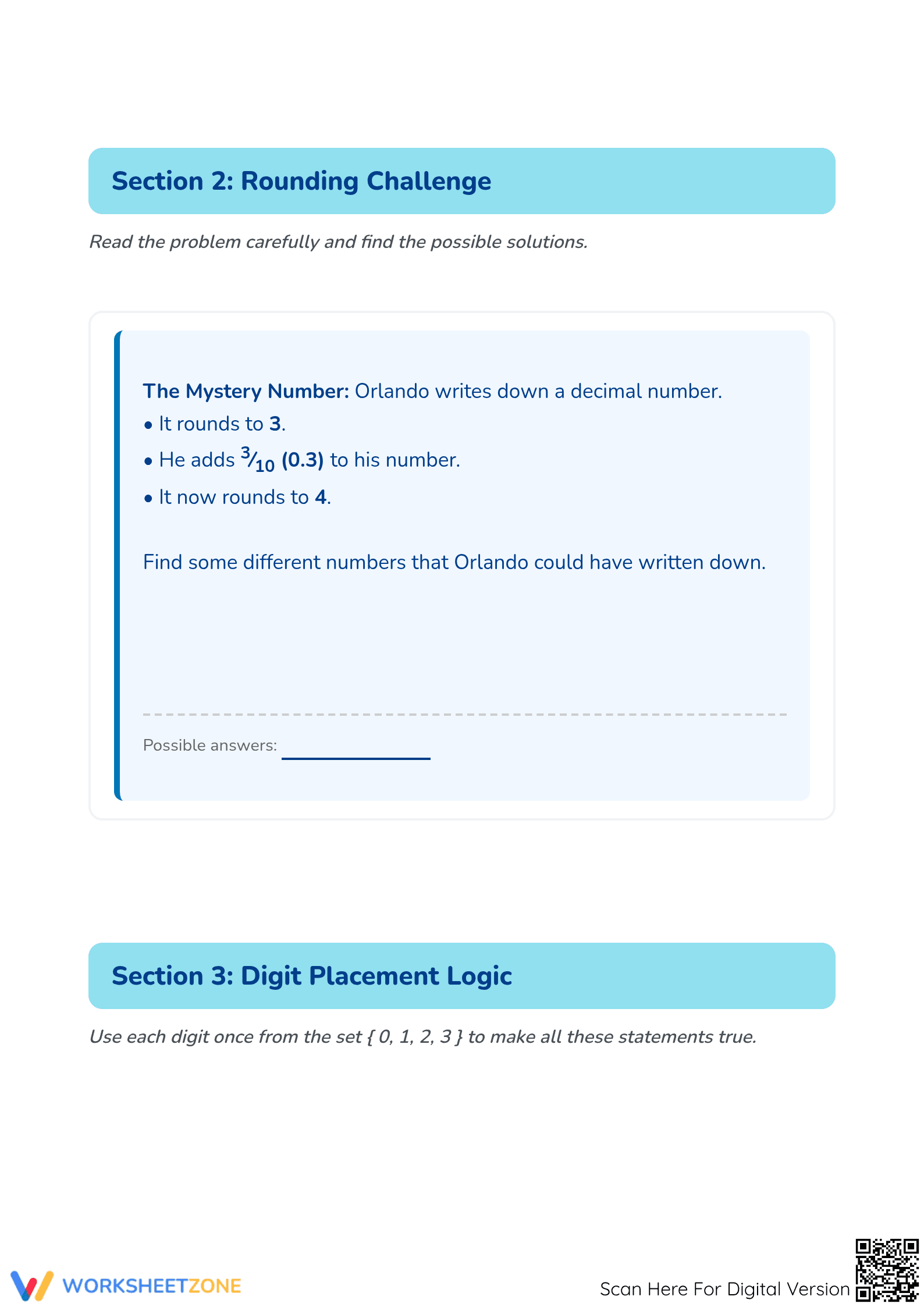
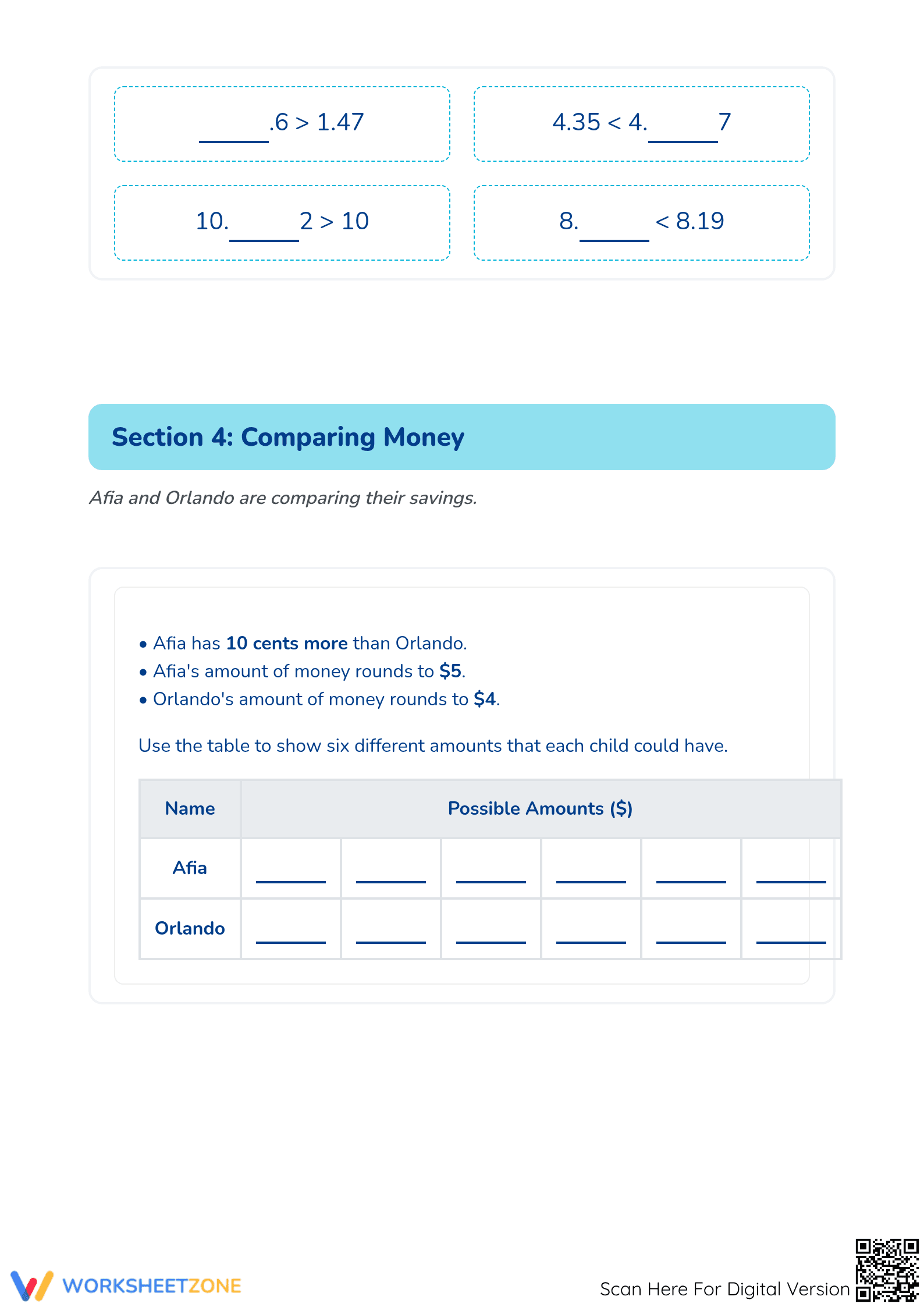
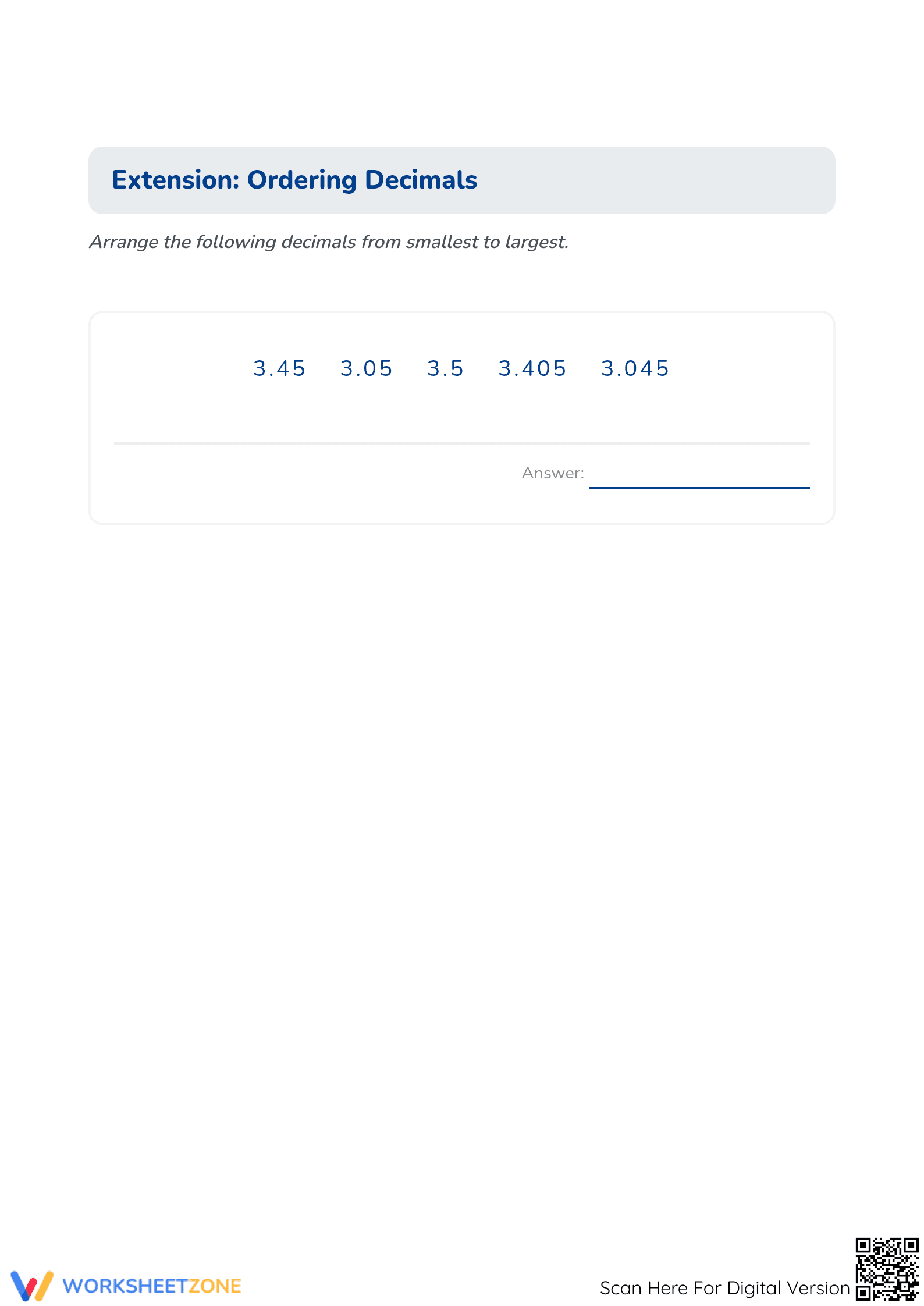
This four-page PDF includes a variety of task types designed to reinforce decimal fluency. Students will round decimals to the nearest whole number and tenth, and order values from smallest to largest and largest to smallest. The worksheet also features comparison tasks using mathematical symbols. A full answer key is provided for efficient grading.
Skill Progression
- Guided practice: The initial section provides 12 problems focused on rounding decimals to the nearest whole number, allowing students to apply basic place value rules with a low entry point.
- Supported practice: Students transition to 12 problems for rounding to the nearest tenth, requiring a more nuanced understanding of digit positions and the standard rounding principles.
- Independent practice: The final 26 problems challenge students to order complex decimal strings and use mathematical symbols for comparison, moving learners toward independent mastery.
This instructional model follows the gradual release framework, effectively moving from "I Do" to "You Do" to ensure student confidence and accuracy.
Standards Alignment
The primary focus of this worksheet is CCSS.MATH.CONTENT.5.NBT.A.4, which requires students to use place value understanding to round decimals to any place. Additionally, it supports CCSS.MATH.CONTENT.5.NBT.A.3.B through tasks that involve comparing and ordering decimal values. Both standard codes can be copied directly into lesson plans, IEP goals, or district curriculum mapping tools.
How to Use It
Use this worksheet as a summative assessment after a unit on decimal place value to gauge individual student progress. Alternatively, assign specific pages as homework to reinforce concepts taught during direct instruction. For a formative assessment observation, watch how students determine which digit to look at when rounding; identifying this common stumbling block early allows for targeted intervention. Expected completion time is 35 minutes.
Who It's For
Designed for Grade 5 students, this resource also serves as excellent remediation for Grade 6 or enrichment for advanced Grade 4 learners. It is particularly effective for students requiring extra practice with place value concepts. Pair this worksheet with a decimal place value anchor chart or a short direct instruction lesson for a complete educational experience.
According to the RAND AIRS 2024 report, providing students with structured, repetitive practice in decimal place value is a fundamental predictor of success in middle school algebraic reasoning. This worksheet aligns with these findings by offering a systematic progression aligned to CCSS.MATH.CONTENT.5.NBT.A.4 for decimal rounding. By engaging with over 50 targeted problems, students move beyond rote memorization toward a profound conceptual understanding of how decimal values relate within the base-ten system. Fisher & Frey (2014) emphasize that such gradual release scaffolds—moving from guided rounding to independent comparison—are essential for transitioning learners toward full mastery of complex mathematical systems. The inclusion of a comprehensive answer key further supports self-regulated learning environments, which is a significant factor in improving overall student achievement across diverse settings. Educators can confidently rely on this standards-aligned tool to effectively bridge the critical gap between initial instruction and the permanent retention of essential decimals skills.


