


























Views
Downloads

Root Words and Suffixes Worksheet | Grade 1 Printable
Paste this activity's link or code into your existing LMS (Google Classroom, Canvas, Teams, Schoology, Moodle, etc.).
Students can open and work on the activity right away, with no student login required.
You'll still be able to track student progress and results from your teacher account.
Strengthen early literacy skills with this comprehensive Grade 1 vocabulary development resource focused on morphology. This worksheet helps students master the essential ability to identify root words and understand how common inflectional suffixes change word meaning and function. By breaking down complex words into their core components, students build a foundation for advanced decoding and reading fluency.
At a Glance
- Grade: 1 · Subject: ELA
- Standard:
CCSS.ELA-LITERACY.L.1.4.C— Identify frequently occurring root words and their inflectional forms in text- Skill Focus: Root Words and Suffixes (-s, -es, -ing, -ed)
- Format: 4 pages · 28 problems · Answer key included · PDF
- Best For: Independent vocabulary practice and word study
- Time: 20–30 minutes
What's Inside
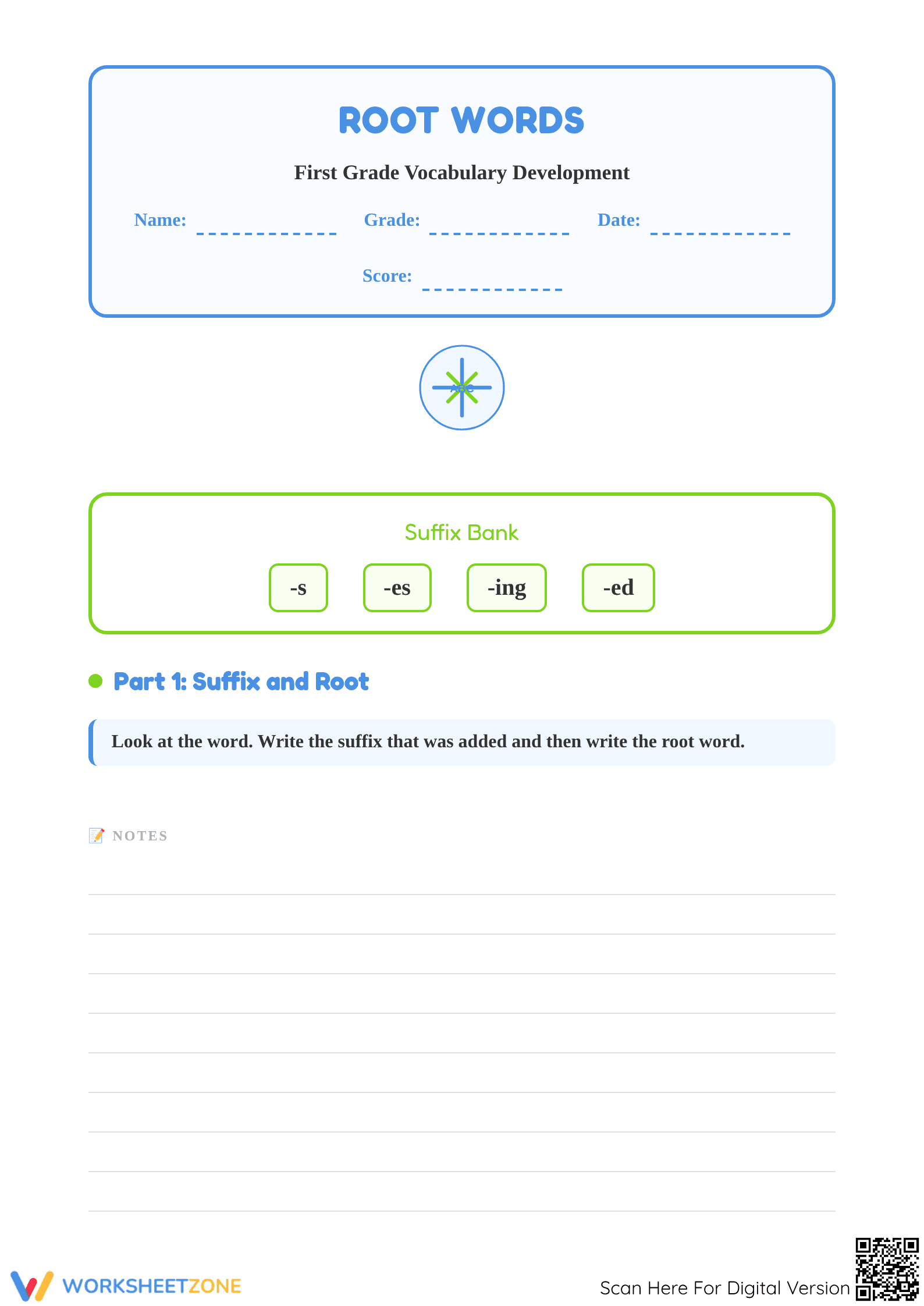
This 4-page PDF contains 28 structured problems across four distinct parts. It features a helpful suffix bank containing -s, -es, -ing, and -ed to guide student work. The layout includes word decomposition tables, sentence-based root word identification, creative word-building exercises, and multiple-choice assessment questions. A full answer key is provided to facilitate quick grading or student self-correction.
Skill Progression
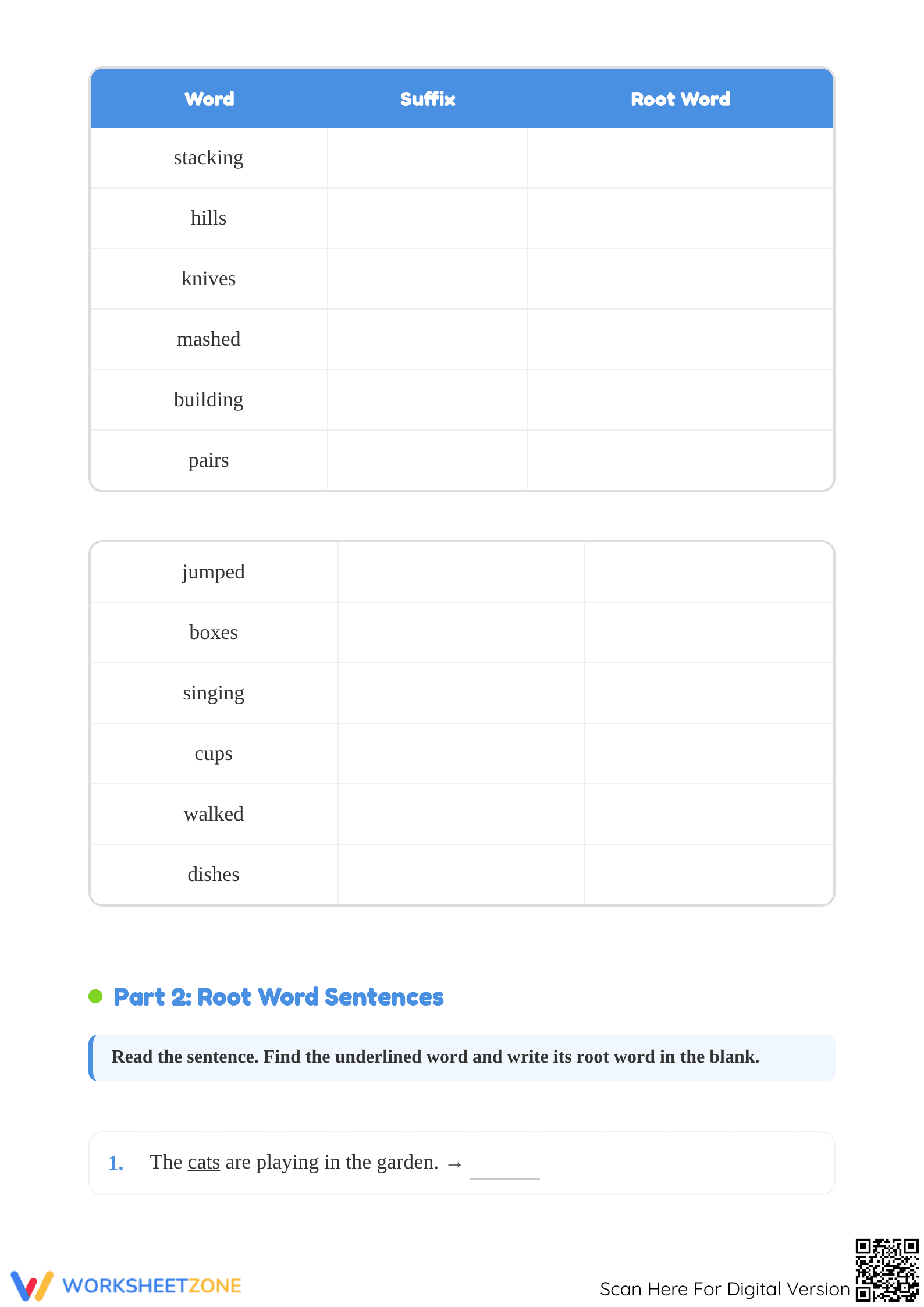
- Guided Decomposition: Part 1 provides 12 words in a tabular format, asking students to separate the suffix from the root word (e.g., "stacking" becomes "stack" + "ing").
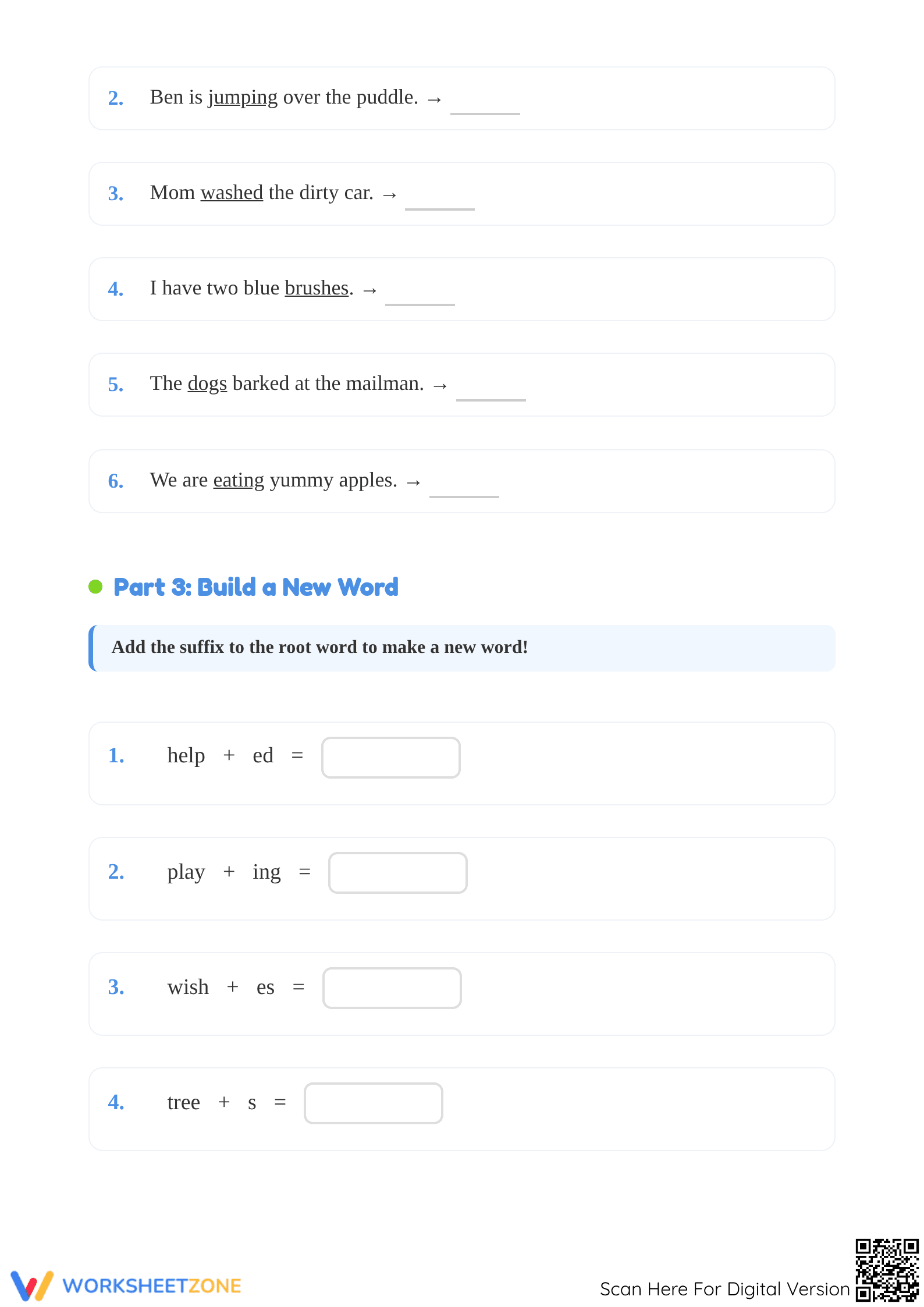
- Contextual Identification: Part 2 uses 6 sentences where students must find underlined inflected words and extract the original root word in context.
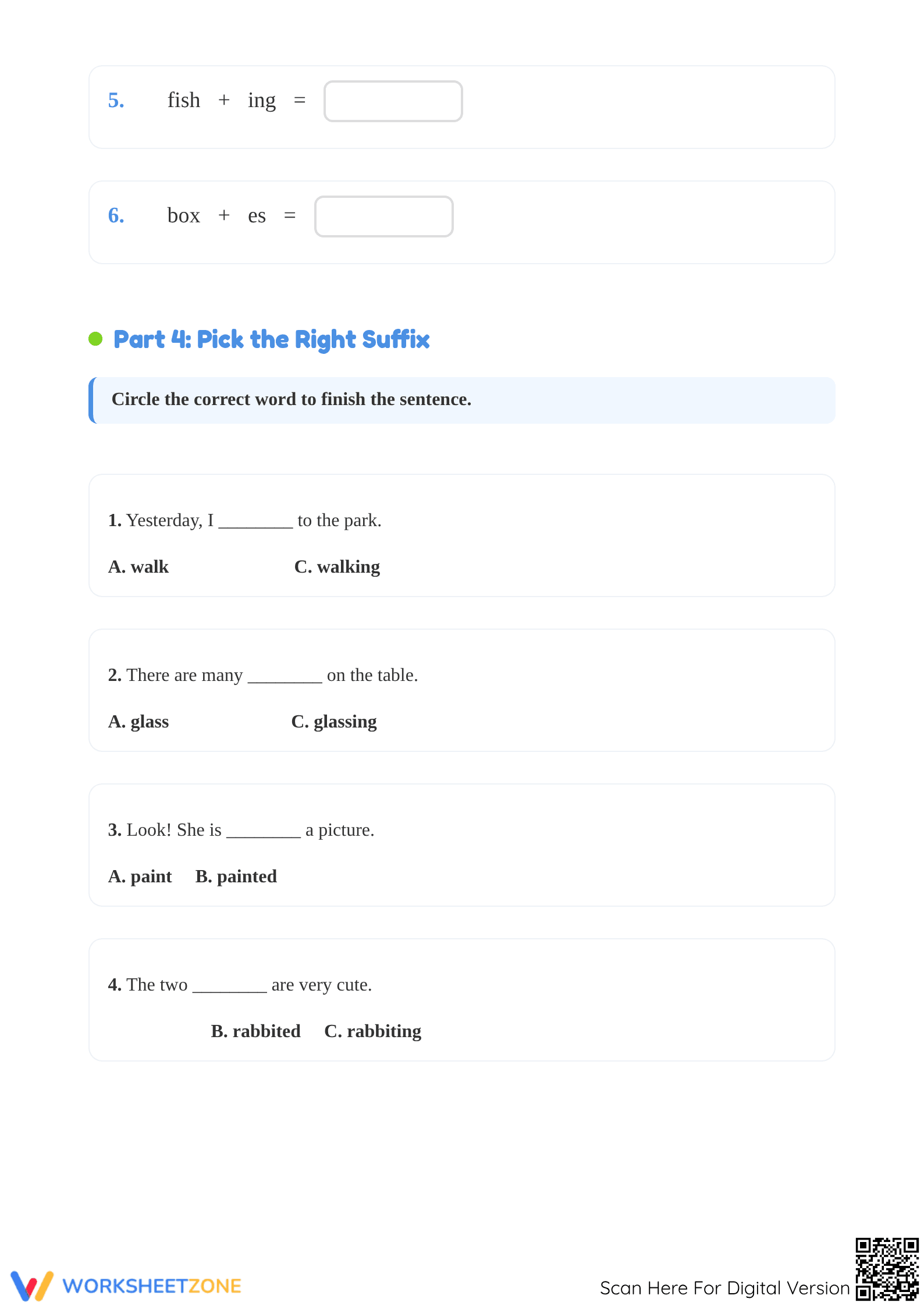
- Independent Construction: Parts 3 and 4 move to independent practice, where students build 6 new words from root/suffix pairs and complete 4 multiple-choice sentences.
This sequence follows a gradual-release model, moving from structured identification to independent word creation.
Standards Alignment
This resource is specifically aligned to CCSS.ELA-LITERACY.L.1.4.C: "Identify frequently occurring root words (e.g., look) and their inflectional forms (e.g., looks, looked, looking)." It also supports foundational reading standards related to phonics and word recognition. The standard code can be copied directly into lesson plans, IEP goals, or district curriculum mapping tools.
How to Use It
Assign this worksheet during independent work stations or as a follow-up to a direct instruction lesson on suffixes. It works excellently as a formative assessment; as students work through the word building in Part 3, observe whether they can correctly apply the suffix rules without over-generalizing. Most first-grade students will complete the full four-page set within a 25-minute literacy block.
Who It's For
While designed for Grade 1 students, this resource is highly effective for English Language Learners (ELL) who are developing an understanding of English word structures. It serves as a natural pairing for any phonics lesson or as a companion to an anchor chart detailing suffix meanings.
Effective vocabulary instruction in the primary grades necessitates a move beyond rote memorization toward morphological awareness, as demonstrated by the Rand AIRS 2024 report on literacy outcomes. This Grade 1 Root Words and Suffixes worksheet directly implements these findings by requiring students to decompose and construct complex words using the standard CCSS.ELA-LITERACY.L.1.4.C framework. By isolating root words from common inflectional suffixes like -ing, -ed, -s, and -es, learners develop a structural understanding of English that facilitates decoding and comprehension of unfamiliar texts. The progression from simple identification in word tables to contextual application in sentences ensures that morphological skills are internalized rather than practiced in isolation. Educational research consistently highlights that early mastery of these foundational linguistic patterns is a primary predictor of future reading fluency and academic success across all subject areas. This resource provides the rigorous, evidence-based practice necessary to secure these essential literacy milestones for all students.


